Bonds Rally Ignores Oil as AI Stocks Stumble. Is That a Signal?

Bonds Rally Ignores Oil as AI Stocks Stumble. Is That a Signal?
By:Ilya Spivak
Bonds rallied again as chip stocks stumbled, shrugging off another climb in crude oil. Does that spell trouble for the AI boom?
- Treasury bonds extended their rally as chipmakers sold off again, even as crude oil climbed
- Gold held its footing and the US dollar weakened, defying the “war trade” readthrough from higher energy prices
- US CPI data will test who’s closer to the mark, markets betting on 50bps in rate hikes in 2027, or Fed officials expecting none
Long-term US borrowing costs keep falling, and crude oil is not the reason. Treasury bonds extended their rally even as oil prices climbed again. In the playbook markets have followed since the US-Iran war began in February, pricier energy means stickier inflation, bigger rate hike bets, and higher yields. That link seems to be weakening.
Other rate-sensitive markets followed the bond market’s lead. Gold kept trying to build a bottom despite the oil pop, which would have weighed on it not long ago. The US dollar weakened. The euro, perhaps the most hampered of the major currencies, tried to turn higher, while the Australian dollar and British pound pushed toward recent range highs.
Bonds seem to be trading the AI story
What has lined up with the bond rally is a stumble in the AI trade. Bonds jumped last week after a report that OpenAI’s revenue is running about $20 billion short of what markets expected. They rose again as chip stocks sold off for a second time this week. The latest slide began in South Korea, where chipmakers have been rattled by a report that Chinese rival CXMT will have a competing server memory product ready by December. The tech-heavy Nasdaq 100 is now testing the bounds of its advance since late July.
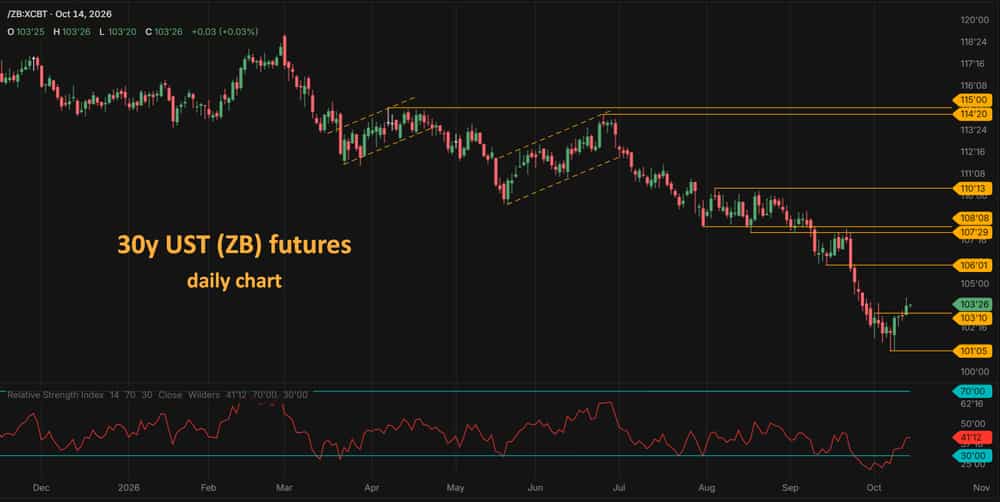
One explanation is competition for capital. Long-term yields reflect more than expectations for near-term inflation. Governments are selling heavy amounts of debt to finance yawning deficits, while hyperscalers are raising money to fund the AI buildout, and both draw on the same pool of long-term savings. If doubts about the AI boom suggest hyperscalers will borrow less aggressively than assumed, that pressure eases and bond prices can rise.
Bond market pricing fits that reading. The five- and 10-year breakeven inflation rates priced into Treasury bonds have moved against oil recently, as if the latest jump in crude is not enough to lift prices, perhaps because demand is softening underneath. The Cleveland Fed’s nowcast reflects the war’s cost-push effect on headline inflation, but its core gauge, which excludes food and energy, points lower. The Atlanta Fed’s GDPNow model has slid to 3.6% for the third quarter, down from 5-6% when tracking began, a sign that incoming data have weighed on the growth outlook.
Earnings did little to change the tone. Most major banks posted slight beats, though Wells Fargo’s revenue fell short at $21.9 billion against $22.3 billion expected, and Johnson & Johnson missed on earnings per share at $2.59 versus $3.03. FactSet’s blended estimates show third-quarter earnings growth of just 3% for financials, the weakest of any sector. The heavy lifting is expected to come from energy, at 121%, and technology, at 65.1%.
Will CPI side with the Fed or the markets?
The Fed turned more hawkish between July and September. Last month’s rate hike passed in a unanimous 12-0 vote, and updated projections upgraded both growth and inflation. Policymakers still see one more hike this year, with rates then holding steady through 2027. An overwhelming majority of them expect cuts by 2028. Markets agree on a December hike but price a further 50bps of tightening next year, clashing with officials.
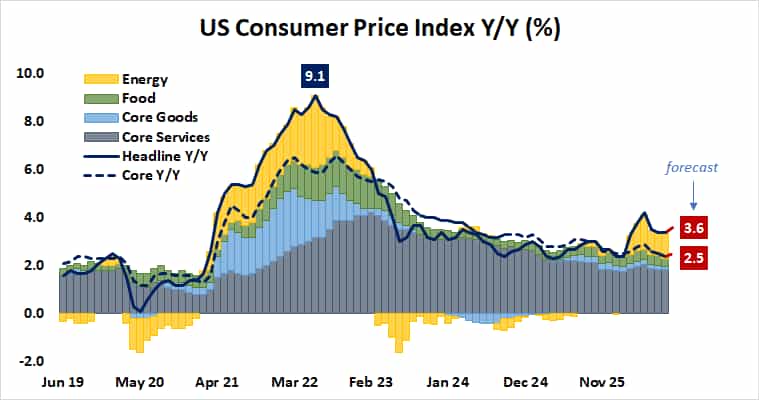
Recent inflation trends favor the central bank. The three-month annualized pace of the personal consumption expenditures (PCE) price index, the Fed’s preferred gauge, is already at the 2% target, and the smoother six-month rate is drifting in that direction.
The consumer price index (CPI) report on Wednesday is the week’s first big test. Headline inflation is expected to rise to 3.7% year-on-year from 3.4%, and the core rate to 2.5% from 2.4%. On a monthly basis however, core price growth is seen slowing to 0.2% from 0.3% previously. Producer price index (PPI) figures follow Thursday, and retail sales will show how consumers are coping. The University of Michigan’s sentiment index recently fell to its second-lowest on record as one-year inflation expectations jumped to 4.7%, the highest since May. Fed Chair Kevin Warsh is also set for a conversation with International Monetary Fund (IMF) Managing Director Kristalina Georgieva.
If CPI shows core inflation cooling, the markets’ 2027 rate hike bets may look overdone. That could extend the bond rally and support gold as the US dollar weakens. Stocks may not share in the relief, however, if what is pulling yields lower is a wobbling AI boom.
Ilya Spivak, tastylive Head of Global Macro, has over 15 years of experience in trading strategy. He specializes in identifying thematic moves in currencies, commodities, interest rates and equities. He hosts Macro Money and co-hosts Overtime, Monday-Thursday. @Ilyaspivak
For live daily programming, market news and commentary, visit tastylive.com or @tastyliveshow on YouTube
Trade with a better broker, open a tastytrade account today. tastylive, Inc. and tastytrade, Inc. are separate but affiliated companies.
Options involve risk and are not suitable for all investors. Please read Characteristics and Risks of Standardized Options before deciding to invest in options.
tastylive content is created, produced, and provided solely by tastylive, Inc. (“tastylive”) and is for informational and educational purposes only. It is not, nor is it intended to be, trading or investment advice or a recommendation that any security, futures contract, digital asset, other product, transaction, or investment strategy is suitable for any person. Trading securities, futures products, and digital assets involve risk and may result in a loss greater than the original amount invested. tastylive, through its content, financial programming or otherwise, does not provide investment or financial advice or make investment recommendations. Investment information provided may not be appropriate for all investors and is provided without respect to individual investor financial sophistication, financial situation, investing time horizon or risk tolerance. tastylive is not in the business of transacting securities trades, nor does it direct client commodity accounts or give commodity trading advice tailored to any particular client’s situation or investment objectives. Supporting documentation for any claims (including claims made on behalf of options programs), comparisons, statistics, or other technical data, if applicable, will be supplied upon request. tastylive is not a licensed financial adviser, registered investment adviser, or a registered broker-dealer. Options, futures, and futures options are not suitable for all investors. Prior to trading securities, options, futures, or futures options, please read the applicable risk disclosures, including, but not limited to, the Characteristics and Risks of Standardized Options Disclosure and the Futures and Exchange-Traded Options Risk Disclosure found on tastytrade.com/disclosures.
tastytrade, Inc. ("tastytrade”) is a registered broker-dealer and member of FINRA, NFA, and SIPC. tastytrade was previously known as tastyworks, Inc. (“tastyworks”). tastytrade offers self-directed brokerage accounts to its customers. tastytrade does not give financial or trading advice, nor does it make investment recommendations. You alone are responsible for making your investment and trading decisions and for evaluating the merits and risks associated with the use of tastytrade’s systems, services or products. tastytrade is a wholly-owned subsidiary of tastylive, Inc.
tastytrade has entered into a Marketing Agreement with tastylive (“Marketing Agent”) whereby tastytrade pays compensation to Marketing Agent to recommend tastytrade’s brokerage services. The existence of this Marketing Agreement should not be deemed as an endorsement or recommendation of Marketing Agent by tastytrade. tastytrade and Marketing Agent are separate entities with their own products and services. tastylive is the parent company of tastytrade.
tastyfx, LLC (“tastyfx”) is a Commodity Futures Trading Commission (“CFTC”) registered Retail Foreign Exchange Dealer (RFED) and Introducing Broker (IB) and Forex Dealer Member (FDM) of the National Futures Association (“NFA”) (NFA ID 0509630). Leveraged trading in foreign currency or off-exchange products on margin carries significant risk and may not be suitable for all investors. We advise you to carefully consider whether trading is appropriate for you based on your personal circumstances as you may lose more than you invest.
tastycrypto is provided solely by tasty Software Solutions, LLC. tasty Software Solutions, LLC is a separate but affiliate company of tastylive, Inc. Neither tastylive nor any of its affiliates are responsible for the products or services provided by tasty Software Solutions, LLC. Cryptocurrency trading is not suitable for all investors due to the number of risks involved. The value of any cryptocurrency, including digital assets pegged to fiat currency, commodities, or any other asset, may go to zero.
© copyright 2013 - 2026 tastylive, Inc. All Rights Reserved. Applicable portions of the Terms of Use on tastylive.com apply. Reproduction, adaptation, distribution, public display, exhibition for profit, or storage in any electronic storage media in whole or in part is prohibited under penalty of law, provided that you may download tastylive’s podcasts as necessary to view for personal use. tastylive was previously known as tastytrade, Inc. tastylive is a trademark/servicemark owned by tastylive, Inc.
Your privacy choices