Gold Defied Surging Real Rates. That Should Worry Stock Markets.

Gold Defied Surging Real Rates. That Should Worry Stock Markets.
By:Ilya Spivak
Gold refused to fall despite a jump in real interest rates has now sailed higher, hinting the market sees the Fed rate-hike story unraveling for troubling reasons.
- An in-line inflation report moved nothing, leaving stocks near record highs on volume that keeps thinning
- Gold and silver held firm through a surge in real rates that should have sunk them, while the dollar slid despite better real returns
- Core inflation eased for reasons energy cannot explain, warning that demand is quietly giving way
July’s consumer price index (CPI) report landed exactly on forecast — headline inflation at 3.4% year-on-year, the core measure excluding food and energy at 2.5% — and markets barely twitched. The bellwether S&P 500 continues to hover near record highs, but the internals are troubling: the sharp push higher from the lows in late July came with a steep drop in volume, the hallmark of a rally running on fumes.
Tellingly, a strong earnings report from Super Micro Computer (SMCI) overnight sent that stock surging while the broader market went nowhere, and the tech-heavy Nasdaq 100 could not even test the top of its most recent consolidation. Crude oil idled in the congestion it has occupied since the war began, and Treasury bonds round-tripped, briefly reaching for lower yields before the data and settling back unchanged.
The beach ball held underwater
The revealing action has been in precious metals. Through July, real interest rates — borrowing costs after inflation — surged, which is ordinarily kryptonite for an asset that yields nothing. Gold should have buckled. It refused, holding its ground week after week with silver alongside it, like a beach ball held underwater. Now the yellow metal has popped upward, hitting a ten-week high.
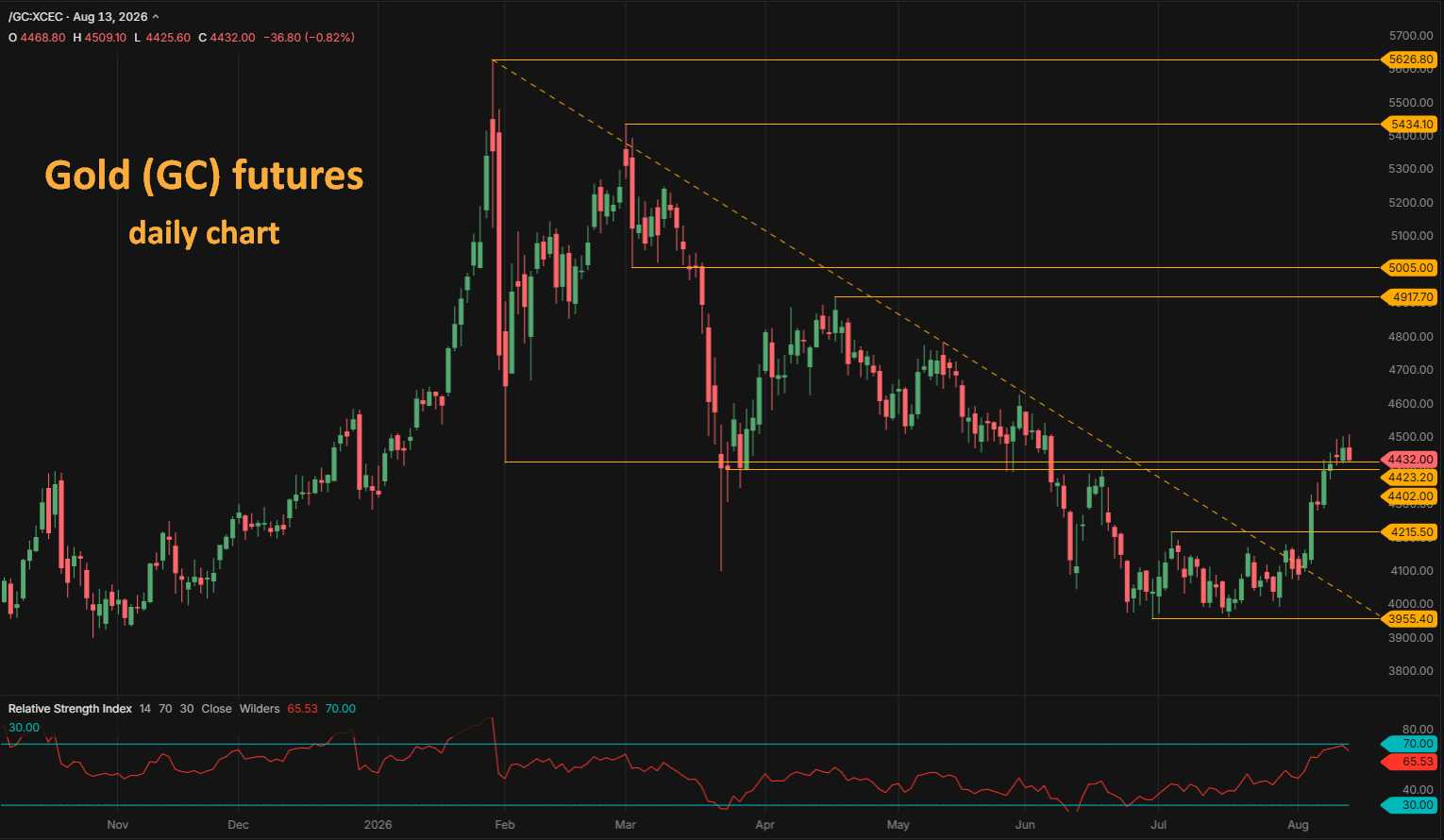
The US dollar has been the mirror image. Rising real rates improved the real return on holding the currency, and it sold off against its major counterparts anyway. Two markets that should have bent to the rate story pushed back against it instead, and they did so with no help from the news flow. That looks like conviction, and it suggests both are sniffing out something the rate-hike consensus has missed.
The kind of inflation that is fading
A clue sits in the CPI report’s internals. Energy’s contribution shrank again as the initial oil shock from the US-Iran war washes out of the calculation, which is unremarkable. What is harder to dismiss is that the core rate excluding energy eased to 2.5% from 2.6%, and why. The contribution from core goods prices held steady, while that of core services slipped even as its monthly pace ticked higher.
That distinction matters more than it sounds. The war delivered a textbook cost-push inflation shock: fighting disrupted supply, oil grew expensive, and the whole price structure lifted. Demand-pull inflation is the other kind, where a hot economy bids prices up because buyers outnumber what supply can meet in the moment. What the core reading hints at is the second kind going into reverse —the pull from demand weakening. After months of expensive energy squeezing households, the cost-push shock may have run long enough to start eating the demand beneath it.
The bond market stopped believing
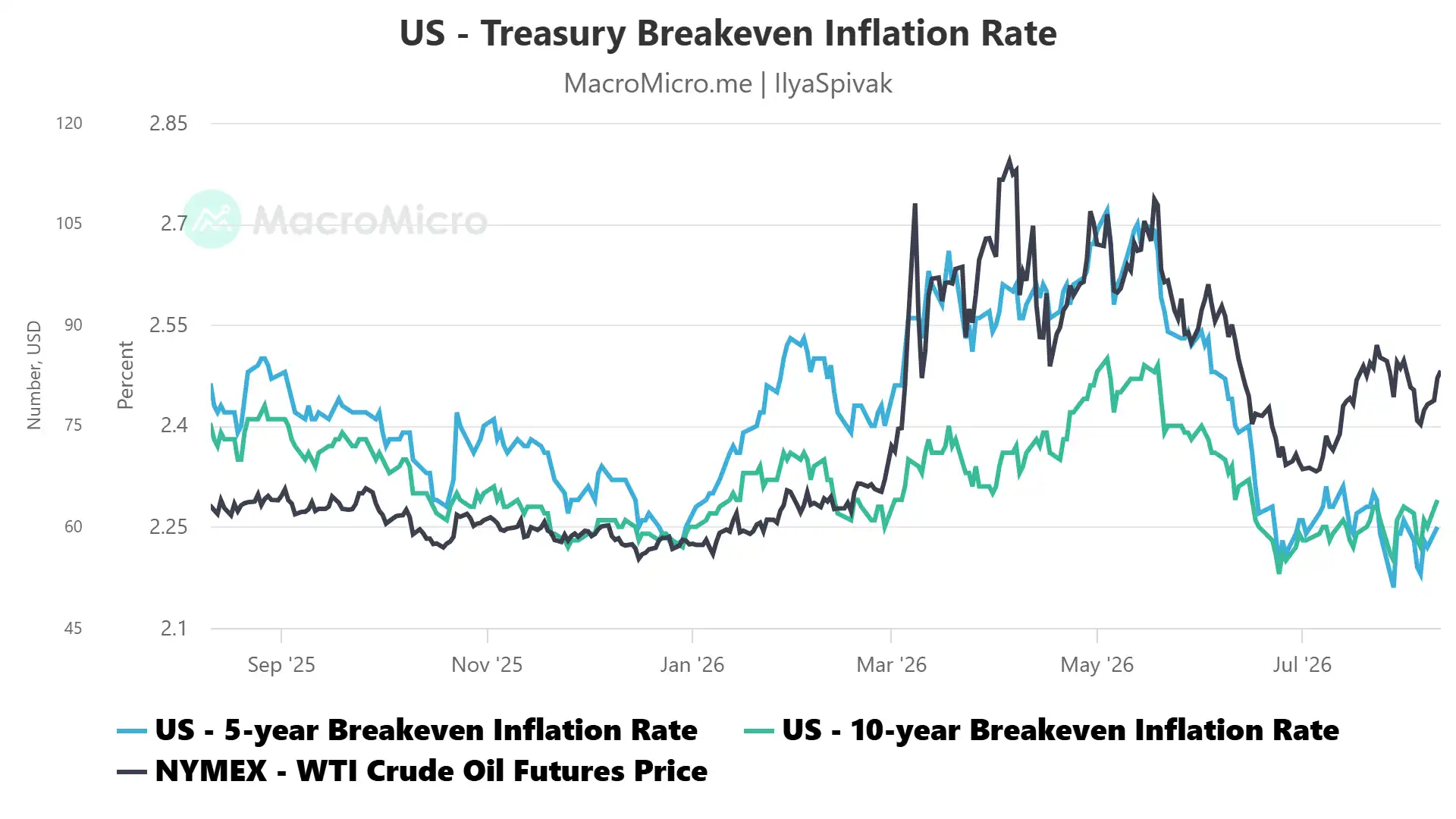
Bond pricing tells the same story. When the war began, breakeven inflation rates — the price growth expectations embedded in Treasury bonds — tracked crude oil closely, rising as it spiked. That relationship has broken. Crude has climbed back from its early-July slide on hopes the conflict was ending, yet breakevens sit near the lows of the year, having recently probed below where they started in January. Traders looking downwind see no lasting inflation threat, even with oil rebounding, which is difficult to square with anything except an economy losing its capacity to generate price pressure.
The growth mix explains the vulnerability. In the first quarter, consumption contributed remarkably little by comparison while a blistering artificial intelligence (AI) data center buildout supplied most of the growth, with business investment expanding above a 10% annualized pace. Consumers rebounded in the second quarter, but the World Cup was in North America for much of it, so whether that strength endures is an open question. Since household spending is roughly five times the size of business investment, only a modest retrenchment would be needed to swamp the boom entirely.
The rate-hike edifice starts to wobble
Policy expectations are already shifting at the margin. Odds of a Federal Reserve hike in September slipped from a coin flip to roughly 60/40 against, and conviction about moves early next year softened. Most striking, futures now imply a 91.7% chance that by the end of next year rates sit exactly where they finish this one. That is not the shape of a market bracing for sustained tightening.
The rest of the week should sharpen the picture. Wholesale inflation figures (PPI) arrive first, where producers have been absorbing some of the price shock in their margins and shielding consumers from it. Then come retail sales and a consumer sentiment survey from the University of Michigan (UofM) seen slipping again, the timeliest read yet on whether households are pulling back. If they are, the rate-hike edifice built on the war’s cost-push shock may come down, and for the worst of reasons. Gold, silver, and the dollar have seemingly spent weeks positioning for that outcome. The stock market may crumble back its heady levels if they prove right as growth fears take hold.
Ilya Spivak, tastylive Head of Global Macro, has over 15 years of experience in trading strategy. He specializes in identifying thematic moves in currencies, commodities, interest rates and equities. He hosts Macro Money and co-hosts Overtime, Monday-Thursday. @Ilyaspivak
For live daily programming, market news and commentary, visit tastylive.com or @tastyliveshow on YouTube
Trade with a better broker, open a tastytrade account today. tastylive, Inc. and tastytrade, Inc. are separate but affiliated companies.
Options involve risk and are not suitable for all investors. Please read Characteristics and Risks of Standardized Options before deciding to invest in options.
tastylive content is created, produced, and provided solely by tastylive, Inc. (“tastylive”) and is for informational and educational purposes only. It is not, nor is it intended to be, trading or investment advice or a recommendation that any security, futures contract, digital asset, other product, transaction, or investment strategy is suitable for any person. Trading securities, futures products, and digital assets involve risk and may result in a loss greater than the original amount invested. tastylive, through its content, financial programming or otherwise, does not provide investment or financial advice or make investment recommendations. Investment information provided may not be appropriate for all investors and is provided without respect to individual investor financial sophistication, financial situation, investing time horizon or risk tolerance. tastylive is not in the business of transacting securities trades, nor does it direct client commodity accounts or give commodity trading advice tailored to any particular client’s situation or investment objectives. Supporting documentation for any claims (including claims made on behalf of options programs), comparisons, statistics, or other technical data, if applicable, will be supplied upon request. tastylive is not a licensed financial adviser, registered investment adviser, or a registered broker-dealer. Options, futures, and futures options are not suitable for all investors. Prior to trading securities, options, futures, or futures options, please read the applicable risk disclosures, including, but not limited to, the Characteristics and Risks of Standardized Options Disclosure and the Futures and Exchange-Traded Options Risk Disclosure found on tastytrade.com/disclosures.
tastytrade, Inc. ("tastytrade”) is a registered broker-dealer and member of FINRA, NFA, and SIPC. tastytrade was previously known as tastyworks, Inc. (“tastyworks”). tastytrade offers self-directed brokerage accounts to its customers. tastytrade does not give financial or trading advice, nor does it make investment recommendations. You alone are responsible for making your investment and trading decisions and for evaluating the merits and risks associated with the use of tastytrade’s systems, services or products. tastytrade is a wholly-owned subsidiary of tastylive, Inc.
tastytrade has entered into a Marketing Agreement with tastylive (“Marketing Agent”) whereby tastytrade pays compensation to Marketing Agent to recommend tastytrade’s brokerage services. The existence of this Marketing Agreement should not be deemed as an endorsement or recommendation of Marketing Agent by tastytrade. tastytrade and Marketing Agent are separate entities with their own products and services. tastylive is the parent company of tastytrade.
tastyfx, LLC (“tastyfx”) is a Commodity Futures Trading Commission (“CFTC”) registered Retail Foreign Exchange Dealer (RFED) and Introducing Broker (IB) and Forex Dealer Member (FDM) of the National Futures Association (“NFA”) (NFA ID 0509630). Leveraged trading in foreign currency or off-exchange products on margin carries significant risk and may not be suitable for all investors. We advise you to carefully consider whether trading is appropriate for you based on your personal circumstances as you may lose more than you invest.
tastycrypto is provided solely by tasty Software Solutions, LLC. tasty Software Solutions, LLC is a separate but affiliate company of tastylive, Inc. Neither tastylive nor any of its affiliates are responsible for the products or services provided by tasty Software Solutions, LLC. Cryptocurrency trading is not suitable for all investors due to the number of risks involved. The value of any cryptocurrency, including digital assets pegged to fiat currency, commodities, or any other asset, may go to zero.
© copyright 2013 - 2026 tastylive, Inc. All Rights Reserved. Applicable portions of the Terms of Use on tastylive.com apply. Reproduction, adaptation, distribution, public display, exhibition for profit, or storage in any electronic storage media in whole or in part is prohibited under penalty of law, provided that you may download tastylive’s podcasts as necessary to view for personal use. tastylive was previously known as tastytrade, Inc. tastylive is a trademark/servicemark owned by tastylive, Inc.
Your privacy choices