Lennar (LEN) Q3 2025 Earnings Preview: Margins, Housing Data, and Valuation Risks

Cost control has been a tailwind for Lennar’s stock—now the market wants proof it’s still working
Lennar (LEN) reports Q3 fiscal 2025 earnings after the close on Thursday, September 18.
Last quarter, Lennar held margins steady at 18% while benefiting from easing construction costs—a combination that kept sales resilient even as new home prices softened.
This quarter’s results, along with upcoming U.S. housing data, should help clarify whether Lennar’s valuation discount represents an attractive buying opportunity.
Lennar (LEN) heads into its fiscal third-quarter earnings with the U.S. housing market still searching for direction. The first half of 2025 was marked by soft demand and elevated mortgage rates, but July’s rebound in housing starts offered a welcome surprise. Moving forward, the key question is whether demand is strengthening enough to sustain sales volumes and protect profit margins.
So far this year, Lennar’s stock has tracked closely with the broader homebuilding sector. After sliding early in 2025, shares have mounted a strong comeback—climbing to roughly $135—nearly 40% above their 52-week low. Year-to-date, shares of Lennar are now up roughly 8%, keeping pace with the SPDR S&P Homebuilders ETF (XHB), which has gained about 11%.
Lennar is slated to report Q3 earnings results after the close on Thursday, September 18. Wall Street expects revenue of $9.05–$9.07 billion, down about 4% year-over-year, and EPS of $2.10–$2.14—roughly 45% below last year’s $3.90 level. Home deliveries are projected at 22,000–23,000 units, with gross margins clocking in around 18%.
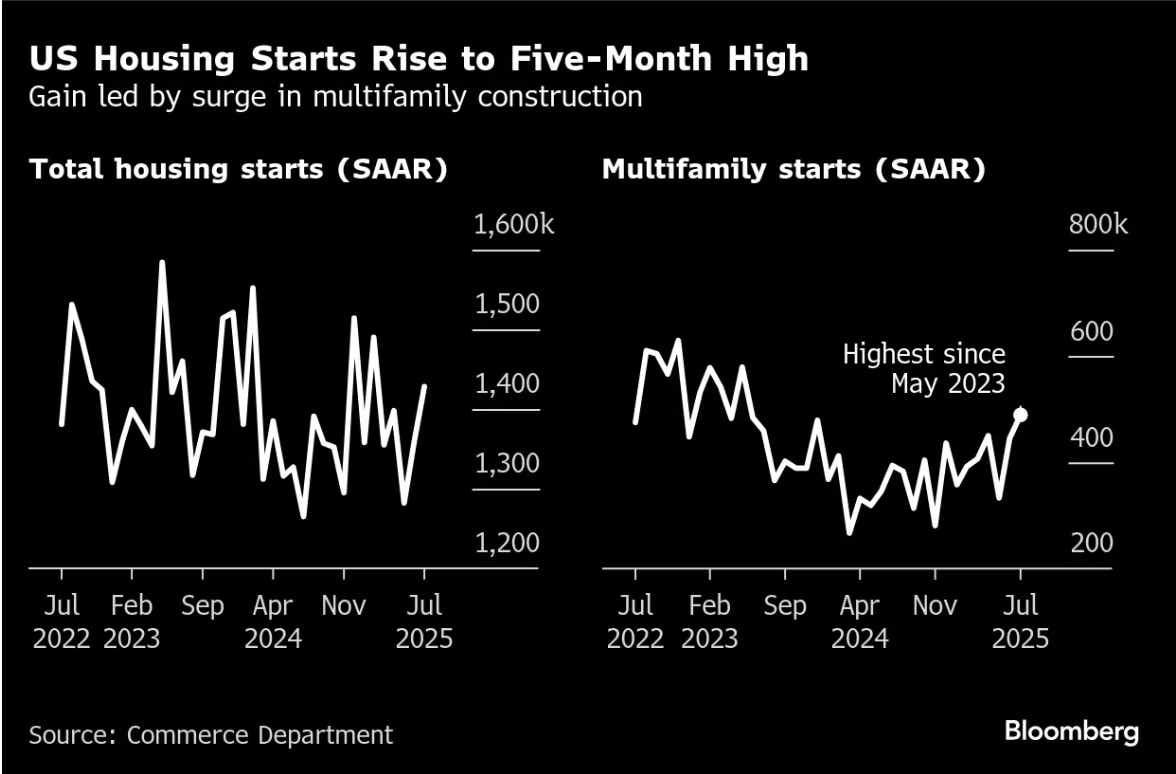
A Tentative Rebound in U.S. Housing Starts
After a sluggish spring, U.S. housing activity finally showed signs of life in July. Single-family housing starts climbed 2.8% month-over-month to an annualized pace of 939,000 units, reversing June’s decline. When including multifamily units, total starts rose 5.2% and are now nearly 13% higher than a year ago—an encouraging sign for builders. Building permits, a key forward-looking gauge, remained soft, but eked out a 0.5% gain for single-family homes, suggesting early signs of stabilization in the construction pipeline.
The improvement coincides with a modest easing in mortgage rates, with the 30-year fixed slipping to roughly 6.58%—its lowest level since last autumn—on expectations for a near-term rate cut by the Federal Reserve. That said, affordability challenges, labor shortages, and elevated regulatory costs continue to weigh on homebuilder sentiment. The National Association of Home Builders recently cautioned that production levels remain constrained, and that sustained progress will depend on the health of the U.S. economy.
Inventory dynamics remain uneven heading into autumn. Active listings are up nearly 21% from a year ago, but new listings have fallen for four straight months. Pending sales are still hovering near multidecade lows, and homes are taking longer to sell. Regional trends are diverging as well, with steeper price cuts and longer time-on-market in the South and West.
Why Lennar’s Q3 Report Matters
Lennar remains one of the largest and most closely watched homebuilders in the U.S., and its results are often viewed as a bellwether for the entire housing sector. The company has been proactive in aligning production with demand, relying on targeted incentives to maintain sales momentum despite affordability headwinds. In Q2, gross margins held at 18%—below last year’s peak but consistent with guidance—supported by disciplined cost controls, shorter build cycles, and easing construction costs.
Those operational improvements give Lennar some breathing room, but the broader housing backdrop remains challenging. Average selling prices continue to edge lower, and incentives still make up more than 13% of sales. Management’s strategy of prioritizing volume over pricing is supporting market share, but it leaves margins exposed if demand softens further.
Investors will be watching closely to see whether Lennar can hold margins near 18% while maintaining delivery volumes in a difficult environment. Management’s commentary on order trends, cancellations, and incentives will be parsed for clues as to whether July’s rebound in housing starts signals the start of a sustained recovery—or if the sector is still waiting for the next true growth cycle to take hold.
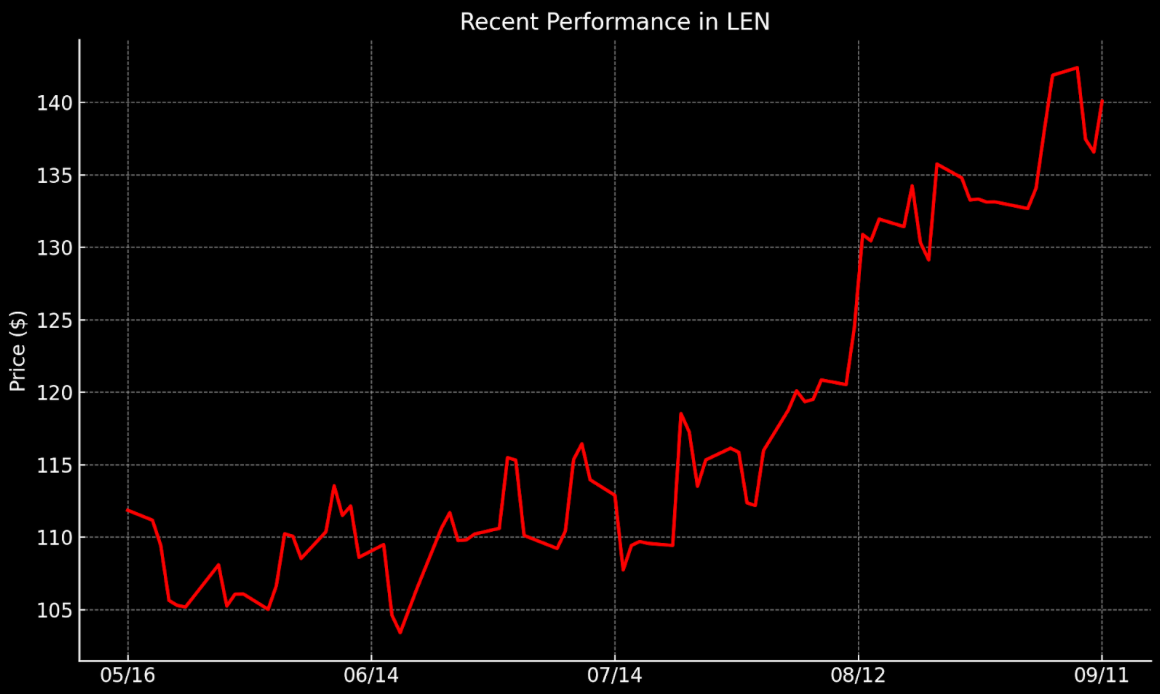
Discounted Valuation Meets Cautious Expectations
For investors, Lennar remains a valuation puzzle. The stock trades near 11x trailing GAAP earnings, well below the homebuilding sector’s 20x median. That makes it look inexpensive for a company with strong liquidity, a capital-light land strategy, and one of the largest delivery pipelines in the industry.
Other valuation measures echo the same theme. Lennar’s price-to-sales ratio sits near 1x, suggesting investors value its revenue stream roughly in line with peers. Its 1.6 price-to-book multiple, however, trails the sector’s 2.2 median—highlighting a discount that feels out of step with the company’s scale, balance sheet strength, and consistent execution.
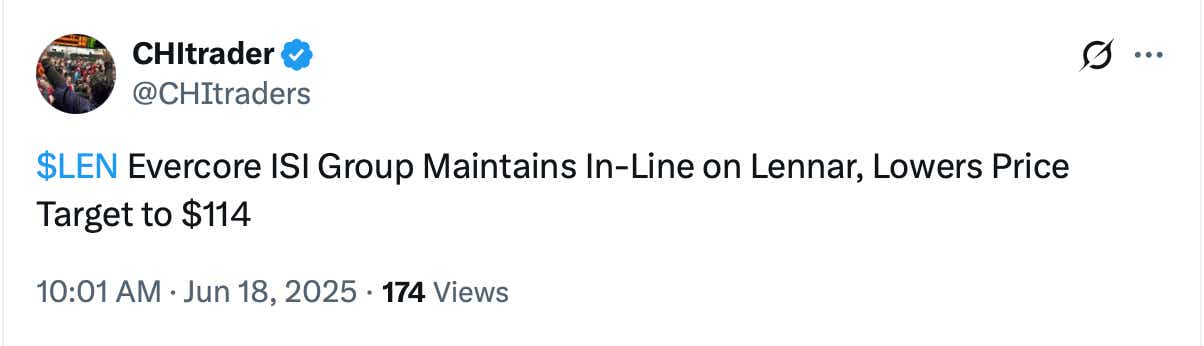
The catch is that a cheap valuation doesn’t always mean near-term upside. At roughly $135 per share—above the average analyst target of $122—Lennar’s stock already prices in confidence in its execution, cost discipline, and improved inventory turns, even as profits have declined year over year. That leaves little room for disappointment if deliveries soften or margins face additional pressure in Q4.
Wall Street seems content to wait and watch. Of the 20 analysts covering Lennar, 15 rate the stock a “hold,” while only five call it a “buy” or “overweight.” The consensus view is that Lennar remains a best-in-class operator, but with limited near-term catalysts until affordability improves and demand signals a more durable recovery.
Taken together, Lennar looks inexpensive relative to its long-term earnings potential but fairly valued against near-term expectations. Bulls point to its cost discipline and asset-light land strategy as key advantages, arguing these leave the company well-positioned for the next housing upcycle—and make today’s multiple attractive for patient investors. Bears counter that with shares already trading above consensus price targets, there’s limited upside until demand shows clearer signs of a sustained recovery.
Lennar Earnings Preview Takeaways
Lennar’s September 18 earnings call is shaping up as more than a routine update—it’s a litmus test for whether July’s rebound in housing activity signals the start of a true recovery or just a fleeting bounce. The company continues to execute well, with steady gross margins, faster build cycles, and disciplined cost control. Even so, pricing pressure and reliance on incentives remain headwinds, raising the question of whether Lennar can sustain its margins.
What happens next could set the tone for the entire homebuilding sector. A strong report, coupled with constructive commentary on orders and pricing, could reignite confidence that the housing cycle is turning—and validate the stock’s recent rally. But if demand remains sluggish, or margins slip, investors may question whether the stock has run too far, too fast. To learn more about trading strategies tailored for earnings season, readers can follow this link.
Andrew Prochnow has traded the global financial markets for more than 15 years, including 10 years as a professional options trader.
For live daily programming, market news and commentary, visit tastylive or the YouTube channels tastylive (for options traders), and tastyliveTrending for stocks, futures, forex & macro.
Trade with a better broker, open a tastytrade account today. tastylive, Inc. and tastytrade, Inc. are separate but affiliated companies.
Options involve risk and are not suitable for all investors. Please read Characteristics and Risks of Standardized Options before deciding to invest in options.
tastylive content is created, produced, and provided solely by tastylive, Inc. (“tastylive”) and is for informational and educational purposes only. It is not, nor is it intended to be, trading or investment advice or a recommendation that any security, futures contract, digital asset, other product, transaction, or investment strategy is suitable for any person. Trading securities, futures products, and digital assets involve risk and may result in a loss greater than the original amount invested. tastylive, through its content, financial programming or otherwise, does not provide investment or financial advice or make investment recommendations. Investment information provided may not be appropriate for all investors and is provided without respect to individual investor financial sophistication, financial situation, investing time horizon or risk tolerance. tastylive is not in the business of transacting securities trades, nor does it direct client commodity accounts or give commodity trading advice tailored to any particular client’s situation or investment objectives. Supporting documentation for any claims (including claims made on behalf of options programs), comparisons, statistics, or other technical data, if applicable, will be supplied upon request. tastylive is not a licensed financial adviser, registered investment adviser, or a registered broker-dealer. Options, futures, and futures options are not suitable for all investors. Prior to trading securities, options, futures, or futures options, please read the applicable risk disclosures, including, but not limited to, the Characteristics and Risks of Standardized Options Disclosure and the Futures and Exchange-Traded Options Risk Disclosure found on tastytrade.com/disclosures.
tastytrade, Inc. ("tastytrade”) is a registered broker-dealer and member of FINRA, NFA, and SIPC. tastytrade was previously known as tastyworks, Inc. (“tastyworks”). tastytrade offers self-directed brokerage accounts to its customers. tastytrade does not give financial or trading advice, nor does it make investment recommendations. You alone are responsible for making your investment and trading decisions and for evaluating the merits and risks associated with the use of tastytrade’s systems, services or products. tastytrade is a wholly-owned subsidiary of tastylive, Inc.
tastytrade has entered into a Marketing Agreement with tastylive (“Marketing Agent”) whereby tastytrade pays compensation to Marketing Agent to recommend tastytrade’s brokerage services. The existence of this Marketing Agreement should not be deemed as an endorsement or recommendation of Marketing Agent by tastytrade. tastytrade and Marketing Agent are separate entities with their own products and services. tastylive is the parent company of tastytrade.
tastyfx, LLC (“tastyfx”) is a Commodity Futures Trading Commission (“CFTC”) registered Retail Foreign Exchange Dealer (RFED) and Introducing Broker (IB) and Forex Dealer Member (FDM) of the National Futures Association (“NFA”) (NFA ID 0509630). Leveraged trading in foreign currency or off-exchange products on margin carries significant risk and may not be suitable for all investors. We advise you to carefully consider whether trading is appropriate for you based on your personal circumstances as you may lose more than you invest.
tastycrypto is provided solely by tasty Software Solutions, LLC. tasty Software Solutions, LLC is a separate but affiliate company of tastylive, Inc. Neither tastylive nor any of its affiliates are responsible for the products or services provided by tasty Software Solutions, LLC. Cryptocurrency trading is not suitable for all investors due to the number of risks involved. The value of any cryptocurrency, including digital assets pegged to fiat currency, commodities, or any other asset, may go to zero.
© copyright 2013 - 2026 tastylive, Inc. All Rights Reserved. Applicable portions of the Terms of Use on tastylive.com apply. Reproduction, adaptation, distribution, public display, exhibition for profit, or storage in any electronic storage media in whole or in part is prohibited under penalty of law, provided that you may download tastylive’s podcasts as necessary to view for personal use. tastylive was previously known as tastytrade, Inc. tastylive is a trademark/servicemark owned by tastylive, Inc.
Your privacy choices