Lithium’s Sleeper Giant Is Starting to Wake Up

The lithium market is waking up, and Albemarle might be the best way to play the turn
- Lithium prices have started to rebound after pulling back sharply from 2022 to 2024.
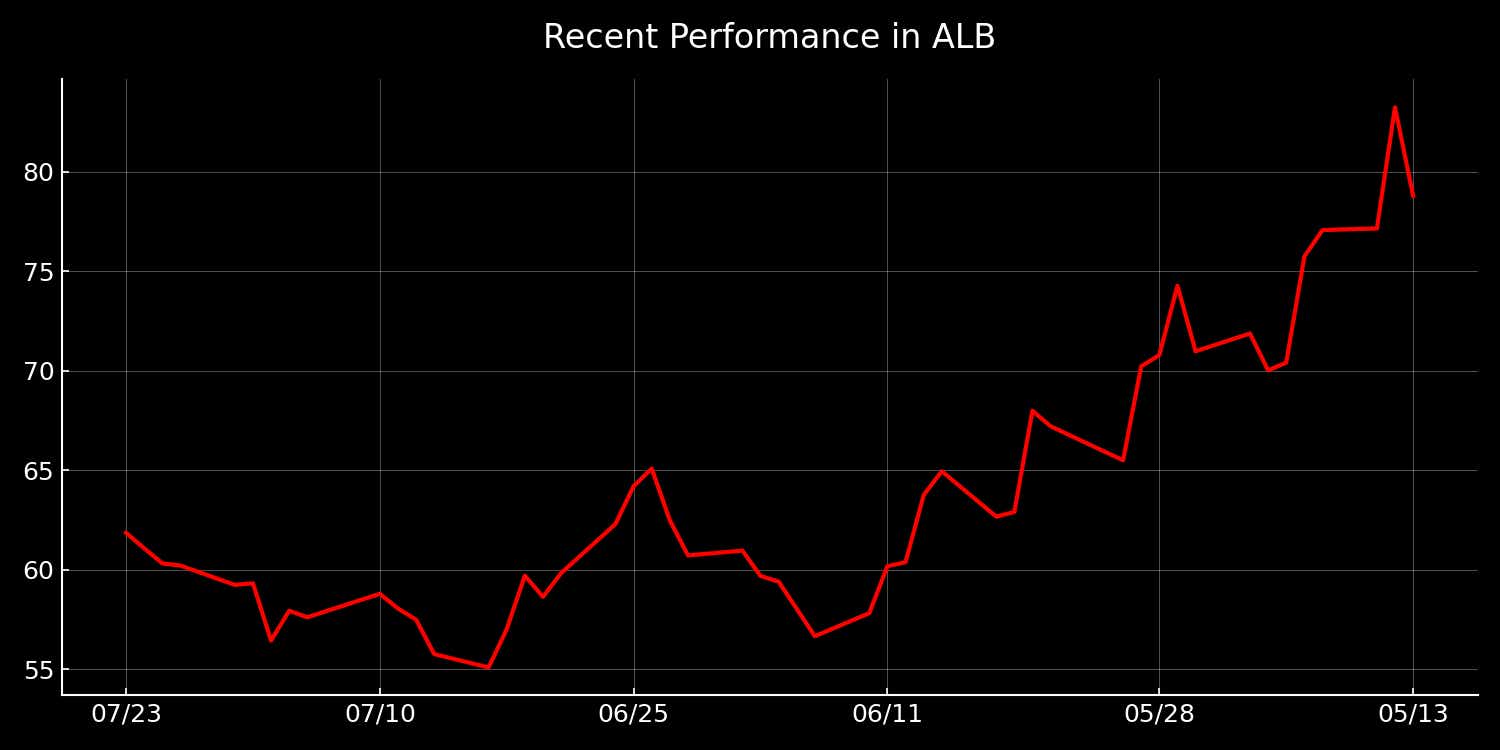
- Shares in Albemarle have surged more than 20% in the past month, and are now trading 50% above their 52-week low.
- The increased stock price reflects improving sentiment, strong Q1 cash flow and growing confidence in a cyclical reset.
- Trading at just 1.3x book and 2.0x sales, the company appears undervalued relative to its long-term positioning—and for patient investors, the stock looks like a “buy.”
Albemarle (ALB) might not look like a growth stock right now—but it could be setting up as one. After soaring past $300 during the lithium boom of 2022, shares plunged alongside collapsing commodity prices, bottoming out near $50 earlier this year. Yet beneath that dramatic drawdown lies a global powerhouse in critical materials: vertically integrated, cost-efficient and central to the energy transition. And now, with lithium prices showing signs of recovery, Albemarle is starting to climb again.
As of late July, the stock has rallied more than 50% off its 52-week low—part of a broader rebound across lithium names that may signal the early stages of a new upcycle. But Albemarle isn’t a speculative junior miner chasing the next discovery. It’s the sector’s bellwether, with scale, infrastructure and staying power. Today, we break down what’s driving the rebound, how the company’s fundamentals are evolving and why Albemarle may not just participate in the next leg higher—but lead it.
A reset for a lithium leader
Albemarle isn’t just a lithium producer. It’s the linchpin of a global supply chain fueling the electric vehicle revolution. But over the past two years, even an industry leader hasn’t been immune to the brutal forces of commodity cycles. After surging past $300 per share in late 2022, driven by soaring lithium prices and peak EV enthusiasm. the stock unraveled, ultimately bottoming near $50 earlier this year. Lithium prices had plunged nearly 90% from their highs, and with them, the narrative of unstoppable demand collapsed. It was a textbook boom-bust reset.
But now, the tide appears to be turning. Since late June, lithium prices have begun to stabilize. They’ve been lifted because China is supplying less of the metal, demand for EVs has become firmer and a more constructive technical backdrop has emerged in the sector. Albemarle’s stock has responded in kind, rallying more than 20% in just the past month and now trading near $76 per share. This bounce isn’t random. The company remains the bellwether of the lithium industry and tends to respond positively when prices recover. However, what makes the stock particularly compelling at this stage of the cycle is the company’s resilience.
Even amid a deep pricing trough, it remains the largest US-based lithium producer, with vertically integrated operations stretching across five continents. In Q1, lithium still contributed nearly 70% of total EBITDA (earnings before interest, taxes, depreciation and amortization), highlighting just how closely Albemarle’s fortunes track the metal’s pricing trajectory. But this isn’t a company standing still. It’s actively positioning for a rebound, leaning on disciplined capital allocation, contract-backed volume commitments, and production ramp-ups at strategic sites like Kemerton and Meishan. In short, it’s building strength while the market resets.
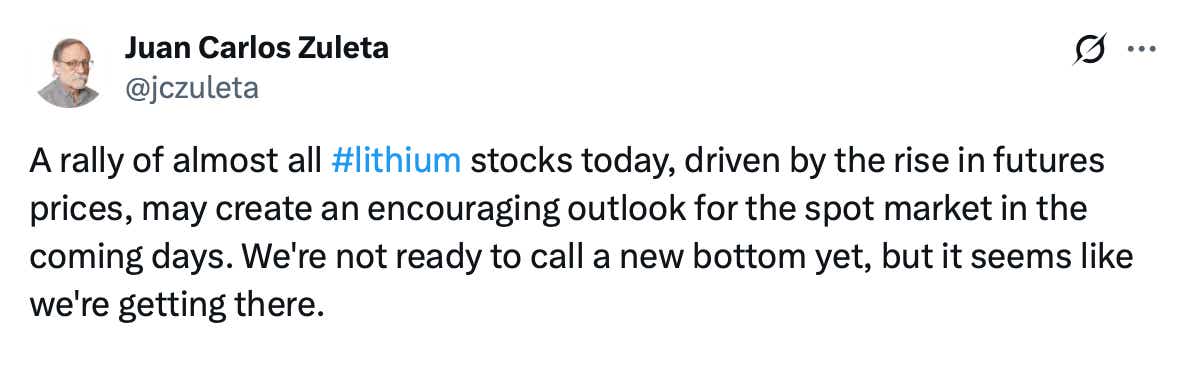
That recovery may already be taking shape. Growing signs of accumulation in lithium stocks—including Albemarle—suggest the market is starting to price in a cyclical turning point. And with shares still trading at less than a quarter of their 2022 peak, backed by cost discipline and imminent volume growth, the risk-reward setup looks increasingly asymmetric.
This isn’t a story built on hype. It’s about timing the cycle, leveraging structural scale and maintaining optionality. If lithium prices keep rising—or even just hold steady—this may not be the tail end of a bounce. It could be the opening act of a broader recovery.
Surviving the storm, preparing for a rebound
At first glance, Albemarle’s Q1 numbers paint a mixed picture. Sales fell 21% year over year, and adjusted EBITDA declined by 8%, dragged down by sharply lower lithium prices. The company posted an adjusted loss of $0.18 per share and saw Energy Storage sales drop by more than a third. To the casual observer, it looks like a business still under pressure. But peel back the surface, and a different story begins to emerge—one of strategic positioning, operational discipline and financial resilience in the face of a brutal commodity downturn.
Despite pricing headwinds, Albemarle posted record lithium salt production in Q1, with its integrated conversion network running at full tilt. Energy storage margins held firm at 36%, outperforming peers and pointing to a well-calibrated cost base. Even with flat volume and steep price erosion, the segment still generated $186 million in EBITDA, thanks partly to lower input costs and efficiency gains from its ongoing $350 million productivity initiative, now nearly 90% complete.
Elsewhere in the business, the signs of strength were even more pronounced. The company’s smaller—but strategically vital—specialties segment grew EBITDA nearly 40% on the back of rising volume and cost control. Ketjen, Albemarle’s catalyst business, saw EBITDA surge over 75%, benefiting from improved product mix and stronger JV income. These segments don’t drive the lithium narrative but help steady the ship.
On top of the above, the company’s full-year guidance remains intact, anchored by an assumed lithium price deck of $9 per kilogram (kg), with energy storage volume expected to rise modestly in the second half of 2025. And while Q2 margins may face pressure from a greater share of lower-priced contracts, Albemarle still has plenty of levers to support earnings. Production ramp-ups at Kemerton and Meishan, robust contract coverage that buffers against spot price swings, and continued cost reductions all position the company to maintain mid-20% Energy Storage margins for the full year, even in a time of flat pricing.
Yes, Albemarle is still fundamentally tied to lithium and that means earnings volatility could be part of the equation. But at what increasingly looks like a cyclical low, its ability to generate cash, defend margins and maintain a strong balance sheet sets it apart from the competition. This isn’t a company in survival mode. It’s one laying the groundwork for the next upcycle. And if lithium’s recent rebound holds, that wave may already be starting to build.
At the crossroads of value and opportunity
With Albemarle still operating in the shadow of a deep cyclical downturn, traditional valuation metrics don’t tell the whole story. The company posted an adjusted loss in Q1, making earnings-based multiples like P/E functionally irrelevant for now. But the broader picture is more nuanced and arguably more compelling for long-term investors willing to look past near-term noise.
At roughly 2.0x trailing sales, Albemarle’s price-to-sales ratio sits modestly above the sector median of 1.3x. On the surface, that might suggest the stock remains expensive. But that comparison ignores one critical variable: the company isn’t a marginal lithium player—it’s the structural leader, with integrated assets, global reach and the lowest-cost position among its peers. For a company expected to return to positive earnings as soon as lithium pricing stabilizes, a modest premium to sales makes sense, particularly in a sector where volatility is the norm and durability is rare.
Other valuation metrics make Albemarle’s investment case look increasingly compelling. The stock trades at just 1.3x book value, well below the industry median of 1.9x and near the bottom of its 10-year range. Its enterprise value-to-sales multiple sits at 2.8x—somewhat higher than the sector average of 1.9x, but arguably warranted given the comapany’s scale, operating leverage and strategic role as a cornerstone of the global lithium supply chain. When prices for the metal are normal, that multiple could prove conservative.
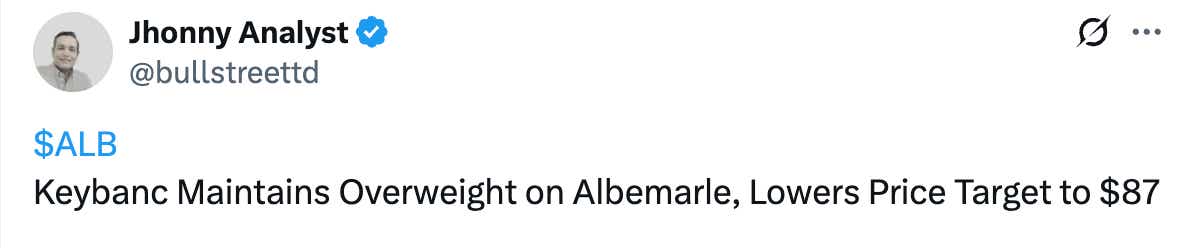
That brings us to sentiment. Despite the recent rebound, the stock is still largely out of favor on Wall Street. Only nine of the 24 analysts covering the the company rate it a “buy” or “overweight,” while the majority—15—are stuck at “hold.” The average price target? Just $76 per share—on par with the stock's current trading level. At first glance, that may seem neutral or even bearish. But in truth, it highlights how far sentiment has drifted from fundamentals. In the last month, the market seems to be reassessing Albemarle more positively—and a rerating may already be in motion.
That disconnect between perception and reality is where the opportunity lies. This isn’t a speculative lithium moonshot. Albemarle is a cycle-tested leader with a disciplined balance sheet, improving cash flow, and a vertically integrated supply chain that would be nearly impossible to replicate. As EV demand climbs and global trade policy increasingly favors domestic, integrated producers, Albemarle’s strategic relevance is only growing—and the market may just be starting to catch on.
So is the stock a “buy?” We think so—but with nuance. This isn’t a stock for those expecting instant gratification. Lithium markets remain volatile, and Q2 may bring additional choppiness, especially with contracting mix shifts and tariff effects still playing out. But for long-term investors looking to build exposure to the global energy transition, the company offers one of the most asymmetric setups in the sector.
Investment takeaways
Albemarle isn’t just another commodity stock. It’s the backbone of the global lithium supply chain. With integrated operations in five continents, a fortress-like balance sheet, and strategic relevance that spans EVs, energy storage and national security, this is a company built to outlast the cycle. And after a brutal two-year sell-off, the market may finally be waking up to that fact.
Yes, the near-term numbers still reflect pressure. There were Losses in Q1, analysts remain cautious and the valuation screens oddly for a company of this caliber. But that’s exactly what makes the setup so intriguing. With lithium prices stabilizing, margins holding up and volumes poised to climb, Albemarle is entering the early innings of a potential multi-year reset. This isn’t a fragile rebound. It’s the slow re-acceleration of a global critical materials leader.
Risks include tariff policy and contract renegotiations. Shifts in battery chemistry could still inject volatility. But Albemarle isn’t a speculative junior miner. It’s the sector’s benchmark, with the scale, discipline and diversification to navigate uncertainty. If lithium prices continue to recover—or simply hold the line—the stock could rerate meaningfully higher as volumes ramp and cash flow normalizes.
Ultimately, Albemarle is a bet on the next phase of the energy transition—a bet that EV adoption, grid storage and supply chain localization aren’t fleeting trends but instead are lasting structural shifts. In that world, the company wouldn’t just endure. It leads. For patient investors, this isn’t about chasing a short-term bounce. It’s about positioning for a longer-term resurgence.
Andrew Prochnow, Luckbox analyst-at-large, has traded the global financial markets for more than 15 years, including 10 years as a professional options trader.
For live daily programming, market news and commentary, visit tastylive or the YouTube channels tastylive (for options traders), and tastyliveTrending for stocks, futures, forex & macro.
Trade with a better broker, open a tastytrade account today. tastylive, Inc. and tastytrade, Inc. are separate but affiliated companies.
Options involve risk and are not suitable for all investors. Please read Characteristics and Risks of Standardized Options before deciding to invest in options.
tastylive content is created, produced, and provided solely by tastylive, Inc. (“tastylive”) and is for informational and educational purposes only. It is not, nor is it intended to be, trading or investment advice or a recommendation that any security, futures contract, digital asset, other product, transaction, or investment strategy is suitable for any person. Trading securities, futures products, and digital assets involve risk and may result in a loss greater than the original amount invested. tastylive, through its content, financial programming or otherwise, does not provide investment or financial advice or make investment recommendations. Investment information provided may not be appropriate for all investors and is provided without respect to individual investor financial sophistication, financial situation, investing time horizon or risk tolerance. tastylive is not in the business of transacting securities trades, nor does it direct client commodity accounts or give commodity trading advice tailored to any particular client’s situation or investment objectives. Supporting documentation for any claims (including claims made on behalf of options programs), comparisons, statistics, or other technical data, if applicable, will be supplied upon request. tastylive is not a licensed financial adviser, registered investment adviser, or a registered broker-dealer. Options, futures, and futures options are not suitable for all investors. Prior to trading securities, options, futures, or futures options, please read the applicable risk disclosures, including, but not limited to, the Characteristics and Risks of Standardized Options Disclosure and the Futures and Exchange-Traded Options Risk Disclosure found on tastytrade.com/disclosures.
tastytrade, Inc. ("tastytrade”) is a registered broker-dealer and member of FINRA, NFA, and SIPC. tastytrade was previously known as tastyworks, Inc. (“tastyworks”). tastytrade offers self-directed brokerage accounts to its customers. tastytrade does not give financial or trading advice, nor does it make investment recommendations. You alone are responsible for making your investment and trading decisions and for evaluating the merits and risks associated with the use of tastytrade’s systems, services or products. tastytrade is a wholly-owned subsidiary of tastylive, Inc.
tastytrade has entered into a Marketing Agreement with tastylive (“Marketing Agent”) whereby tastytrade pays compensation to Marketing Agent to recommend tastytrade’s brokerage services. The existence of this Marketing Agreement should not be deemed as an endorsement or recommendation of Marketing Agent by tastytrade. tastytrade and Marketing Agent are separate entities with their own products and services. tastylive is the parent company of tastytrade.
tastyfx, LLC (“tastyfx”) is a Commodity Futures Trading Commission (“CFTC”) registered Retail Foreign Exchange Dealer (RFED) and Introducing Broker (IB) and Forex Dealer Member (FDM) of the National Futures Association (“NFA”) (NFA ID 0509630). Leveraged trading in foreign currency or off-exchange products on margin carries significant risk and may not be suitable for all investors. We advise you to carefully consider whether trading is appropriate for you based on your personal circumstances as you may lose more than you invest.
tastycrypto is provided solely by tasty Software Solutions, LLC. tasty Software Solutions, LLC is a separate but affiliate company of tastylive, Inc. Neither tastylive nor any of its affiliates are responsible for the products or services provided by tasty Software Solutions, LLC. Cryptocurrency trading is not suitable for all investors due to the number of risks involved. The value of any cryptocurrency, including digital assets pegged to fiat currency, commodities, or any other asset, may go to zero.
© copyright 2013 - 2026 tastylive, Inc. All Rights Reserved. Applicable portions of the Terms of Use on tastylive.com apply. Reproduction, adaptation, distribution, public display, exhibition for profit, or storage in any electronic storage media in whole or in part is prohibited under penalty of law, provided that you may download tastylive’s podcasts as necessary to view for personal use. tastylive was previously known as tastytrade, Inc. tastylive is a trademark/servicemark owned by tastylive, Inc.
Your privacy choices