Macro Week Ahead: Is the Iran War Trade Back in the Stock Market?

Macro Week Ahead: Is the Iran War Trade Back in the Stock Market?
By:Ilya Spivak
With mega-cap tech earnings out of the way, the stock market is quietly rejoining the Iran war trade.
- The S&P 500 stalled the moment the earnings tailwind faded, even as Palantir topped estimates
- Crude oil, Treasury yields, and the dollar are still stuck on the “war trade” stocks were ignoring
- ISM services PMI data and an RBA rate hike could amplify the hawkish global chorus this week
After three weeks of cheerfully erasing every implication of the US-Iran war, stocks started this week with an uncomfortable look at the rest of the asset complex. With mega-cap tech earnings done until Nvidia (NVDA) on May 20, the tailwind that powered the late-April melt-up has gone quiet and the “war trade” front and center in other markets seems to be back in focus.
Stocks rejoin the Iran war trade as the earnings tailwind fades
The bellwether S&P 500 stalled today, with much of the upside gap at the weekly trading open fading as the session wore on. The technical issues flagged last week remain glaring. Volumes have shrunk throughout the rebound from the wartime selloff. The relative strength index (RSI) momentum gauge shows negative divergence: prices set higher highs while the indicator does not. Conviction seems to be running out of steam.
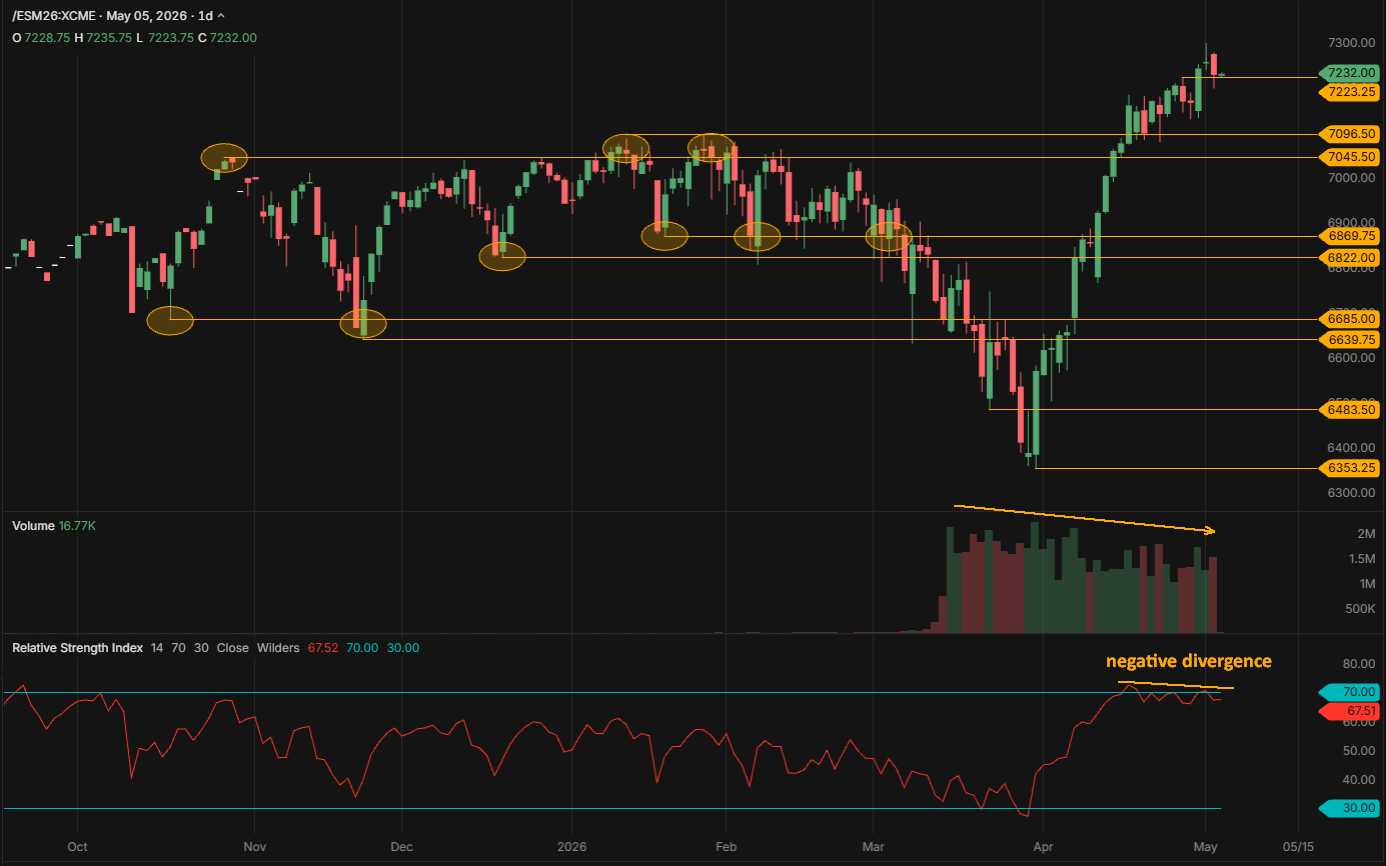
The breakaway rally that erased the war’s damage and punched to new records lined up almost exactly with the start of mega-cap tech earnings. With Microsoft (MSFT), Alphabet (GOOG), Amazon (AMZN), Apple (AAPL), and META having now reported and the calendar quiet until Nvidia (NVDA), bullish enthusiasm has waned.
Palantir (PLTR) topped earnings forecasts overnight — overshooting analysts’ bets by 18% on EPS and 6% on revenue — and the markets shrugged. Shares seesawed higher, then lower in after-hours trade, only to settle little-changed. If the artificial intelligence (AI) growth story was as convincing as last week, these outcomes might have lit a fire.
Other markets never stopped trading the war
Crude oil is back near the top of its wartime range. Treasury bond prices are sliding as yields push higher, with sticky oil forcing interest rate expectations up across global central banks.
Gold is leaking lower as rising yields and a stronger US dollar make non-interest-bearing and anti-fiat assets less attractive. A suddenly circumspect tone on Wall Street is helping the greenback reassert itself.
Bitcoin remains an exception, quietly extending the upside breakout that began in early April.
The data center engine has obvious vulnerabilities
Last week’s first-quarter US gross domestic product (GDP) report made clear how heavily the economy is leaning on the AI buildout. Fixed nonresidential investment contributed 1.39 percentage points (ppt) to the 2% headline growth figure, edging out consumers at 1.08ppt.
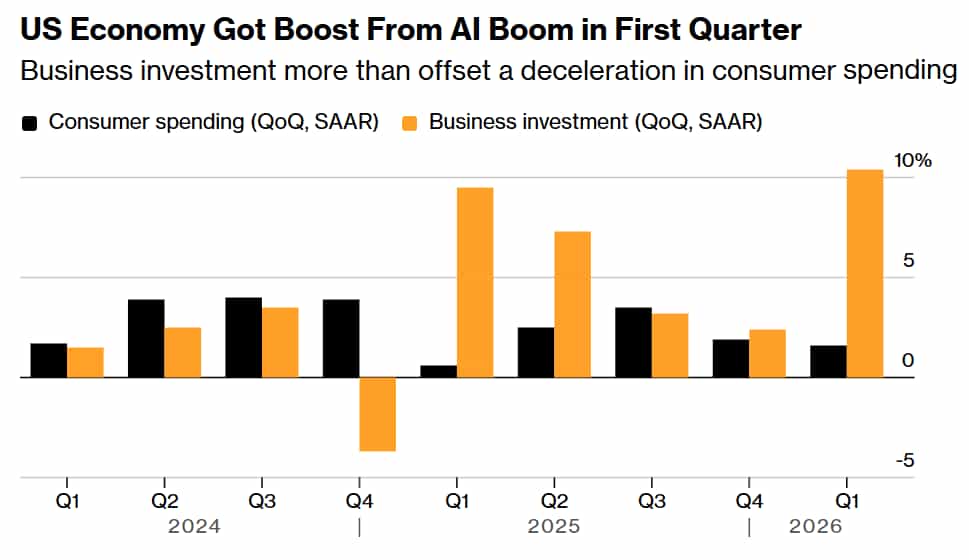
Business investment grew at an annualized 10.4% in the first quarter, while consumption has decelerated for two quarters straight, growing at a rate of just 1.6%. That is how a small 14% slice of GDP – the investment bit – manages to outstrip the growth uplift from a meaty 68% slice – household consumption.
That math only holds while business investment keeps moving fast. The five Mag 7 names that reported last week touted some $750 billion in additional capex. The catch: AI supply chains are deeply internationalized, and the Strait of Hormuz — a chokepoint for vital inputs, energy and otherwise — remains effectively closed.
Even if the so-called AI “hyperscalers” splash out for materials to build data centers at any price, that itself feeds inflation, lifts rates, and tightens financing for both them and the consumer. That ought to make it devilishly hard to sustain first-quarter growth dynamics.
Inflation is broadening as central banks line up hawkish
Core inflation is perking even before the war’s oil shock is accounted for. Goods inflation is rising again as the rebasing away of tariff costs that the Federal Reserve was banking on proves to be elusive. Service-sector inflation is posting the largest monthly gains since mid-2025. Housing prices are climbing too.
The price growth shock from energy comes atop all that. It usually takes about one month for crude oil price swings to filter into headline US consumer price index (CPI) inflation data. Only the modest January and February run-up has shown up there so far. The bigger war-driven spike should begin to appear in April’s data, due for release next week.
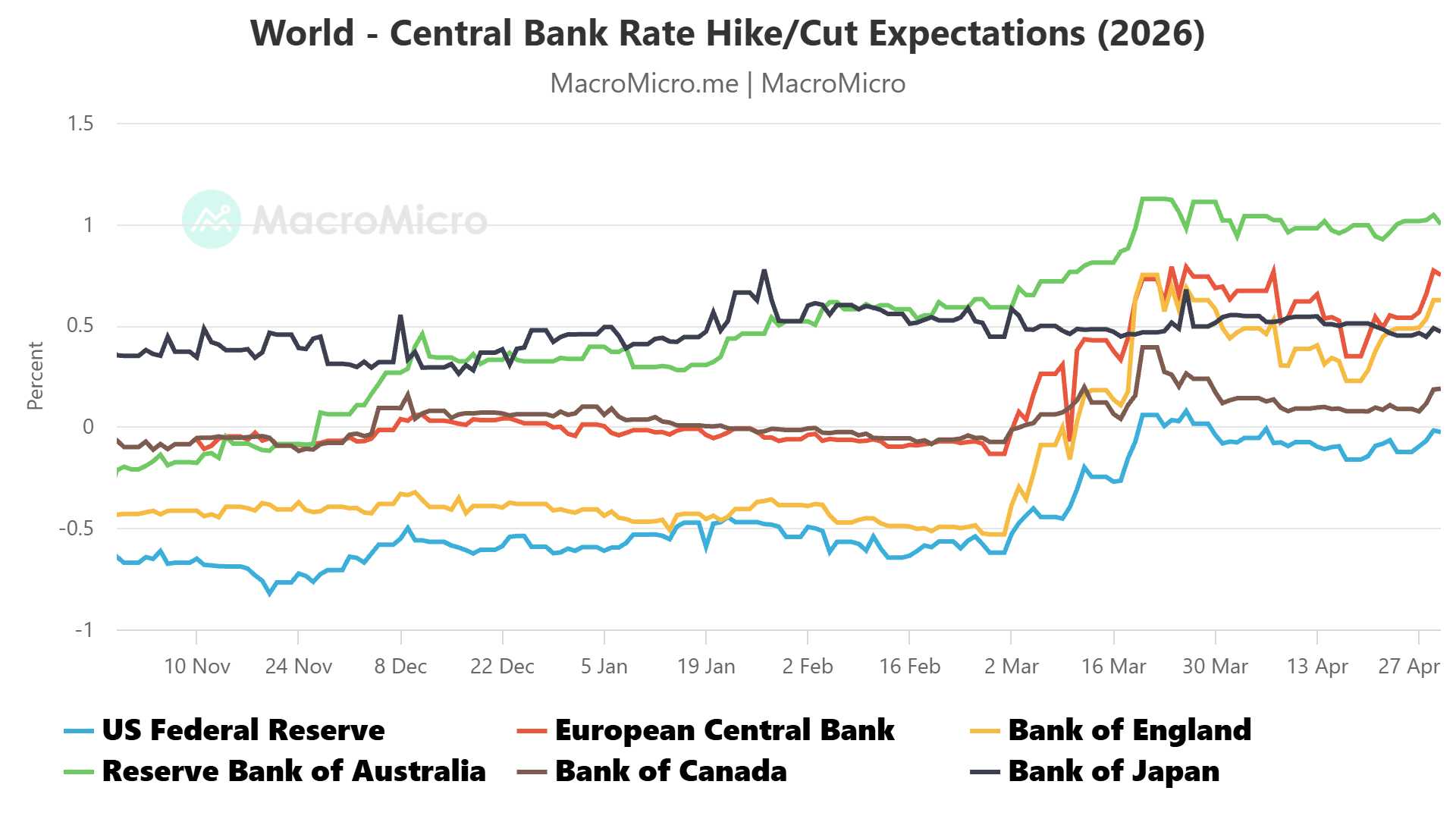
Markets now price 75 basis points (bps) of European Central Bank (ECB) rate hikes by year-end, more than 50bps from the Bank of England (BOE), and at least one hike from the Bank of Canada (BOC). The Fed is back to no cuts this year, with the priced-in odds of a hike outweighing those of a cut at every meeting through October 2027.
The Reserve Bank of Australia (RBA) is expected to deliver its first war-related rate hike at a policy meeting later today, marking its third consecutive 25bps increase this year. It is slated for a fourth one to follow before 2026 is out.
ISM services PMI data is the next test
Service sector purchasing managers index (PMI) data from the Institute for Supply Management (ISM) is the next test for markets.
Last week, the ISM manufacturing PMI print came in at 52.7 for April – effectively in line with forecasts calling for 53.0 and matching the March result. The headline probably matters less than the internals however: surging prices, shrinking employment, and softening new orders.
If the service-sector gauge paints a similar picture, inflation fears may get a boost as the case for rate cuts fades further. Stocks have spent three weeks blissfully ignoring all of this. Today may be the first hint that are ready to pay attention.
Ilya Spivak, tastylive Head of Global Macro, has over 15 years of experience in trading strategy. He specializes in identifying thematic moves in currencies, commodities, interest rates and equities. He hosts Macro Money and co-hosts Overtime, Monday-Thursday. @Ilyaspivak
For live daily programming, market news and commentary, visit tastylive.com or @tastyliveshow on YouTube
Trade with a better broker, open a tastytrade account today. tastylive, Inc. and tastytrade, Inc. are separate but affiliated companies.
Options involve risk and are not suitable for all investors. Please read Characteristics and Risks of Standardized Options before deciding to invest in options.
tastylive content is created, produced, and provided solely by tastylive, Inc. (“tastylive”) and is for informational and educational purposes only. It is not, nor is it intended to be, trading or investment advice or a recommendation that any security, futures contract, digital asset, other product, transaction, or investment strategy is suitable for any person. Trading securities, futures products, and digital assets involve risk and may result in a loss greater than the original amount invested. tastylive, through its content, financial programming or otherwise, does not provide investment or financial advice or make investment recommendations. Investment information provided may not be appropriate for all investors and is provided without respect to individual investor financial sophistication, financial situation, investing time horizon or risk tolerance. tastylive is not in the business of transacting securities trades, nor does it direct client commodity accounts or give commodity trading advice tailored to any particular client’s situation or investment objectives. Supporting documentation for any claims (including claims made on behalf of options programs), comparisons, statistics, or other technical data, if applicable, will be supplied upon request. tastylive is not a licensed financial adviser, registered investment adviser, or a registered broker-dealer. Options, futures, and futures options are not suitable for all investors. Prior to trading securities, options, futures, or futures options, please read the applicable risk disclosures, including, but not limited to, the Characteristics and Risks of Standardized Options Disclosure and the Futures and Exchange-Traded Options Risk Disclosure found on tastytrade.com/disclosures.
tastytrade, Inc. ("tastytrade”) is a registered broker-dealer and member of FINRA, NFA, and SIPC. tastytrade was previously known as tastyworks, Inc. (“tastyworks”). tastytrade offers self-directed brokerage accounts to its customers. tastytrade does not give financial or trading advice, nor does it make investment recommendations. You alone are responsible for making your investment and trading decisions and for evaluating the merits and risks associated with the use of tastytrade’s systems, services or products. tastytrade is a wholly-owned subsidiary of tastylive, Inc.
tastytrade has entered into a Marketing Agreement with tastylive (“Marketing Agent”) whereby tastytrade pays compensation to Marketing Agent to recommend tastytrade’s brokerage services. The existence of this Marketing Agreement should not be deemed as an endorsement or recommendation of Marketing Agent by tastytrade. tastytrade and Marketing Agent are separate entities with their own products and services. tastylive is the parent company of tastytrade.
tastyfx, LLC (“tastyfx”) is a Commodity Futures Trading Commission (“CFTC”) registered Retail Foreign Exchange Dealer (RFED) and Introducing Broker (IB) and Forex Dealer Member (FDM) of the National Futures Association (“NFA”) (NFA ID 0509630). Leveraged trading in foreign currency or off-exchange products on margin carries significant risk and may not be suitable for all investors. We advise you to carefully consider whether trading is appropriate for you based on your personal circumstances as you may lose more than you invest.
tastycrypto is provided solely by tasty Software Solutions, LLC. tasty Software Solutions, LLC is a separate but affiliate company of tastylive, Inc. Neither tastylive nor any of its affiliates are responsible for the products or services provided by tasty Software Solutions, LLC. Cryptocurrency trading is not suitable for all investors due to the number of risks involved. The value of any cryptocurrency, including digital assets pegged to fiat currency, commodities, or any other asset, may go to zero.
© copyright 2013 - 2026 tastylive, Inc. All Rights Reserved. Applicable portions of the Terms of Use on tastylive.com apply. Reproduction, adaptation, distribution, public display, exhibition for profit, or storage in any electronic storage media in whole or in part is prohibited under penalty of law, provided that you may download tastylive’s podcasts as necessary to view for personal use. tastylive was previously known as tastytrade, Inc. tastylive is a trademark/servicemark owned by tastylive, Inc.
Your privacy choices