Nobody Expects a Dovish Warsh. The Jackson Hole Agenda Sets It Up

Nobody Expects a Dovish Warsh. The Jackson Hole Agenda Sets It Up
By:Ilya Spivak
All eyes are on Fed Chair Kevin Warsh as he takes the podium at a Jackson Hole symposium tailor-made for a dovish message. Gold and the dollar have already moved. Bonds are the last to notice.
- Nvidia’s blowout forecast gapped stocks higher, then the market spent most of the day going nowhere
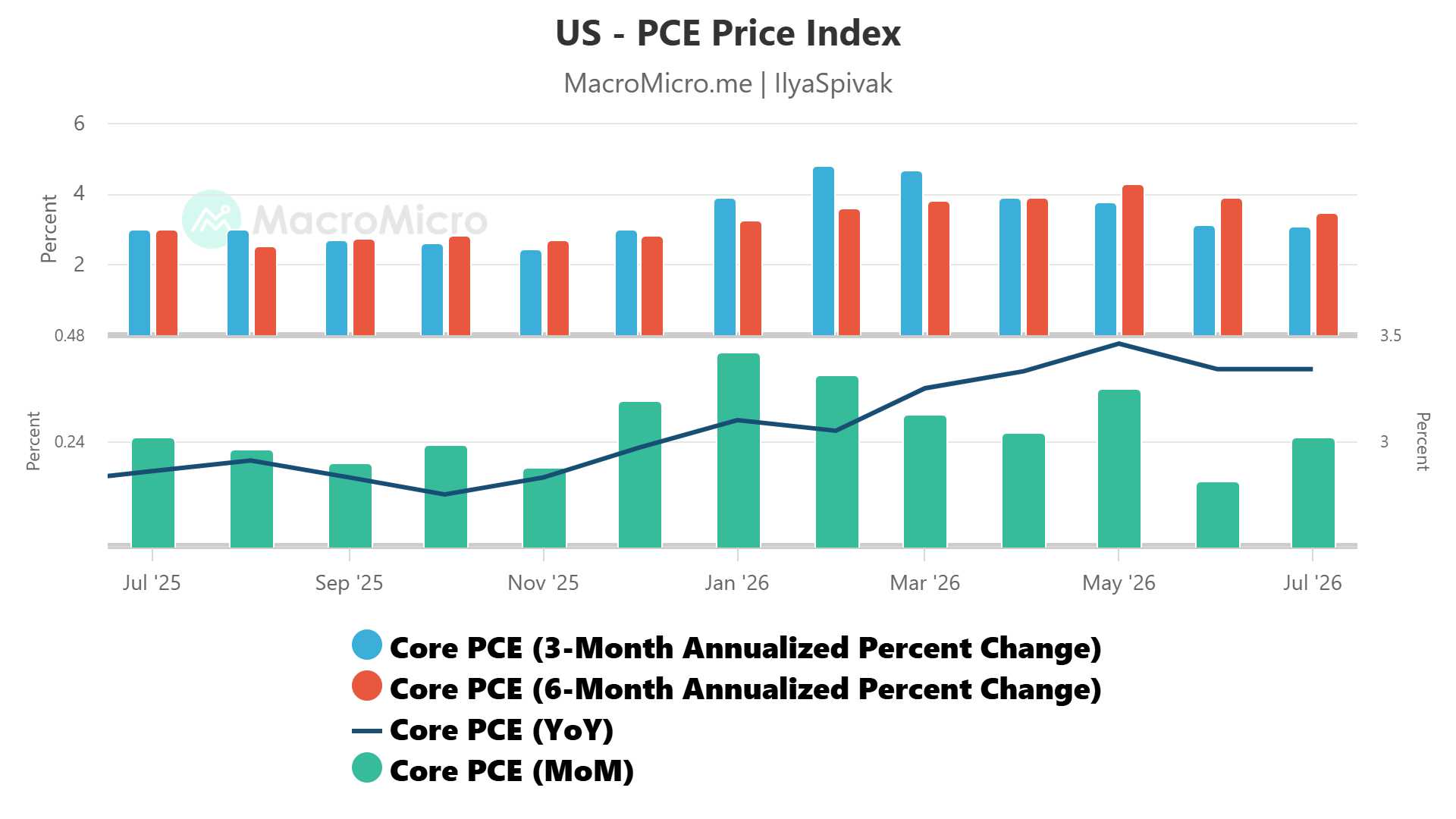
- The three- and six-month trends in core inflation on the Fed’s favored gauge show cooling price growth
- The TLT long-bond ETF may be front-running a turn the futures have yet to make with a conspicuous break higher
Stocks jumped at the open and then did very little for the rest of the day. Nvidia delivered an aggressive revenue forecast overnight, with chief executive Jensen Huang saying he sees nothing ahead but more demand, and investors took him at his word. Technology led, which carried the tech-heavy Nasdaq 100 and the bellwether S&P 500 with it. Crude oil firmed after President Trump bristled at returning to the memorandum of understanding (MOU) agreed June. Tehran is reportedly angling to revive it after the latest round of US secondary sanctions. Gold and silver extended their advance while the US dollar held near three-month lows.
Tellingly, more than half of the equity move was the opening gap. The S&P 500 still seems stuck in a familiar range. Nasdaq looked a bit more decisive but made little process beyond undoing a would-be breakdown from earlier in the week. Crude sits close to the middle of the broad range it has carved out since the US-Iran war began, its highs and lows narrowing toward that midpoint even as tanker traffic from Qatar and Kuwait picks up through the Strait of Hormuz and Tehran talks to Oman about jointly managing the waterway.
The bond market has stopped listening to the Iran war
Long-dated Treasury bonds have stalled since the start of August, halting the relentless climb in 30-year yields defining much of the year so far. Earlier pauses were brief, giving way to a bounce and then a resumption, each swing tracking wartime headlines. This pause looks different because it has lasted, and because the thing that drove earlier has not changed. Crude oil traded broadly higher in August, yet the rally in yields has stalled anyway, which suggests they have come unhooked from the conflict.
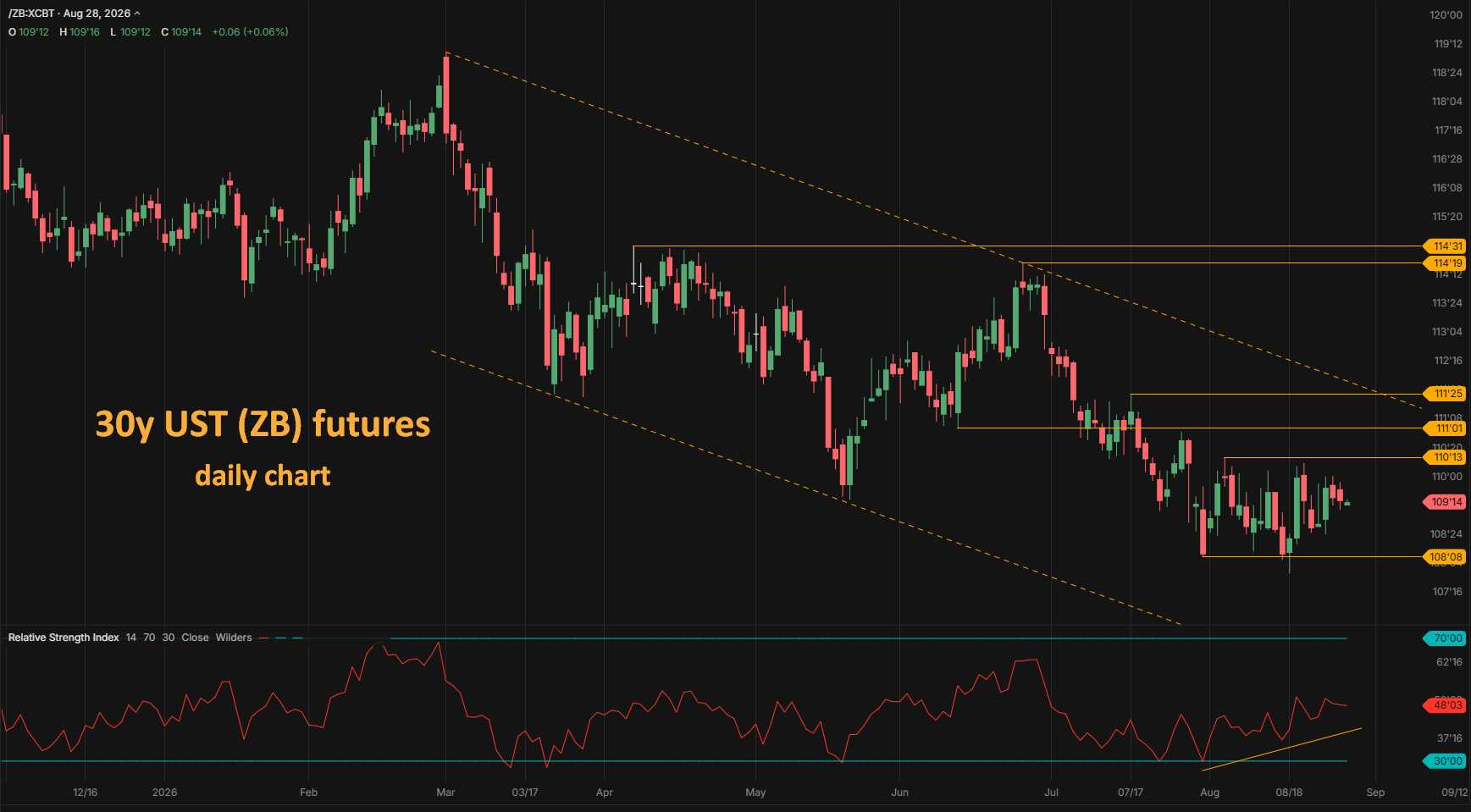
Officials have leaned on the market twice in the meantime. American and Japanese authorities intervened to boost the Japanese yen, a shot across the bow for bond traders. Treasury Secretary Scott Bessent then doubled the maximum size of bond buyback operations from $2 to $4 billion. Against a cash market turning over more than $1 trillion a day, that may look like a rounding error. Bessent seemed to acknowledge as much on CNBC, implying the move was meant to signal rather than strong-arm markets.
Gold and the dollar figured this out in July
The metals worked it out first. Through July, the ETF tracking inflation-protected Treasuries (TIP) fell about 3%, reflecting a sharp rise in real interest rates. An asset yielding nothing should struggle in those conditions, yet gold refused to break. When yields stopped rising in August, it sprang higher. The message seemed to be that the Fed may prove more dovish than the market had extrapolated from the war.
The US dollar ran the same logic in reverse, holding through July when improving carry should have lifted it, then selling off hard into month-end and continuing lower. It bounced modestly after July’s edition of the Fed’s favored PCE inflation data printed a touch hotter than expected, but still it remains firmly locked within a month-long downtrend.
The Fed’s own gauge is going its way
That PCE report put headline price growth at 3.7% year-on-year, unchanged from June, while forecasters expected a downtick to 3.6%. The core measure excluding food and energy held steady at 3.3% for a second month, as analysts foretold. That seemingly warm surface-level reading hides cooler temperatures underneath. Core inflation’s three-month annualized pace has been easing since the start of the year, and the six-month rate has ticked lower for two months running. With energy removed from the calculation, this seems to imply there is more here than just a wartime oil shock washing out of the statistics. A central bank watching its preferred inflation measure drift toward target while oil settles into the middle of its range has little obvious reason to rush a rate hike.
Traders have noticed. Cumulative odds still imply better than a 90% chance of a hike by December, but that total is reached by stacking probabilities across meetings. Only September carries genuine agreement, at roughly 66% in favor of a hold versus 34% for a single 25-basis-point (bps) hike, and other alternatives dismissed. By October, market pricing is already closer to a coin toss, and from there through the end of next year no single outcome commands better than even odds. Since the start of August, as gold rallied and the dollar sank, the odds of the Fed simply standing pat this year have risen to about 30%, while incoming economic data has broadly underwhelmed relative to forecasts and the Atlanta Fed’s GDPNow model has tellingly trended lower.
The speech the agenda was built for
The spotlight now turns to Jackson Hole. For almost 20 years, the Fed’s annual symposium has functioned as a kind of tuning exercise, where the keynote speech effectively teaches markets how to read incoming data in line with officials’ reaction function. New Fed Chair Kevin Warsh considers forward guidance a mistake and will try to signal as little as possible, so the usual playbook may not apply. What does apply is the gathering’s agenda. This year’s theme is “financial innovation [and its] implications for payments and policy”. The argument that helped put Warsh at the central bank’s helm is precisely that artificial intelligence (AI) represents a productivity revolution large enough to wring costs out of the economy and deliver structural disinflation, which in turn argues for lower rates over time.
So, Warsh is set to deliver the keynote speech at a symposium that seems devoted to the subject of his own dovish thesis. The obligatory commitment to “restoring price stability” will no doubt re-appear, but a clear signal paving the way for near-term tightening seems like the kind of thing Warsh would make certain to avoid, even as he sets up a structural case for easier policy down the road. Bonds may be starting to edge toward the same conclusion. The ETF tracking long-term Treasuries (TLT) broke above the level that capped it all month and pointedly held that level on a retest over the two subsequent sessions. Bond futures have yet to follow. If Warsh spends Friday explaining why technology makes inflation a smaller problem than the market fears, they may not have long to wait.
Ilya Spivak, tastylive Head of Global Macro, has over 15 years of experience in trading strategy. He specializes in identifying thematic moves in currencies, commodities, interest rates and equities. He hosts Macro Money and co-hosts Overtime, Monday-Thursday. @Ilyaspivak
For live daily programming, market news and commentary, visit tastylive.com or @tastyliveshow on YouTube
Trade with a better broker, open a tastytrade account today. tastylive, Inc. and tastytrade, Inc. are separate but affiliated companies.
Options involve risk and are not suitable for all investors. Please read Characteristics and Risks of Standardized Options before deciding to invest in options.
tastylive content is created, produced, and provided solely by tastylive, Inc. (“tastylive”) and is for informational and educational purposes only. It is not, nor is it intended to be, trading or investment advice or a recommendation that any security, futures contract, digital asset, other product, transaction, or investment strategy is suitable for any person. Trading securities, futures products, and digital assets involve risk and may result in a loss greater than the original amount invested. tastylive, through its content, financial programming or otherwise, does not provide investment or financial advice or make investment recommendations. Investment information provided may not be appropriate for all investors and is provided without respect to individual investor financial sophistication, financial situation, investing time horizon or risk tolerance. tastylive is not in the business of transacting securities trades, nor does it direct client commodity accounts or give commodity trading advice tailored to any particular client’s situation or investment objectives. Supporting documentation for any claims (including claims made on behalf of options programs), comparisons, statistics, or other technical data, if applicable, will be supplied upon request. tastylive is not a licensed financial adviser, registered investment adviser, or a registered broker-dealer. Options, futures, and futures options are not suitable for all investors. Prior to trading securities, options, futures, or futures options, please read the applicable risk disclosures, including, but not limited to, the Characteristics and Risks of Standardized Options Disclosure and the Futures and Exchange-Traded Options Risk Disclosure found on tastytrade.com/disclosures.
tastytrade, Inc. ("tastytrade”) is a registered broker-dealer and member of FINRA, NFA, and SIPC. tastytrade was previously known as tastyworks, Inc. (“tastyworks”). tastytrade offers self-directed brokerage accounts to its customers. tastytrade does not give financial or trading advice, nor does it make investment recommendations. You alone are responsible for making your investment and trading decisions and for evaluating the merits and risks associated with the use of tastytrade’s systems, services or products. tastytrade is a wholly-owned subsidiary of tastylive, Inc.
tastytrade has entered into a Marketing Agreement with tastylive (“Marketing Agent”) whereby tastytrade pays compensation to Marketing Agent to recommend tastytrade’s brokerage services. The existence of this Marketing Agreement should not be deemed as an endorsement or recommendation of Marketing Agent by tastytrade. tastytrade and Marketing Agent are separate entities with their own products and services. tastylive is the parent company of tastytrade.
tastyfx, LLC (“tastyfx”) is a Commodity Futures Trading Commission (“CFTC”) registered Retail Foreign Exchange Dealer (RFED) and Introducing Broker (IB) and Forex Dealer Member (FDM) of the National Futures Association (“NFA”) (NFA ID 0509630). Leveraged trading in foreign currency or off-exchange products on margin carries significant risk and may not be suitable for all investors. We advise you to carefully consider whether trading is appropriate for you based on your personal circumstances as you may lose more than you invest.
tastycrypto is provided solely by tasty Software Solutions, LLC. tasty Software Solutions, LLC is a separate but affiliate company of tastylive, Inc. Neither tastylive nor any of its affiliates are responsible for the products or services provided by tasty Software Solutions, LLC. Cryptocurrency trading is not suitable for all investors due to the number of risks involved. The value of any cryptocurrency, including digital assets pegged to fiat currency, commodities, or any other asset, may go to zero.
© copyright 2013 - 2026 tastylive, Inc. All Rights Reserved. Applicable portions of the Terms of Use on tastylive.com apply. Reproduction, adaptation, distribution, public display, exhibition for profit, or storage in any electronic storage media in whole or in part is prohibited under penalty of law, provided that you may download tastylive’s podcasts as necessary to view for personal use. tastylive was previously known as tastytrade, Inc. tastylive is a trademark/servicemark owned by tastylive, Inc.
Your privacy choices