Nvidia CEO Exit Hit Bonds and Gold Harder Than Stocks. Why?

Nvidia CEO Exit Hit Bonds and Gold Harder Than Stocks. Why?
By:Ilya Spivak
Jensen Huang’s ouster sent Nvidia shares reeling, but the broader stock market churned while bonds, metals, and currencies took the hit. Will those moves unwind as the shock fades?
- Nvidia shares plunged after CEO Jensen Huang’s exit, but capital rotated into other stocks
- Bonds, gold, silver, and major currencies sold off as investors appeared to raise cash
- Markets now price 56 basis points of Fed rate hikes in 2027 ahead of US producer price data
A scandal at Nvidia sent shockwaves across financial markets. The chipmaker’s board removed CEO Jensen Huang after accusations against him mounted over the past two days, and an interim chief executive is now in place. The company still plans to report earnings next week as scheduled. Nvidia shares gapped sharply lower and were down nearly 20% at one point before paring losses to close over 4% lower.
The broader stock market took it in stride. Rivals like AMD and Broadcom gained, as did hyperscalers designing their own chips, such as Alphabet. Amazon and Tesla rose too. An equal-weighted view of the market looked soggy but not catastrophically so, suggesting capital leaving the largest stock in the market fanned out in search of a new home.
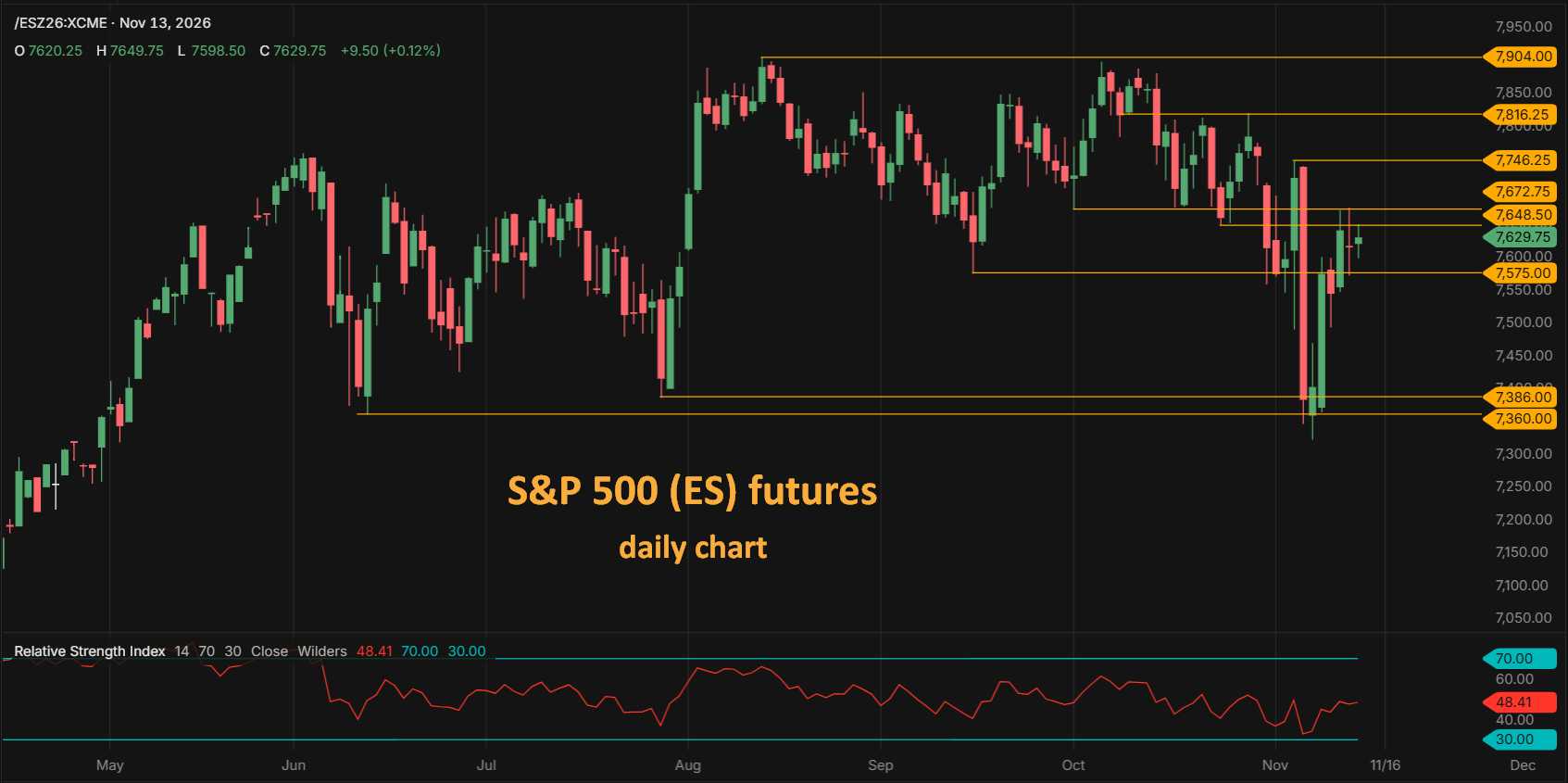
The indexes reflect that churn. The S&P 500 may be carving out another lower high after testing former support-turned-resistance below the 7700 level – potential stage-setting for an extension of the downtrend from its early-October top – but otherwise went nowhere. The tech-heavy Nasdaq 100 posted an inside day, hovering near familiar levels.
Who was selling bonds, gold, and silver?
The scars showed up outside equities. Treasury bonds fell sharply. Gold slid and briefly dipped below its October low before recovering, while silver dropped more than 3%. The US dollar climbed against all its major counterparts, with the Australian dollar, euro, and British pound hit hardest. The Canadian dollar, which turned lower well before its peers, and the Japanese yen, where intervention risk has dulled volatility, moved the least.
Another bout of inflation fears might explain the selloff, much as the hot consumer price index (CPI) report did earlier this week. But crude oil managed only a modest bounce, which makes that story hard to sustain. A more likely culprit is liquidation. Nvidia’s outsized market cap makes it a fixture in a vast range of portfolios. Investors forced to raise cash to cover losses on it may have sold assets that are easy to sell in a pinch, like bonds and precious metals.
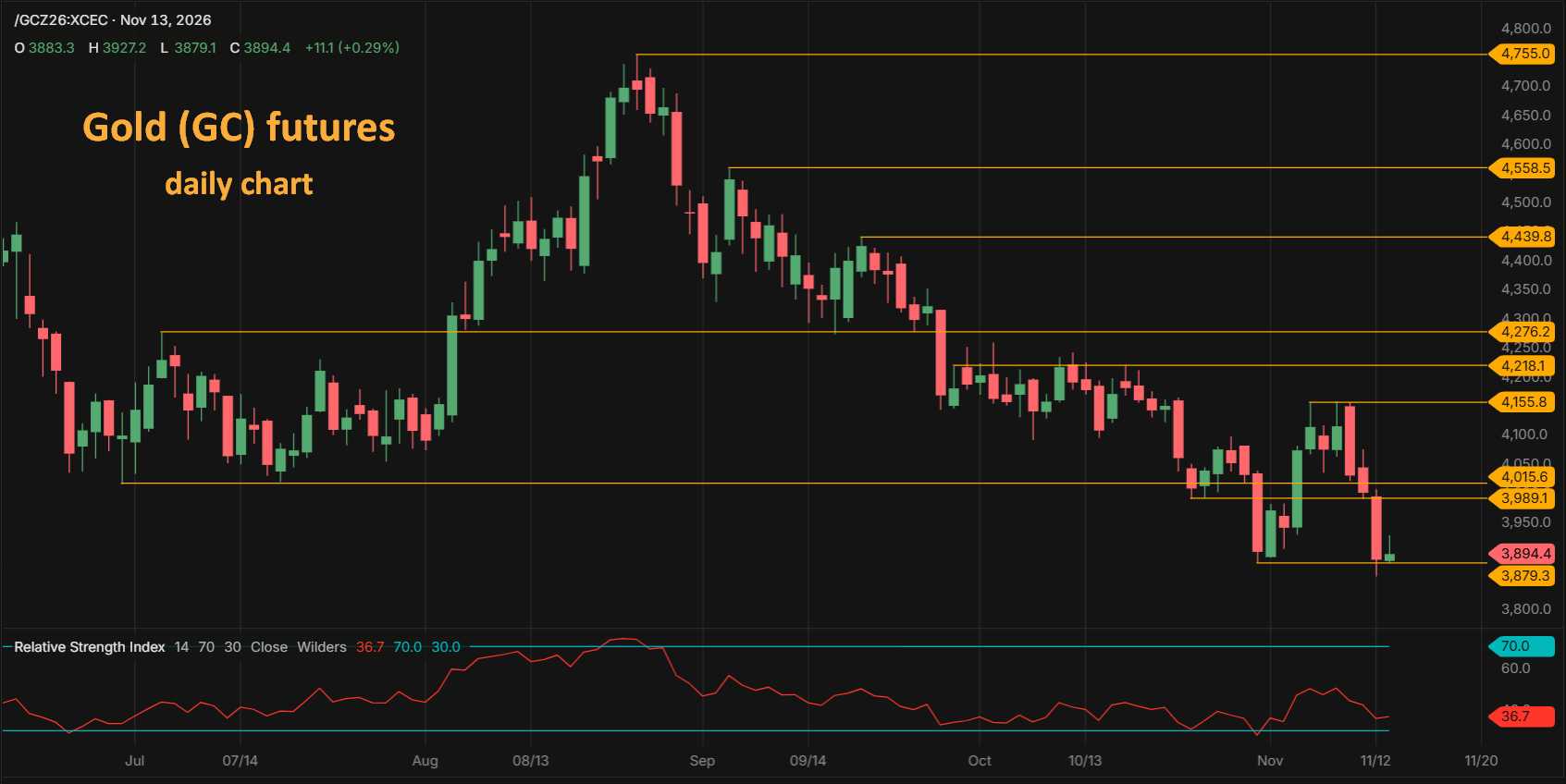
Critically, bonds, gold, and the Canadian dollar all found support at key levels. Treasuries held the shelf where they paused on the way up and are clinging to the rally that began in early October. If the selling reflected capital flows with no lasting change in the macro narrative, these moves may reverse as the shock wears off.
Will PPI data force a rethink on Fed rate hikes?
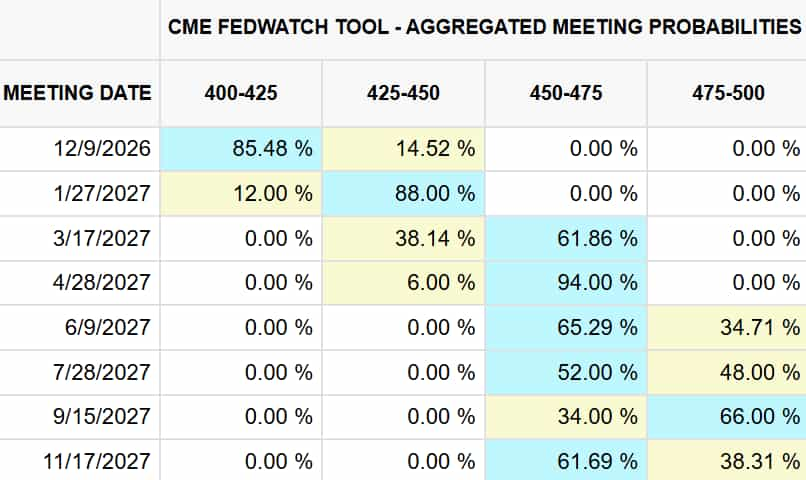
Traders are now leaning harder into Fed tightening. A 25-basis-point (bps) rate hike in December is about 85% likely, with a 15% chance of a 50bps move, an option Fed Governor Christopher Waller has recently floated. That would complete the two hikes the Fed projected for this year in September. For 2027, markets now price 56bps of tightening, with a follow-on hike fully discounted by March and another by June. The Fed projected none, expecting rates to hold steady before falling in 2028.
That bet may prove precarious. The latest CPI data showed the war’s price shock moving from core goods into core services, where inflation proved hardest to dislodge after COVID. Yet services are where most Americans work and shop, and consumer spending is the largest driver of US growth. Third-quarter figures revealed that driver is already looking haggard, with costlier imports swallowing its contribution and leaving the AI data center buildout to carry the economy.
Signs of fatigue are emerging there too. October survey data from the Institute for Supply Management (ISM) showed manufacturing order backlogs and employment growing more slowly as inventories rebuilt, while services new orders slowed sharply. Bond market breakeven inflation rates have fallen alongside crude oil, hinting at little demand-driven price pressure beyond the energy shock.
That makes Nvidia’s leadership turmoil especially poignant. Huang has been the AI industry’s chief booster and the hands-on leader of its most pivotal company. If the buildout loses momentum without a healthy consumer to pick up the slack, inflation’s readthrough may ultimately be fewer Fed rate hikes. Friday’s producer price index (PPI) report is expected to show wholesale prices rising 0.4% month-on-month in October after September’s 1.3% surge, with core up 0.3% after 0.7% previously. Signs of cooling in the pipeline could prime markets for a rethink.
Ilya Spivak, tastylive Head of Global Macro, has over 15 years of experience in trading strategy. He specializes in identifying thematic moves in currencies, commodities, interest rates and equities. He hosts Macro Money and co-hosts Overtime, Monday-Thursday. @Ilyaspivak
For live daily programming, market news and commentary, visit tastylive.com or @tastyliveshow on YouTube
Trade with a better broker, open a tastytrade account today. tastylive, Inc. and tastytrade, Inc. are separate but affiliated companies.
Options involve risk and are not suitable for all investors. Please read Characteristics and Risks of Standardized Options before deciding to invest in options.
tastylive content is created, produced, and provided solely by tastylive, Inc. (“tastylive”) and is for informational and educational purposes only. It is not, nor is it intended to be, trading or investment advice or a recommendation that any security, futures contract, digital asset, other product, transaction, or investment strategy is suitable for any person. Trading securities, futures products, and digital assets involve risk and may result in a loss greater than the original amount invested. tastylive, through its content, financial programming or otherwise, does not provide investment or financial advice or make investment recommendations. Investment information provided may not be appropriate for all investors and is provided without respect to individual investor financial sophistication, financial situation, investing time horizon or risk tolerance. tastylive is not in the business of transacting securities trades, nor does it direct client commodity accounts or give commodity trading advice tailored to any particular client’s situation or investment objectives. Supporting documentation for any claims (including claims made on behalf of options programs), comparisons, statistics, or other technical data, if applicable, will be supplied upon request. tastylive is not a licensed financial adviser, registered investment adviser, or a registered broker-dealer. Options, futures, and futures options are not suitable for all investors. Prior to trading securities, options, futures, or futures options, please read the applicable risk disclosures, including, but not limited to, the Characteristics and Risks of Standardized Options Disclosure and the Futures and Exchange-Traded Options Risk Disclosure found on tastytrade.com/disclosures.
tastytrade, Inc. ("tastytrade”) is a registered broker-dealer and member of FINRA, NFA, and SIPC. tastytrade was previously known as tastyworks, Inc. (“tastyworks”). tastytrade offers self-directed brokerage accounts to its customers. tastytrade does not give financial or trading advice, nor does it make investment recommendations. You alone are responsible for making your investment and trading decisions and for evaluating the merits and risks associated with the use of tastytrade’s systems, services or products. tastytrade is a wholly-owned subsidiary of tastylive, Inc.
tastytrade has entered into a Marketing Agreement with tastylive (“Marketing Agent”) whereby tastytrade pays compensation to Marketing Agent to recommend tastytrade’s brokerage services. The existence of this Marketing Agreement should not be deemed as an endorsement or recommendation of Marketing Agent by tastytrade. tastytrade and Marketing Agent are separate entities with their own products and services. tastylive is the parent company of tastytrade.
tastyfx, LLC (“tastyfx”) is a Commodity Futures Trading Commission (“CFTC”) registered Retail Foreign Exchange Dealer (RFED) and Introducing Broker (IB) and Forex Dealer Member (FDM) of the National Futures Association (“NFA”) (NFA ID 0509630). Leveraged trading in foreign currency or off-exchange products on margin carries significant risk and may not be suitable for all investors. We advise you to carefully consider whether trading is appropriate for you based on your personal circumstances as you may lose more than you invest.
tastycrypto is provided solely by tasty Software Solutions, LLC. tasty Software Solutions, LLC is a separate but affiliate company of tastylive, Inc. Neither tastylive nor any of its affiliates are responsible for the products or services provided by tasty Software Solutions, LLC. Cryptocurrency trading is not suitable for all investors due to the number of risks involved. The value of any cryptocurrency, including digital assets pegged to fiat currency, commodities, or any other asset, may go to zero.
© copyright 2013 - 2026 tastylive, Inc. All Rights Reserved. Applicable portions of the Terms of Use on tastylive.com apply. Reproduction, adaptation, distribution, public display, exhibition for profit, or storage in any electronic storage media in whole or in part is prohibited under penalty of law, provided that you may download tastylive’s podcasts as necessary to view for personal use. tastylive was previously known as tastytrade, Inc. tastylive is a trademark/servicemark owned by tastylive, Inc.
Your privacy choices