Nvidia Isn’t the Problem. Why Are Stock Markets Really Falling?

Nvidia Isn’t the Problem. Why Are Stock Markets Really Falling?
By:Ilya Spivak
Stocks dropped before a blockbuster Nvidia earnings report and seemed unimpressed after results topped forecasts. A weak US consumer is the real concern from here.
- Nvidia beat earnings and revenue forecasts, but the stock market’s response was muted
- US retail sales slowed in October as spending on cars and furniture fell
- Fed rate hike bets for 2027 keep fading as growth worries replace inflation fears
Stock markets suffered another ugly day ahead of Nvidia’s third-quarter earnings report. Selling was broad across sectors and themes, though a few more stocks were in the green than at the start of the week. Elsewhere, the selloff was less uniform. Crude oil steadied, the US dollar stopped rallying, and Treasury bonds edged higher.
The chipmaker’s results crossed the wires after the closing bell. Earnings per share (EPS) came in at $2.68, about 9% above forecasts of $2.47, while revenue beat expectations by about 7%. Those are solid numbers, if short of the blowout beats of years past. Nvidia shares rose to test above $160 in after-hours trading.
What stands most of all is the markets’ lackluster response. The after-hours gain barely dents the recent decline in Nvidia shares. The S&P 500 closed at the bottom of a range in place since June, and its post-earnings bounce has been unconvincing. The tech-heavy Nasdaq 100 popped a bit more but remains within the bounds of its decline.
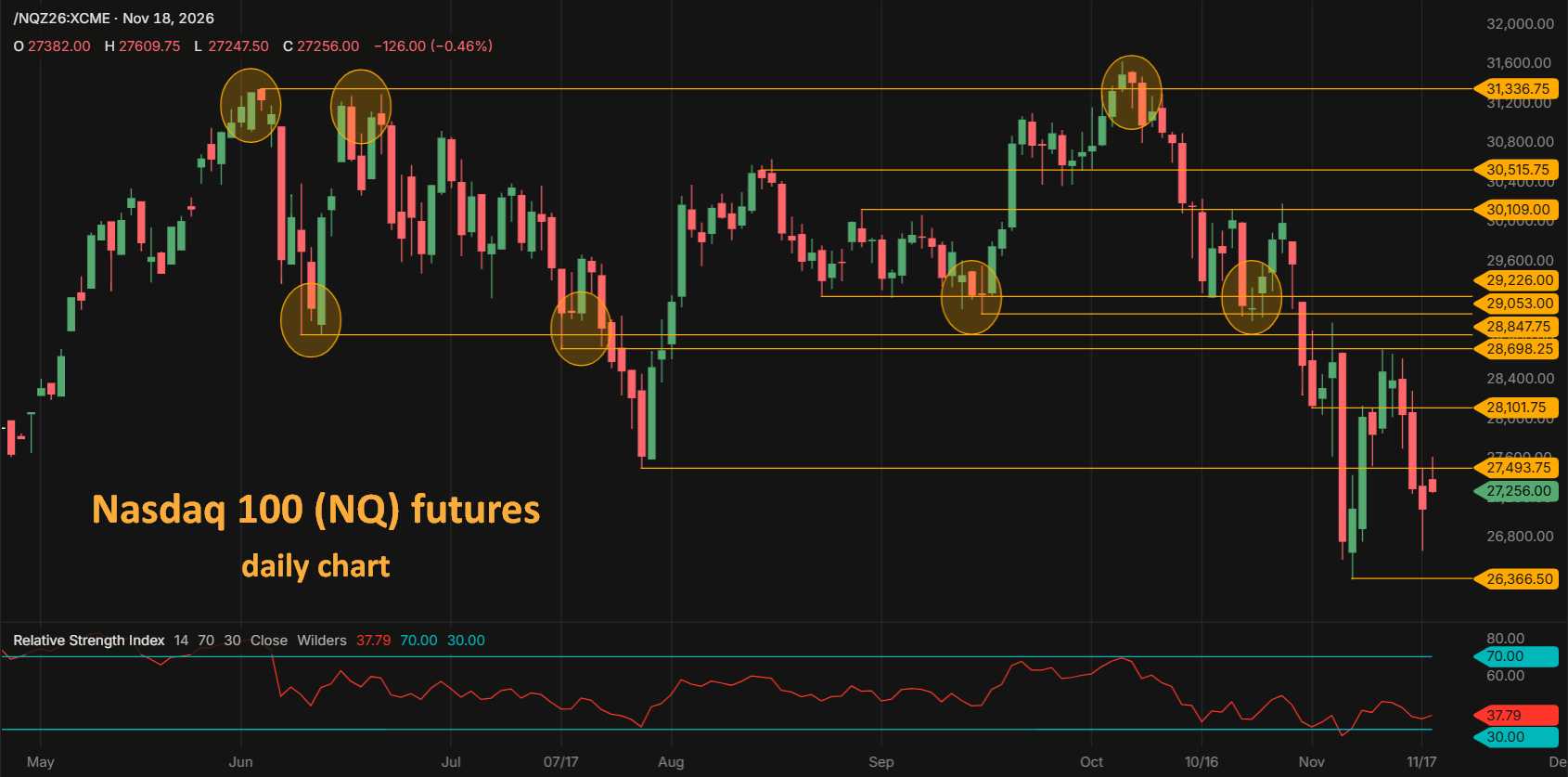
That raises the key question. If the markets’ worries about Nvidia were fixed, would that revive market-wide risk appetite? The selloff in stocks began in early October, well before the scandal that ousted Jensen Huang as CEO. If something else is driving it, quarterly results were never likely to turn the tide.
Is the US consumer starting to crack?
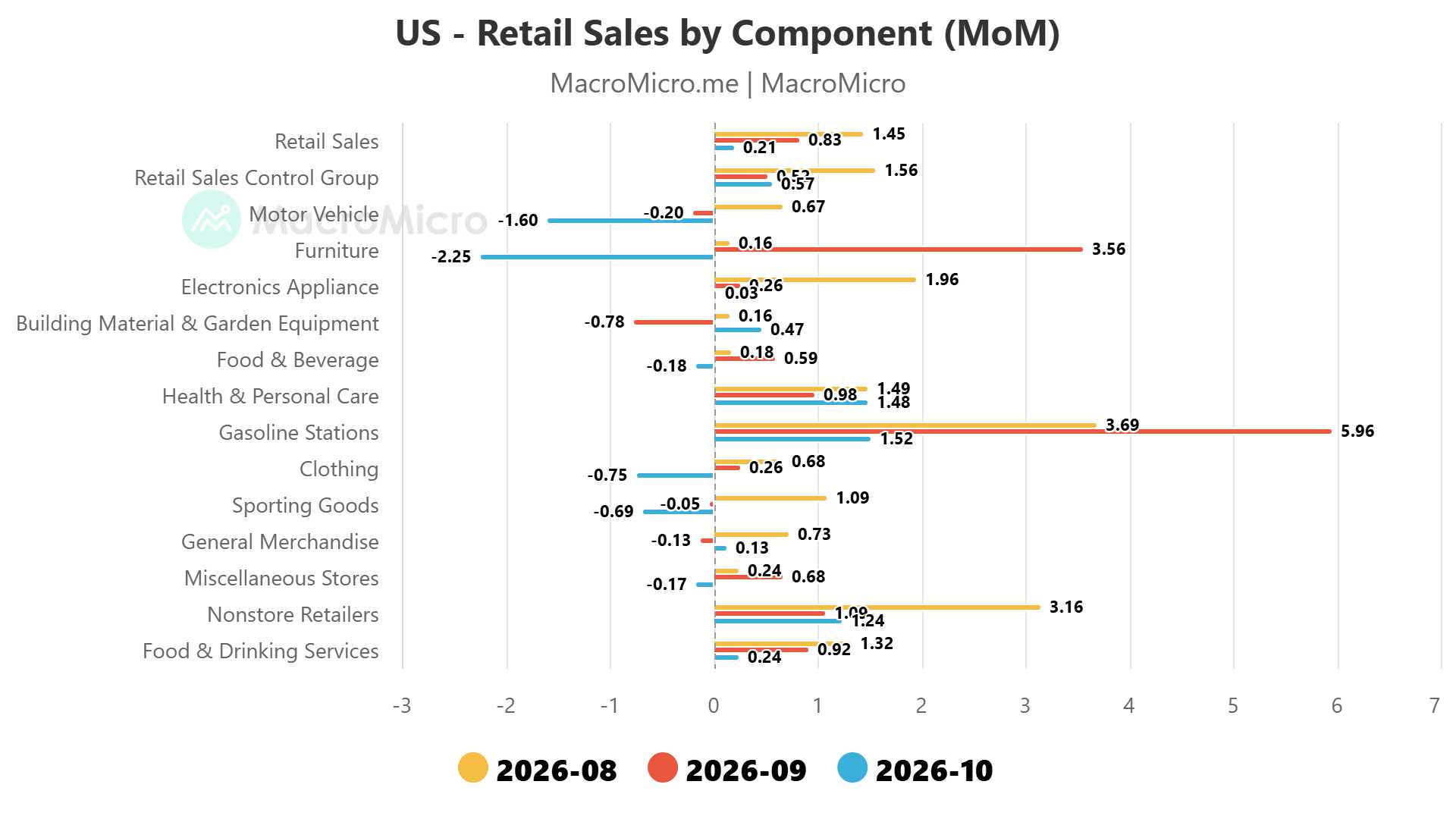
US retail sales data offered a clue. Headline sales rose 0.2% in October, matching forecasts but slowing from 0.8% in September and 1.45% in August. The details look worse. Many categories swung from growth to outright decline. Sales at motor vehicle dealers, which make up roughly a fifth of the total, fell 1.6%. Furniture sales dropped about 2.25%. Both are big-ticket purchases that consumers tend to put off when they tighten their belts.
Gas station sales rose 1.5% after a nearly 6% jump in September. Retail sales are not adjusted for inflation however, and people’s driving patterns mostly follow a routine. This means that slower spending at gas stations mostly reflects cheaper fuel prices. That may seem like relief, but the underlying context looks more ominous.
The recent drop in energy prices has come alongside a steep fall in market-based inflation expectations – so-called “breakeven rates” – priced into Treasury bond yields. This suggests the markets see inflation as mostly a supply shock, with weak upward price pressure from broader economic activity. That points to soggy underlying demand.
It also echoes third-quarter gross domestic product (GDP) data. Costlier imports more than erased the boost from consumer spending, leaving AI-linked investment to carry growth. Consumers account for about 68% of the economy, roughly five times as much as business investment. Even a modest pullback in household spending would be hard for the data center boom to offset, especially if that boom is slowing.
Will the Fed blink on rate hikes?
The markets are having second thoughts about some of their recent hawkish mythmaking. A 25-basis-point (bps) rate hike in December remains fully priced, completing the two hikes the Fed projected for this year in September. For 2027, a follow-on hike is fully priced by March, and another is fully discounted by July. That adds 50bps of tightening next year, versus none in Fed projections. Still, that is one rate hike less than traders were considering as recently as a week ago, after a hot consumer price index (CPI) report.
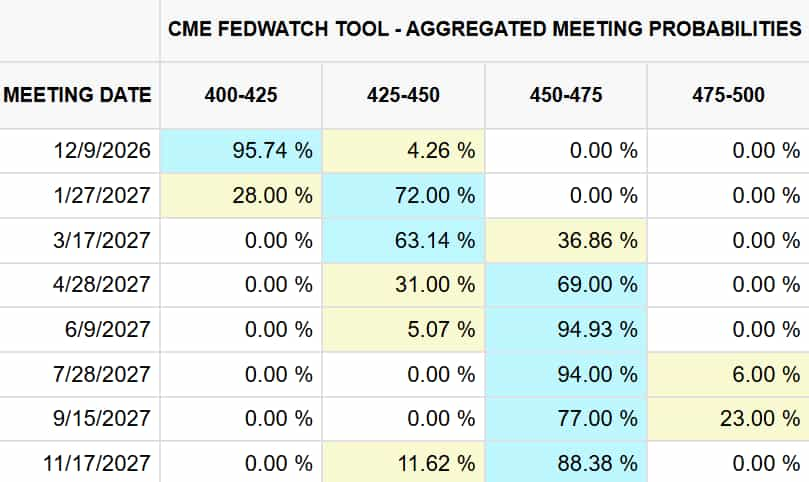
Minutes from the October meeting of the Federal Open Market Committee (FOMC) are due Wednesday. Recent comments from Fed officials, including Governor Christopher Waller, Cleveland Fed President Beth Hammack, and St. Louis Fed President Alberto Musalem, have leaned hawkish. If the minutes show policymakers worried about tightening into a slowdown, bonds may extend gains.
The US dollar could also start to diverge. Risk-sensitive currencies like the Australian and Canadian dollars may stay under pressure, but the euro and British pound are showing early signs of a turn, and the Swiss franc and Japanese yen may gain as yield differentials narrow. Stocks would still look vulnerable in that scenario, since growth fears would be driving the rethink in policy bets.
Ilya Spivak, tastylive Head of Global Macro, has over 15 years of experience in trading strategy. He specializes in identifying thematic moves in currencies, commodities, interest rates and equities. He hosts Macro Money and co-hosts Overtime, Monday-Thursday. @Ilyaspivak
For live daily programming, market news and commentary, visit tastylive.com or @tastyliveshow on YouTube
Trade with a better broker, open a tastytrade account today. tastylive, Inc. and tastytrade, Inc. are separate but affiliated companies.
Options involve risk and are not suitable for all investors. Please read Characteristics and Risks of Standardized Options before deciding to invest in options.
tastylive content is created, produced, and provided solely by tastylive, Inc. (“tastylive”) and is for informational and educational purposes only. It is not, nor is it intended to be, trading or investment advice or a recommendation that any security, futures contract, digital asset, other product, transaction, or investment strategy is suitable for any person. Trading securities, futures products, and digital assets involve risk and may result in a loss greater than the original amount invested. tastylive, through its content, financial programming or otherwise, does not provide investment or financial advice or make investment recommendations. Investment information provided may not be appropriate for all investors and is provided without respect to individual investor financial sophistication, financial situation, investing time horizon or risk tolerance. tastylive is not in the business of transacting securities trades, nor does it direct client commodity accounts or give commodity trading advice tailored to any particular client’s situation or investment objectives. Supporting documentation for any claims (including claims made on behalf of options programs), comparisons, statistics, or other technical data, if applicable, will be supplied upon request. tastylive is not a licensed financial adviser, registered investment adviser, or a registered broker-dealer. Options, futures, and futures options are not suitable for all investors. Prior to trading securities, options, futures, or futures options, please read the applicable risk disclosures, including, but not limited to, the Characteristics and Risks of Standardized Options Disclosure and the Futures and Exchange-Traded Options Risk Disclosure found on tastytrade.com/disclosures.
tastytrade, Inc. ("tastytrade”) is a registered broker-dealer and member of FINRA, NFA, and SIPC. tastytrade was previously known as tastyworks, Inc. (“tastyworks”). tastytrade offers self-directed brokerage accounts to its customers. tastytrade does not give financial or trading advice, nor does it make investment recommendations. You alone are responsible for making your investment and trading decisions and for evaluating the merits and risks associated with the use of tastytrade’s systems, services or products. tastytrade is a wholly-owned subsidiary of tastylive, Inc.
tastytrade has entered into a Marketing Agreement with tastylive (“Marketing Agent”) whereby tastytrade pays compensation to Marketing Agent to recommend tastytrade’s brokerage services. The existence of this Marketing Agreement should not be deemed as an endorsement or recommendation of Marketing Agent by tastytrade. tastytrade and Marketing Agent are separate entities with their own products and services. tastylive is the parent company of tastytrade.
tastyfx, LLC (“tastyfx”) is a Commodity Futures Trading Commission (“CFTC”) registered Retail Foreign Exchange Dealer (RFED) and Introducing Broker (IB) and Forex Dealer Member (FDM) of the National Futures Association (“NFA”) (NFA ID 0509630). Leveraged trading in foreign currency or off-exchange products on margin carries significant risk and may not be suitable for all investors. We advise you to carefully consider whether trading is appropriate for you based on your personal circumstances as you may lose more than you invest.
tastycrypto is provided solely by tasty Software Solutions, LLC. tasty Software Solutions, LLC is a separate but affiliate company of tastylive, Inc. Neither tastylive nor any of its affiliates are responsible for the products or services provided by tasty Software Solutions, LLC. Cryptocurrency trading is not suitable for all investors due to the number of risks involved. The value of any cryptocurrency, including digital assets pegged to fiat currency, commodities, or any other asset, may go to zero.
© copyright 2013 - 2026 tastylive, Inc. All Rights Reserved. Applicable portions of the Terms of Use on tastylive.com apply. Reproduction, adaptation, distribution, public display, exhibition for profit, or storage in any electronic storage media in whole or in part is prohibited under penalty of law, provided that you may download tastylive’s podcasts as necessary to view for personal use. tastylive was previously known as tastytrade, Inc. tastylive is a trademark/servicemark owned by tastylive, Inc.
Your privacy choices