Oil, Inflation, and the Economy: Will the Stock Market Break?

Oil, Inflation, and the Economy: Will the Stock Market Break?
By:Ilya Spivak
Will surging oil prices topple the stock market as “stagflation” fears send traders scrambling for the exits?
- Crude oil prices climb despite emergency reserve releases
- Rising yields are pressuring stocks, boosting the US dollar
- Revised US GDP, consumer confidence data now in focus
Financial markets remain gripped by a familiar macro narrative: rising oil prices are stoking inflation fears and forcing investors to reconsider expectations for Federal Reserve rate cuts.
Crude oil prices have resumed their advance even after the International Energy Agency (IEA) announced the release of 400 million barrels from emergency reserves. The move highlights how persistent supply concerns have become as markets digest the impact of the ongoing US-Iran conflict on global energy flows.
That is reverberating across assets.
Treasury bonds are under pressure as investors anticipate higher inflation and bid up yields. The US dollar has strengthened alongside rising rates, benefiting both from improved yield appeal and its traditional role as a haven asset during periods of market stress. Gold is understandably struggling.
US stocks have turned sharply lower. The bellwether S&P 500 fell 1.5% on Thursday, suffering its biggest one-day loss in a month and posting its lowest daily close since late November. The tech-tilted Nasdaq 100 fell 1.7% while the small-cap Russell 2000 index lost 2.12%.
Surging oil prices are scattering Fed rate cut expectations
A rethink of US monetary policy expectations seems to be at work.
Traders have begun unwinding the rate cuts they’d priced into the outlook for the Federal Reserve. Markets have become unsure of seeing even a single 25-basis-point (bps) reduction in 2026, having been wholly convinced that they will get two of them for most of the past year.
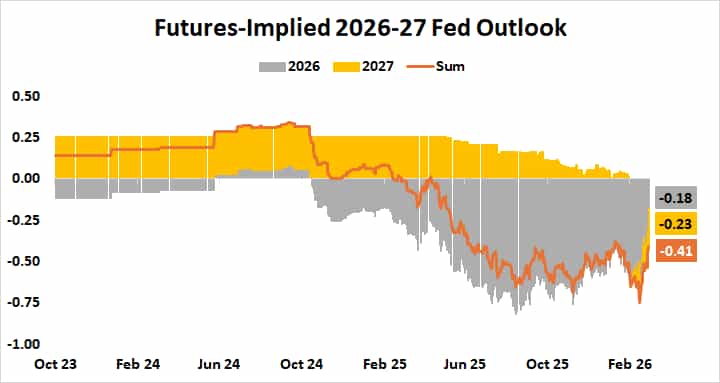
The adjustment reflects a simple calculus: higher oil prices raise inflation expectations, which in turn make it harder for the Fed to justify cutting rates.
Wall Street understandably dislikes this. Fed Chair Jerome Powell marked a top for the S&P 500 in late October when he chastised markets for over-extrapolating rate-cut expectations as a press conference following that month’s FOMC policy meeting. It has been stuck in a choppy range below those highs ever since.
The markets and the central bank have been at odds about where policy ought to go at least since June last year, with traders demanding more stimulus faster and officials resisting. Buffeted by uncertainty, investors seemed to cry out for more cheap-money insurance, but the Fed’s strict inflation and employment mandates kept it modest.
Is the US economy headed for “stagflation”?
Incoming data may bring the markets their next catalyst.
Revised fourth-quarter US gross domestic product (GDP) data is first up. Preliminary estimates showed growth slowed to an annualized 1.4%, down from 4.4% in the third quarter. That result marked the weakest performance since the first quarter of 2025, when the economy shrank amid nervous anticipation of new US tariffs.
Perhaps most critically, those figures revealed a worrying decline in the contribution from private consumption to overall output. Household spending accounts for close to 68% of GDP growth. It is not hard to see how this could amount to a major threat for the economy under current circumstances if it was already fragile late last year.
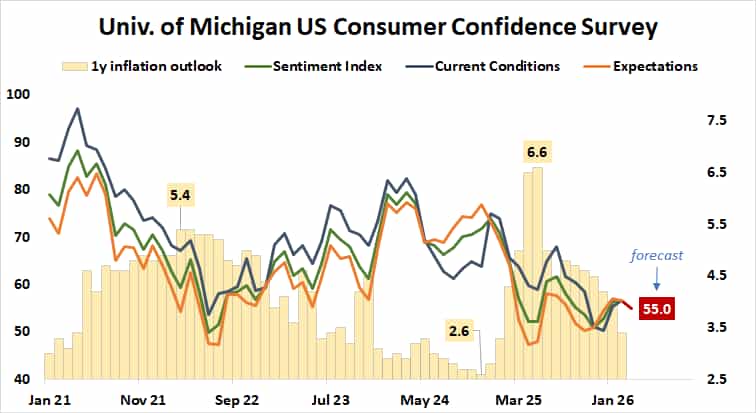
That might make the upcoming University of Michigan (UofM) consumer confidence report especially interesting. The first edition of the March edition is expected to show sentiment falling to a three-month low. If inflation expectations driven by rising oil prices weigh heavily on confidence, that would spell trouble for the economy as a whole.
This “stagflation” scenario – where high inflation and weak growth coexist – is a nightmare for Fed officials and market participants alike. The central bank struggles to deliver timely stimulus lest it fan the flames of price growth just when demand could use the encouragement.
Already shellshocked markets may struggle to digest data painting such a picture.
Ilya Spivak, tastylive head of global macro, has over 15 years of experience in trading strategy, and he specializes in identifying thematic moves in currencies, commodities, interest rates and equities. He hosts Macro Money and co-hosts Overtime, Monday-Thursday. @Ilyaspivak
For live daily programming, market news and commentary, visit tastylive.com or @tastyliveshow on YouTube
Trade with a better broker, open a tastytrade account today. tastylive, Inc. and tastytrade, Inc. are separate but affiliated companies.
Options involve risk and are not suitable for all investors. Please read Characteristics and Risks of Standardized Options before deciding to invest in options.
tastylive content is created, produced, and provided solely by tastylive, Inc. (“tastylive”) and is for informational and educational purposes only. It is not, nor is it intended to be, trading or investment advice or a recommendation that any security, futures contract, digital asset, other product, transaction, or investment strategy is suitable for any person. Trading securities, futures products, and digital assets involve risk and may result in a loss greater than the original amount invested. tastylive, through its content, financial programming or otherwise, does not provide investment or financial advice or make investment recommendations. Investment information provided may not be appropriate for all investors and is provided without respect to individual investor financial sophistication, financial situation, investing time horizon or risk tolerance. tastylive is not in the business of transacting securities trades, nor does it direct client commodity accounts or give commodity trading advice tailored to any particular client’s situation or investment objectives. Supporting documentation for any claims (including claims made on behalf of options programs), comparisons, statistics, or other technical data, if applicable, will be supplied upon request. tastylive is not a licensed financial adviser, registered investment adviser, or a registered broker-dealer. Options, futures, and futures options are not suitable for all investors. Prior to trading securities, options, futures, or futures options, please read the applicable risk disclosures, including, but not limited to, the Characteristics and Risks of Standardized Options Disclosure and the Futures and Exchange-Traded Options Risk Disclosure found on tastytrade.com/disclosures.
tastytrade, Inc. ("tastytrade”) is a registered broker-dealer and member of FINRA, NFA, and SIPC. tastytrade was previously known as tastyworks, Inc. (“tastyworks”). tastytrade offers self-directed brokerage accounts to its customers. tastytrade does not give financial or trading advice, nor does it make investment recommendations. You alone are responsible for making your investment and trading decisions and for evaluating the merits and risks associated with the use of tastytrade’s systems, services or products. tastytrade is a wholly-owned subsidiary of tastylive, Inc.
tastytrade has entered into a Marketing Agreement with tastylive (“Marketing Agent”) whereby tastytrade pays compensation to Marketing Agent to recommend tastytrade’s brokerage services. The existence of this Marketing Agreement should not be deemed as an endorsement or recommendation of Marketing Agent by tastytrade. tastytrade and Marketing Agent are separate entities with their own products and services. tastylive is the parent company of tastytrade.
tastyfx, LLC (“tastyfx”) is a Commodity Futures Trading Commission (“CFTC”) registered Retail Foreign Exchange Dealer (RFED) and Introducing Broker (IB) and Forex Dealer Member (FDM) of the National Futures Association (“NFA”) (NFA ID 0509630). Leveraged trading in foreign currency or off-exchange products on margin carries significant risk and may not be suitable for all investors. We advise you to carefully consider whether trading is appropriate for you based on your personal circumstances as you may lose more than you invest.
tastycrypto is provided solely by tasty Software Solutions, LLC. tasty Software Solutions, LLC is a separate but affiliate company of tastylive, Inc. Neither tastylive nor any of its affiliates are responsible for the products or services provided by tasty Software Solutions, LLC. Cryptocurrency trading is not suitable for all investors due to the number of risks involved. The value of any cryptocurrency, including digital assets pegged to fiat currency, commodities, or any other asset, may go to zero.
© copyright 2013 - 2026 tastylive, Inc. All Rights Reserved. Applicable portions of the Terms of Use on tastylive.com apply. Reproduction, adaptation, distribution, public display, exhibition for profit, or storage in any electronic storage media in whole or in part is prohibited under penalty of law, provided that you may download tastylive’s podcasts as necessary to view for personal use. tastylive was previously known as tastytrade, Inc. tastylive is a trademark/servicemark owned by tastylive, Inc.
Your privacy choices