Oil Prices and Inflation: Will the Iran War Kill Fed Rate Cuts?

Oil Prices and Inflation: Will the Iran War Kill Fed Rate Cuts?
By:Ilya Spivak
Will the stock market finally break lower as the US-Iran war stokes inflation, sinking Fed rate cut hopes?
- Stocks remain stuck in consolidation despite geopolitical turmoil
- Crude oil surge after US-Israel strike on Iran raises inflation risks
- ISM service sector PMI survey in focus to gauge price pressures
Stock markets continue to seesaw as investors weigh whether the biggest threat from the US-Israel strike on Iran is instability linked to the geopolitical conflict itself or the inflation shock that may follow from surging crude oil prices.
The bellwether S&P 500 stock index attempted to break lower Tuesday but ultimately ended the day back in the middle of its recent consolidation range. That follows a now-familiar pattern: stock index futures gapped lower at the weekly trading open as traders reacted to the start of the US-Iran war, then snapped higher amid hopes for a limited engagement, only to lose momentum again. For now, traders seem unable to commit one way or another.
Price action elsewhere in the markets may be more revealing.
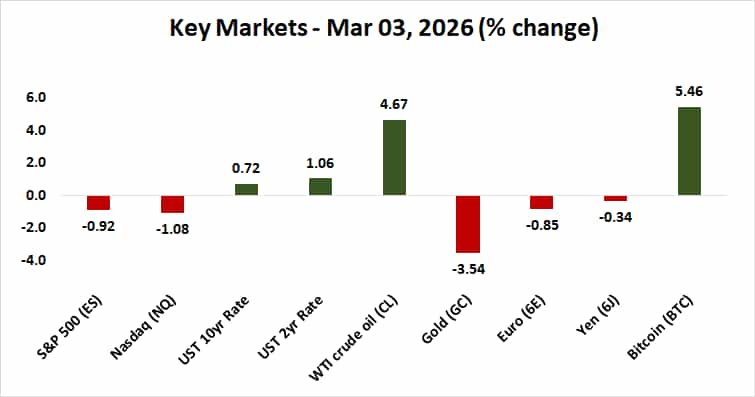
Gold posted a sharp decline despite churning geopolitical risk. It fell 4.39%, the most in a month. That seems unusual: the metal typically benefits from such instability. Investors find understandable appeal in a non-sovereign store of value when governments and financial systems are at risk of becoming entangled in conflict.
Meanwhile, Treasury bonds sold off while the US dollar rallied strongly for a second consecutive session. The greenback added 0.58% against an average of its major currency counterparts, closing at the highest level in six weeks.
US-Iran war: inflation fears taking center stage for markets?
Taken together, the combination of lower gold and bonds alongside a stronger dollar suggests markets may be increasingly focused on inflation and interest rate expectations rather than purely on geopolitical risk.
Crude oil appears to be the key transmission channel.
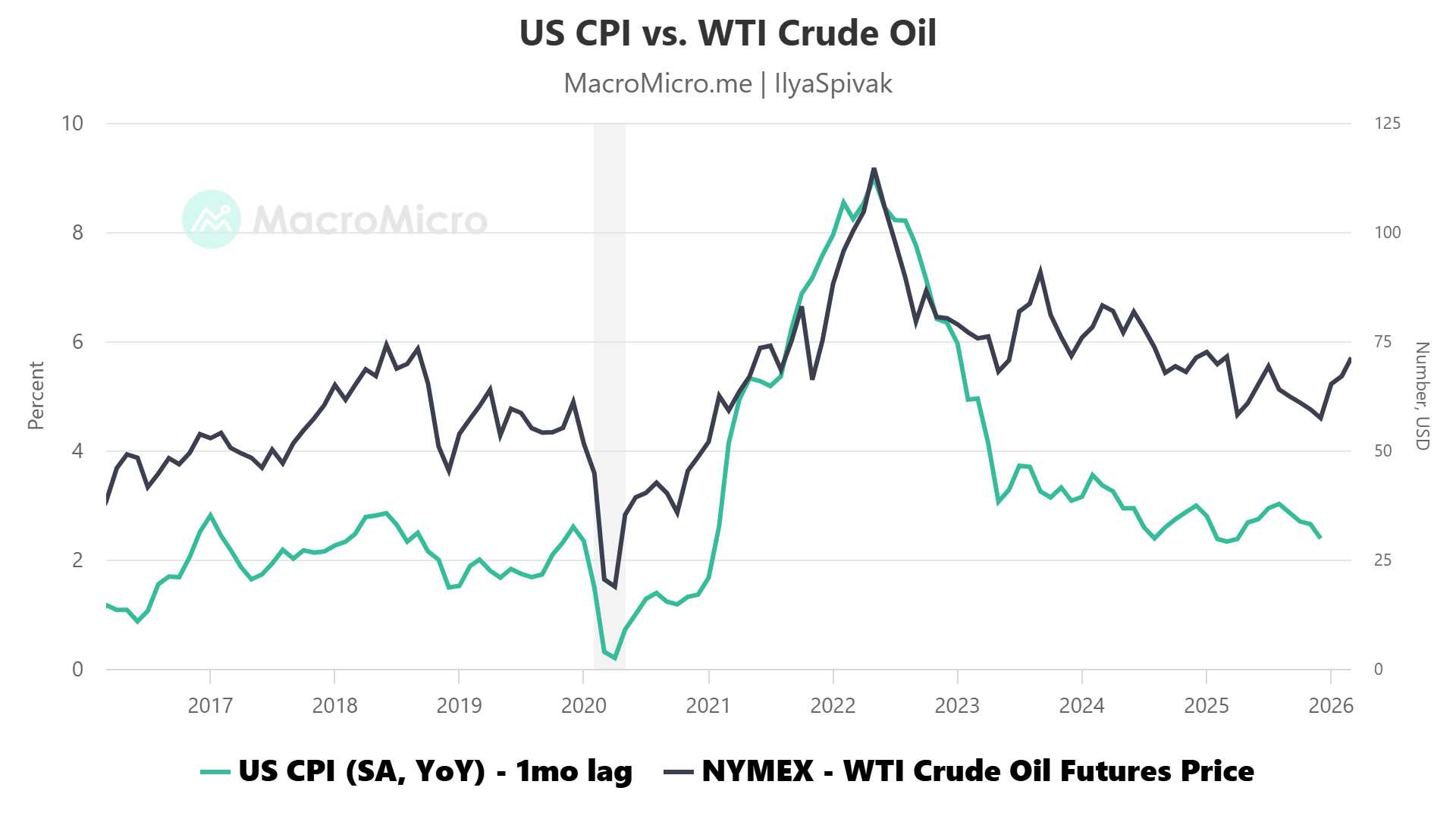
Prices have understandably surged since hostilities began and now appear to be breaking above a downtrend that had guided them since the second half of 2023. This week’s rally builds on a move already underway earlier this year as a popular uprising in Iran, enhanced enforcement against Russia’s so-called “shadow fleet” oil tankers, and US action in Venezuela began to cast doubt on expectations of a global supply glut.
China sits at the center of the story. As the world’s largest crude oil importer, it has relied heavily on discounted barrels from Russia, Iran and Venezuela. Disruptions to those flows could force Beijing to source more oil from producers such as Saudi Arabia, Iraq or Brazil at market prices, tightening inventories that were not positioned for the shift.
The inflation implications could follow quickly. Historically, moves in crude oil can take about a month to filter into headline US consumer price index (CPI) inflation readings. That is a troubling prospect for Federal Reserve policymakers and traders hoping the central bank will get back to cutting interest rates. Price growth is already running above the Fed’s 2% target, and officials have worried aloud about making sure it gets there.
ISM services PMI data: will it help or hurt Fed rate cut hopes?
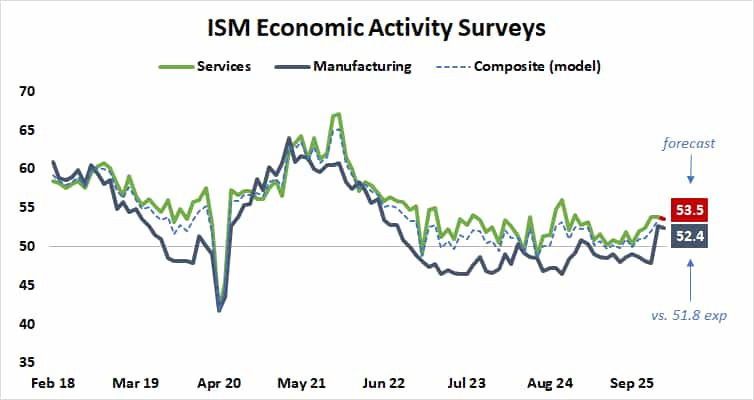
Recent economic data reinforces these concerns. Purchasing managers index (PMI) figures from the Institute of Supply Management (ISM) showed manufacturing sector activity rebounding strongly, with the first two months of the year marking the fastest pace of expansion since mid-2022. At the same time, the report’s prices-paid component jumped sharply, pointing to mounting cost pressures.
Markets nevertheless continue to price in substantial easing. Traders have priced in 43 basis points (bps) in rate cuts this year and 19bps for 2027. That amounts to a 72% chance of two standard-sized 25bps rate cuts in 2026 and a 76% chance of a third one to follow next year. That amounts to about one more rate cut than Fed officials penciled into their projections in December, and with a faster timeline to delivery.
Hawkish comments from Fed officials so far this year hint this divergence has probably become more pronounced. That seems to have put the brakes on Wall Street. Tellingly, the S&P 500 and the Nasdaq 100 have been mired in a choppy range since late October, when Fed Chair Jerome Powell warned investors against over-extrapolating rate-cut expectations.
The spotlight now turns to the service sector ISM report. It is expected to show that the pace of economic activity remained brisk in February after hitting a 12-month high in December and matching that feat in January. In that month’s report, this translated into the fastest price growth since October. Stock markets may face selling pressure while the dollar continues to build higher if the incoming report continues to point toward reflation.
Ilya Spivak, tastylive head of global macro, has over 15 years of experience in trading strategy, and he specializes in identifying thematic moves in currencies, commodities, interest rates and equities. He hosts Macro Money and co-hosts Overtime, Monday-Thursday. @Ilyaspivak
For live daily programming, market news and commentary, visit tastylive.com or @tastyliveshow on YouTube
Trade with a better broker, open a tastytrade account today. tastylive, Inc. and tastytrade, Inc. are separate but affiliated companies.
Options involve risk and are not suitable for all investors. Please read Characteristics and Risks of Standardized Options before deciding to invest in options.
tastylive content is created, produced, and provided solely by tastylive, Inc. (“tastylive”) and is for informational and educational purposes only. It is not, nor is it intended to be, trading or investment advice or a recommendation that any security, futures contract, digital asset, other product, transaction, or investment strategy is suitable for any person. Trading securities, futures products, and digital assets involve risk and may result in a loss greater than the original amount invested. tastylive, through its content, financial programming or otherwise, does not provide investment or financial advice or make investment recommendations. Investment information provided may not be appropriate for all investors and is provided without respect to individual investor financial sophistication, financial situation, investing time horizon or risk tolerance. tastylive is not in the business of transacting securities trades, nor does it direct client commodity accounts or give commodity trading advice tailored to any particular client’s situation or investment objectives. Supporting documentation for any claims (including claims made on behalf of options programs), comparisons, statistics, or other technical data, if applicable, will be supplied upon request. tastylive is not a licensed financial adviser, registered investment adviser, or a registered broker-dealer. Options, futures, and futures options are not suitable for all investors. Prior to trading securities, options, futures, or futures options, please read the applicable risk disclosures, including, but not limited to, the Characteristics and Risks of Standardized Options Disclosure and the Futures and Exchange-Traded Options Risk Disclosure found on tastytrade.com/disclosures.
tastytrade, Inc. ("tastytrade”) is a registered broker-dealer and member of FINRA, NFA, and SIPC. tastytrade was previously known as tastyworks, Inc. (“tastyworks”). tastytrade offers self-directed brokerage accounts to its customers. tastytrade does not give financial or trading advice, nor does it make investment recommendations. You alone are responsible for making your investment and trading decisions and for evaluating the merits and risks associated with the use of tastytrade’s systems, services or products. tastytrade is a wholly-owned subsidiary of tastylive, Inc.
tastytrade has entered into a Marketing Agreement with tastylive (“Marketing Agent”) whereby tastytrade pays compensation to Marketing Agent to recommend tastytrade’s brokerage services. The existence of this Marketing Agreement should not be deemed as an endorsement or recommendation of Marketing Agent by tastytrade. tastytrade and Marketing Agent are separate entities with their own products and services. tastylive is the parent company of tastytrade.
tastyfx, LLC (“tastyfx”) is a Commodity Futures Trading Commission (“CFTC”) registered Retail Foreign Exchange Dealer (RFED) and Introducing Broker (IB) and Forex Dealer Member (FDM) of the National Futures Association (“NFA”) (NFA ID 0509630). Leveraged trading in foreign currency or off-exchange products on margin carries significant risk and may not be suitable for all investors. We advise you to carefully consider whether trading is appropriate for you based on your personal circumstances as you may lose more than you invest.
tastycrypto is provided solely by tasty Software Solutions, LLC. tasty Software Solutions, LLC is a separate but affiliate company of tastylive, Inc. Neither tastylive nor any of its affiliates are responsible for the products or services provided by tasty Software Solutions, LLC. Cryptocurrency trading is not suitable for all investors due to the number of risks involved. The value of any cryptocurrency, including digital assets pegged to fiat currency, commodities, or any other asset, may go to zero.
© copyright 2013 - 2026 tastylive, Inc. All Rights Reserved. Applicable portions of the Terms of Use on tastylive.com apply. Reproduction, adaptation, distribution, public display, exhibition for profit, or storage in any electronic storage media in whole or in part is prohibited under penalty of law, provided that you may download tastylive’s podcasts as necessary to view for personal use. tastylive was previously known as tastytrade, Inc. tastylive is a trademark/servicemark owned by tastylive, Inc.
Your privacy choices