Stock Market at Risk: Spooky Signals in Bonds and Gold Prices

Stock Market at Risk: Spooky Signals in Bonds and Gold Prices
By:Ilya Spivak
Jumping oil prices should be lifting yields and the dollar and sinking gold. None of it is happening, and stock markets should be worried.
- Crude oil jumped on renewed US-Iran fighting, yet bonds, gold, and the dollar refused to trade the usual “war trade” script
- Inflation is cooling in tandem across the US, Canada, and the UK. That could say more about softening demand than just a fading oil price shock
- This week’s S&P Global PMI surveys may reveal whether a broad cyclical turn in the economy is taking hold
The bellwether S&P 500 spent Monday’s session trying to rebound and never managed it, erasing intraday gains to land where it started after a downside gap at the weekly trading open. The tech-heavy Nasdaq 100 looked weaker still, challenging six-week range support. For now, price action seems to reflect lost conviction, an inability to muster a rally more than a determined selloff. A more telling signal appears in markets outside equities, however, where traders are refusing to follow a familiar script.
A war trade that no longer works
Crude oil gapped higher to start the week as US-Iran hostilities flared again, and by the old playbook that should have rippled outward in a familiar way: higher oil means higher inflation, higher rates, and a risk-off scramble that lifts the dollar and sinks gold. That is exactly how markets traded the conflict in its opening weeks.
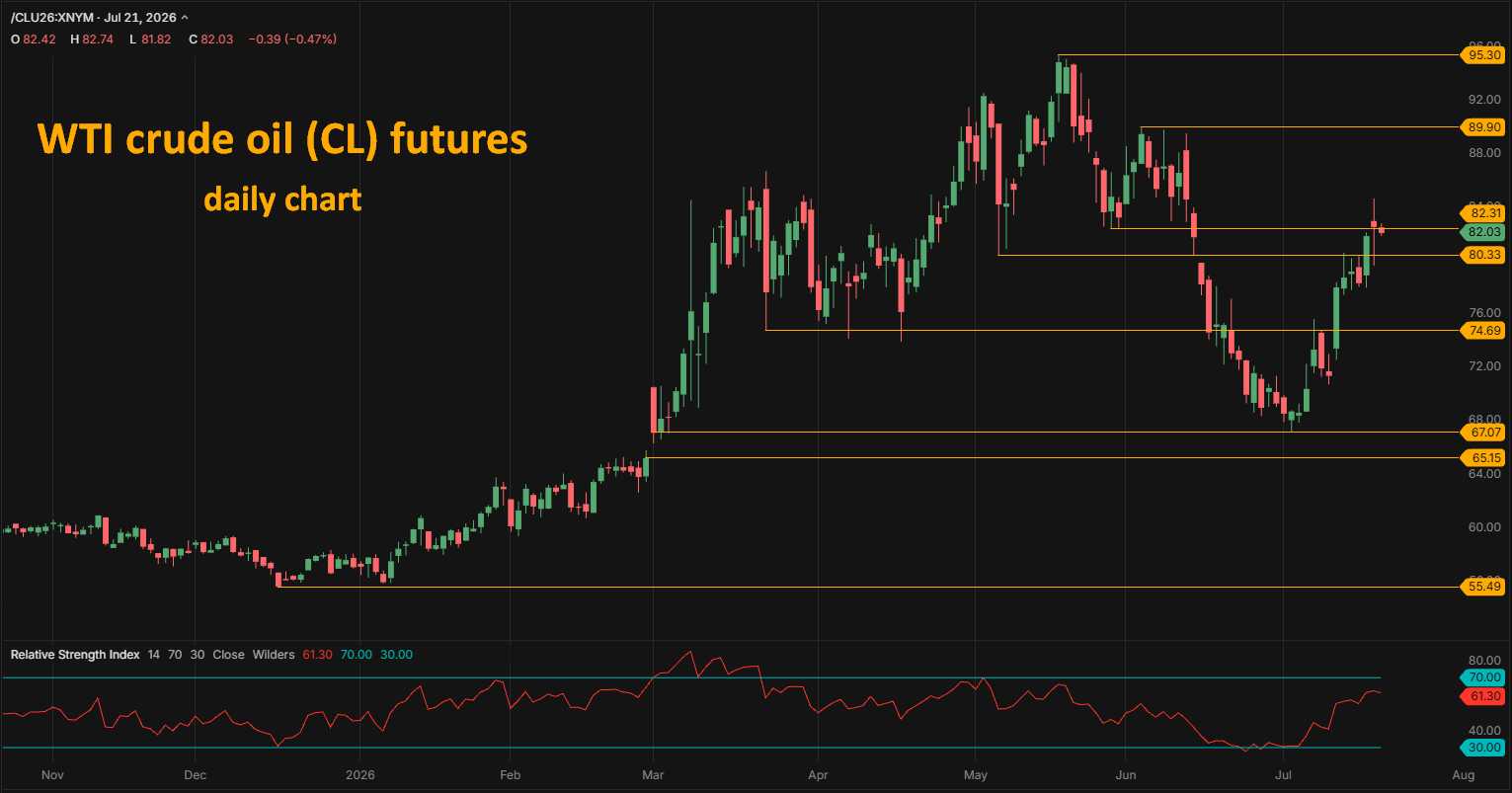
This time that transmission looked broken. Treasury bonds softened slightly but pointedly held the base they have been building since mid-May. Gold, which should be a prime casualty of a fresh inflation scare, eked out a broadly flat result. And the US dollar could not rally with conviction, struggling to retake the uptrend from early May that it broke last week. Oil is climbing, yet the assets that only recently moved in lockstep with it are now looking conspicuously unmoored.
Cooling inflation goes global
That may be because signs of an economic slowdown are starting to multiply, and the evidence is turning up well beyond the US. After US consumer and producer prices both fell month-on-month in June, Canadian inflation cooled to 2.8% year-on-year from 3.2%, the first annual decline since February, as prices fell 0.4% on the month. UK inflation is expected to ease this week as well, and Australian hiring is seen slowing sharply. A synchronized cooldown across multiple economies may point to a turn in the global business cycle and not just the passing effect of an energy shock.
An economy running on the wrong engine
The US has not tipped over yet, but its growth is built on a fragile foundation. First-quarter gross domestic product (GDP) rose 2.1%, and almost all of it came from business investment growing at a blistering annualized rate over 10% amid the AI data center boom, while consumption – 68% of the economy against investment’s 14% – barely contributed. The last two times the consumer chipped in this little, in the first quarters of 2022 and 2025, the economy was outright shrinking.
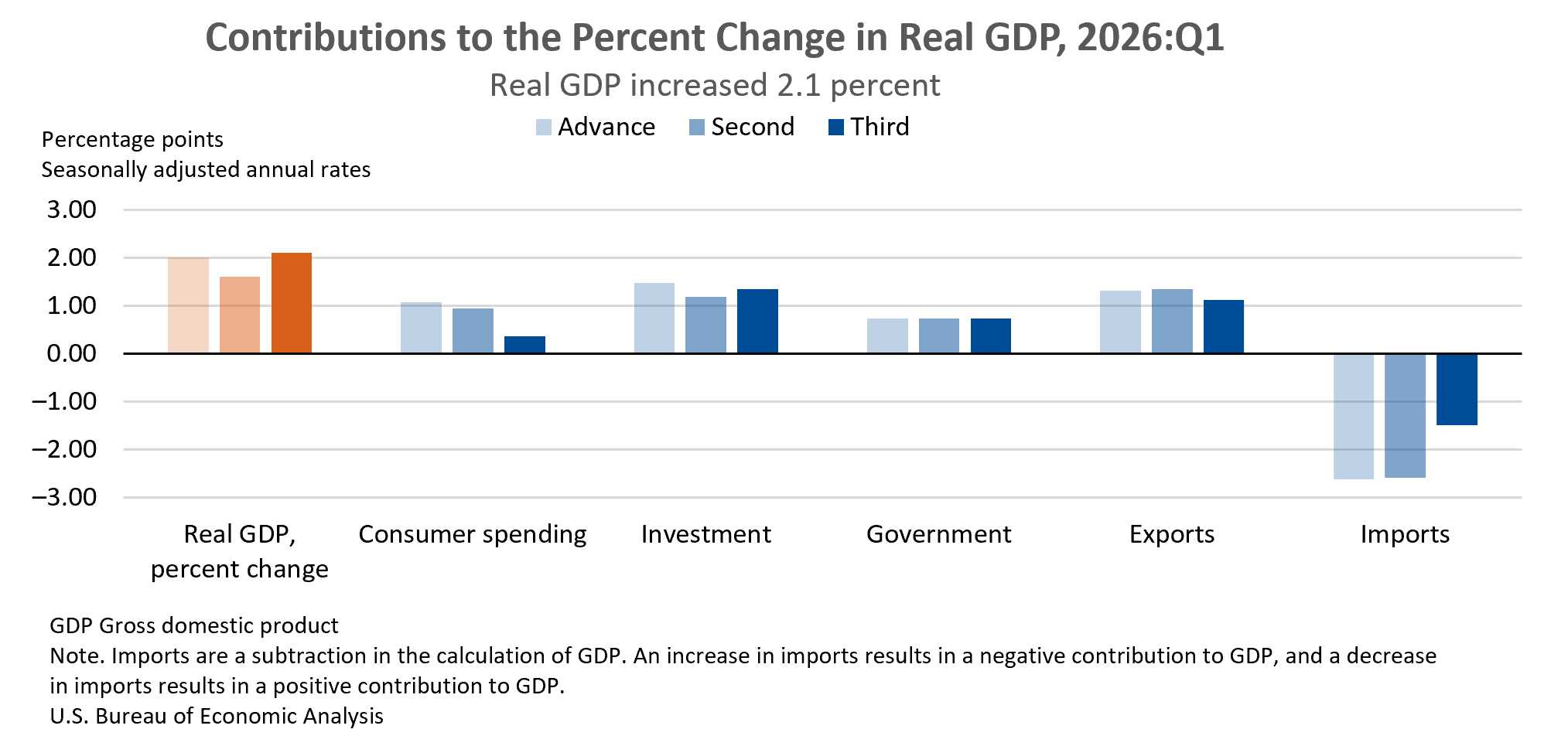
That is an inherently unstable arrangement, because spinning so small an engine fast enough to carry the economy stokes inflation, which then squeezes the consumers that the economy ultimately depends on. Since consumption dwarfs investment by nearly five times, even a modest further pullback by households could overwhelm the investment boom and drag growth into reverse.
The strain is already showing: the Atlanta Fed’s GDPNow model pegs second-quarter growth at just 1.7%, down from the first quarter and steadily deteriorating as fresh data arrives. The template is visible abroad. June’s S&P Global purchasing managers index (PMI) surveys, which showed the economies of Australia, the Eurozone, and the UK stalling or shrinking, hobbled by weakness in their consumer-powered service sectors even as manufacturing continued to benefit from global AI tailwinds.
What July’s PMI data — and the yen — could trigger
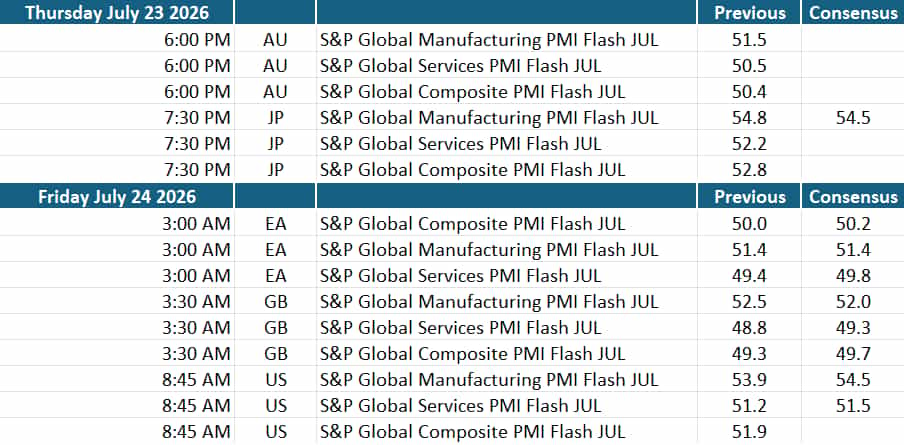
That may explain why Fed rate-hike expectations have barely budged even as crude climbs. Markets still lean toward a single hike this year but refuse to extrapolate further. They might be judging the economy too fragile to withstand aggressive tightening. The end of the week brings a read on the global business cycle by way of July’s PMI updates for Australia, Japan, the Eurozone, the UK, and the US. Soft outcomes may harden the case that slowdown fears are overtaking the geopolitics of oil as the story in focus.
Lurking beneath it all is Japan. The yen sits at its weakest since the mid-1980s, yet the Bank of Japan is still expected to raise rates as domestic inflation firms, an outlier among major central banks. That matters because the perennially low-yielding yen has helped finance the global risk rally: investors borrow in the currency on the cheap and buy higher-returning assets, the AI trade among them.
If growth fears fuel a risk-off turn in markets while Japanese inflation continues to climb, that carry trade could start to unwind, lifting the yen and pulling money out of crowded positions all at once. For a stock market trying to cling to an AI-inspired uptrend even as that story shows signs of exhaustion, that could amount to the straw that breaks the rally’s back. Crude oil remains on a path defined by geopolitics, but the broader markets seem increasingly convinced that growth is becoming a more urgent story, and the PMI data may see that conviction strengthen.
Ilya Spivak, tastylive Head of Global Macro, has over 15 years of experience in trading strategy. He specializes in identifying thematic moves in currencies, commodities, interest rates and equities. He hosts Macro Money and co-hosts Overtime, Monday-Thursday. @Ilyaspivak
For live daily programming, market news and commentary, visit tastylive.com or @tastyliveshow on YouTube
Trade with a better broker, open a tastytrade account today. tastylive, Inc. and tastytrade, Inc. are separate but affiliated companies.
Options involve risk and are not suitable for all investors. Please read Characteristics and Risks of Standardized Options before deciding to invest in options.
tastylive content is created, produced, and provided solely by tastylive, Inc. (“tastylive”) and is for informational and educational purposes only. It is not, nor is it intended to be, trading or investment advice or a recommendation that any security, futures contract, digital asset, other product, transaction, or investment strategy is suitable for any person. Trading securities, futures products, and digital assets involve risk and may result in a loss greater than the original amount invested. tastylive, through its content, financial programming or otherwise, does not provide investment or financial advice or make investment recommendations. Investment information provided may not be appropriate for all investors and is provided without respect to individual investor financial sophistication, financial situation, investing time horizon or risk tolerance. tastylive is not in the business of transacting securities trades, nor does it direct client commodity accounts or give commodity trading advice tailored to any particular client’s situation or investment objectives. Supporting documentation for any claims (including claims made on behalf of options programs), comparisons, statistics, or other technical data, if applicable, will be supplied upon request. tastylive is not a licensed financial adviser, registered investment adviser, or a registered broker-dealer. Options, futures, and futures options are not suitable for all investors. Prior to trading securities, options, futures, or futures options, please read the applicable risk disclosures, including, but not limited to, the Characteristics and Risks of Standardized Options Disclosure and the Futures and Exchange-Traded Options Risk Disclosure found on tastytrade.com/disclosures.
tastytrade, Inc. ("tastytrade”) is a registered broker-dealer and member of FINRA, NFA, and SIPC. tastytrade was previously known as tastyworks, Inc. (“tastyworks”). tastytrade offers self-directed brokerage accounts to its customers. tastytrade does not give financial or trading advice, nor does it make investment recommendations. You alone are responsible for making your investment and trading decisions and for evaluating the merits and risks associated with the use of tastytrade’s systems, services or products. tastytrade is a wholly-owned subsidiary of tastylive, Inc.
tastytrade has entered into a Marketing Agreement with tastylive (“Marketing Agent”) whereby tastytrade pays compensation to Marketing Agent to recommend tastytrade’s brokerage services. The existence of this Marketing Agreement should not be deemed as an endorsement or recommendation of Marketing Agent by tastytrade. tastytrade and Marketing Agent are separate entities with their own products and services. tastylive is the parent company of tastytrade.
tastyfx, LLC (“tastyfx”) is a Commodity Futures Trading Commission (“CFTC”) registered Retail Foreign Exchange Dealer (RFED) and Introducing Broker (IB) and Forex Dealer Member (FDM) of the National Futures Association (“NFA”) (NFA ID 0509630). Leveraged trading in foreign currency or off-exchange products on margin carries significant risk and may not be suitable for all investors. We advise you to carefully consider whether trading is appropriate for you based on your personal circumstances as you may lose more than you invest.
tastycrypto is provided solely by tasty Software Solutions, LLC. tasty Software Solutions, LLC is a separate but affiliate company of tastylive, Inc. Neither tastylive nor any of its affiliates are responsible for the products or services provided by tasty Software Solutions, LLC. Cryptocurrency trading is not suitable for all investors due to the number of risks involved. The value of any cryptocurrency, including digital assets pegged to fiat currency, commodities, or any other asset, may go to zero.
© copyright 2013 - 2026 tastylive, Inc. All Rights Reserved. Applicable portions of the Terms of Use on tastylive.com apply. Reproduction, adaptation, distribution, public display, exhibition for profit, or storage in any electronic storage media in whole or in part is prohibited under penalty of law, provided that you may download tastylive’s podcasts as necessary to view for personal use. tastylive was previously known as tastytrade, Inc. tastylive is a trademark/servicemark owned by tastylive, Inc.
Your privacy choices