Stock Markets in Trouble: Is the AI Frenzy Turning on Wall Street?

Stock Markets in Trouble: Is the AI Frenzy Turning on Wall Street?
By:Ilya Spivak
Stock markets are suddenly shuddering at meaty AI buildout plans as real interest rates surge, threatening to crush the economy.
- Stock markets plunged, led lower by tech names, after Alphabet pledged even more capex than previously
- Surging real interest rates may mean that Wall Street now sees the AI buildout as a problem for economic growth
- Gold prices are warning that the economy is already wounded critically, forcing a broad rethink of asset prices across global markets
Stocks took a beating as the artificial intelligence (AI) buildout frenzy that helped propel prices to dizzying heights this year turned inward, creating a negative feedback loop for markets in the same way it previously drove them upward. The bellwether S&P 500 suffered its biggest one-day loss in a month. The Nasdaq 100 erased all of its upward progress from the early days of May as the heretofore darlings of the tech sector led the way lower.
The selloff followed the market’s negative response to seemingly solid earnings from Alphabet (GOOGL), the first of the top AI “hyperscalers” to deliver results this reporting season. The company delivered earnings per share (EPS) of $9.11, topping the median forecast of $2.91 by over 200%. It also raised its capex forecast to a range of $195-$205 billion for the year, up from $190 billion previously. The stock fell almost immediately after the report hit in afterhours trade, then lost another 7.13% in regular hours.
Stocks are suddenly unhappy with the AI boom
In April, stock markets enthusiastically embraced such news as they attempted to shake off the shock of the US-Iran war, after the two sides agreed to what would be the first of many ceasefire attempts. Wild-eyed promises of lavish spending on AI infrastructure were taken as permission to launch a near-vertical rally in chipmaking stocks, which then pulled broader markets higher in a way that seemed to ignore geopolitics.
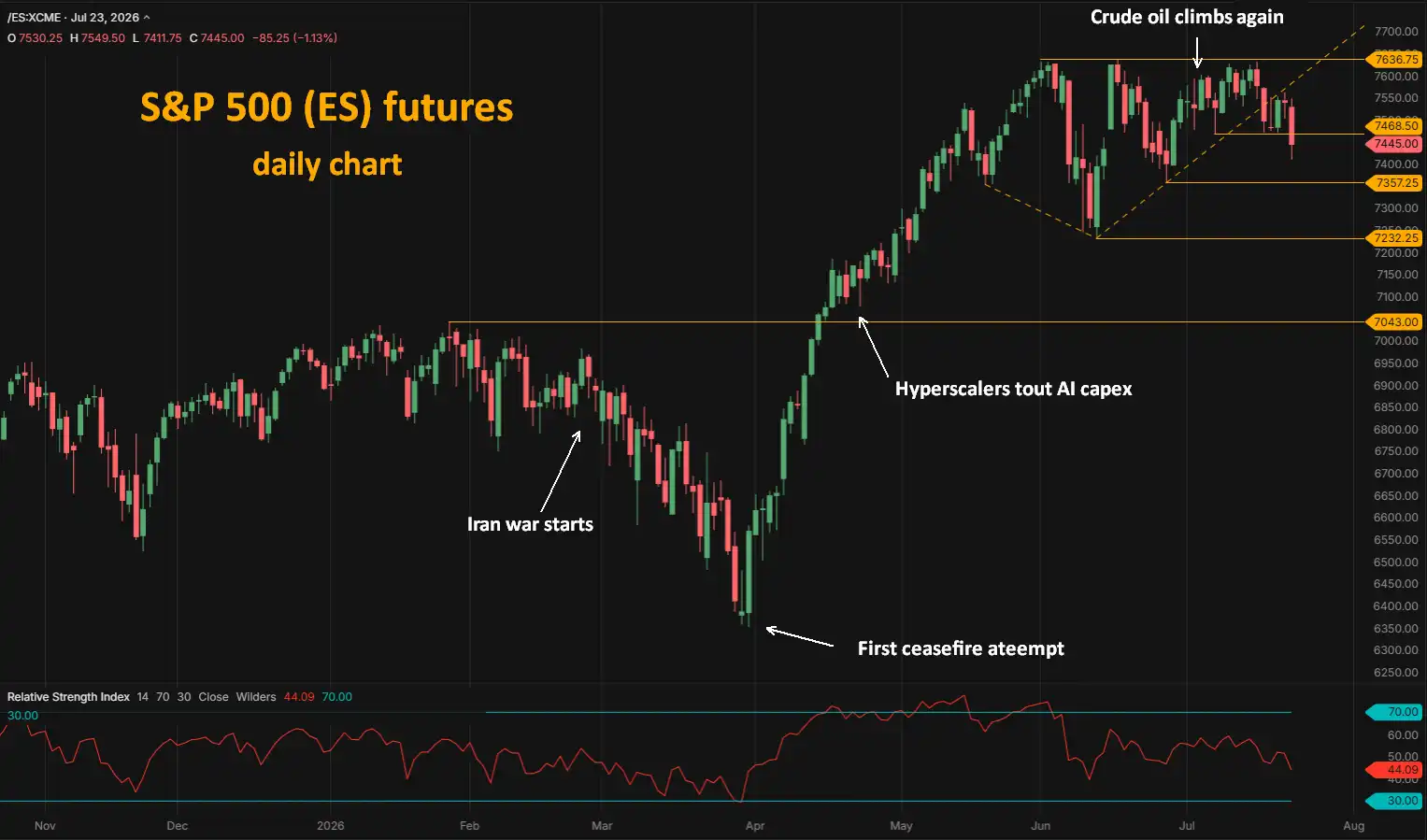
The working explanation for why this has suddenly inverted – as channeled from trading desks through the financial media – posits that capex projections have been dialed up so much that markets cannot help but question the return on investment this largesse can earn. However, concerns about overbuilding amid the AI boom have been voiced loudly from many corners and for many months, and they were roundly ignored by markets. The critical question is why they seem to have started caring now.
When stock markets embarked on their chip stocks binge, they seemed to break away from a synchronized “war trade” playing out across the major assets. When the US-Iran war began in late February, traders interpreted the spike in crude oil prices that it triggered in terms of the inflation threat to follow. Central banks could not make good on rate cut plans in such a world, they reasoned. Stocks, bonds, and gold prices fell in tandem while yields surged alongside the US dollar. News of the first ceasefire attempt triggered reversals across all of these moves in concert.
AI and the inflation trade: one and the same?
When stocks wandered off to the upside, the other major markets seemed to return to the “war trade” normal. Treasury bonds and gold prices fell anew and the dollar rose as markets repriced for the Federal Reserve to hike interest rates at least once before year-end. This made it seem like the AI and the inflation themes were separate, when they are in fact intimately linked.
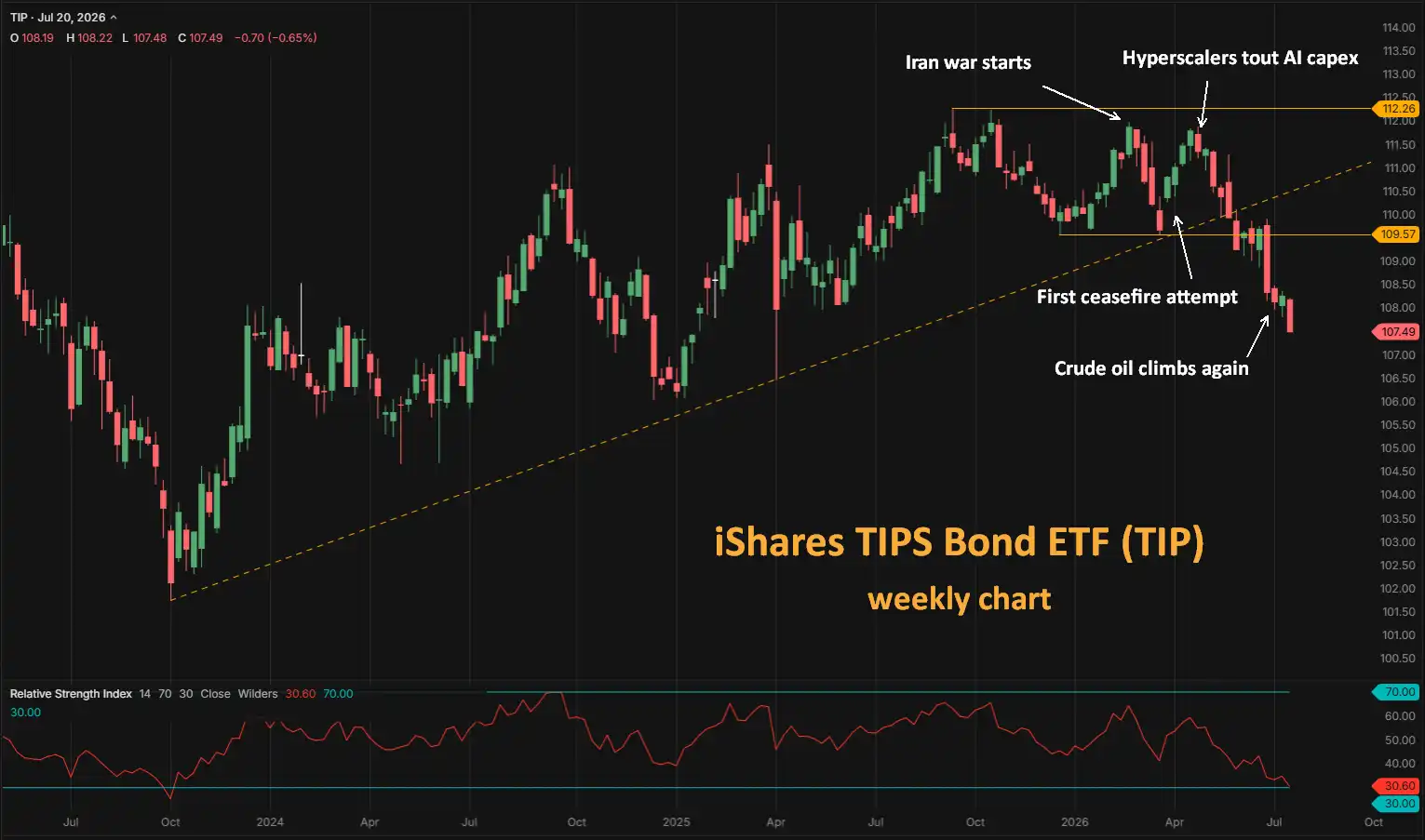
The hyperscalers’ mythmaking triggered a sharp rise in real interest rates. After all, the promise of dumping some $750 billion on the already white-hot AI buildout might understandably bring markets to demand inflation compensation. No wonder bonds and gold sold off as nominal rates marched relentlessly upward while stocks soared to record highs. When oil subsequently fell to pre-war levels amid a flurry of peacemaking, the give-back in the inflation trade was only modest.
As crude now rallies back to a two-month-high after Yemen’s Houthis joined the fray on behalf of their Iranian patron, breakeven inflation expectations priced into Treasuries are staying pinned near the lows for the year. Meanwhile, Alphabet’s promise of still more generous capex outlays spurred another sharp jump in real rates. The iShares TIPS Bond ETF (TIP) tracking a basket of inflation-protected Treasuries fell to a 16-month low.
Beware the gold market’s warning
That this is a problem for Wall Street is – in fact – not new. The S&P 500 and Nasdaq have languished in choppy sideways range since early June. That is the same time that the TIPS bonds ETF broke down from a nearly three-year uptrend dating back to October 2023. The depths of its recent weakness point to the highest real rates since April last year, when President Donald Trump’s tariff regime rollout caused a panic in the bond market and forced the administration to quickly backpedal.
That is a heavy burden on consumers at a time when they already look anemic. The prior two times that households contributed as little to gross domestic product (GDP) growth as they did in the first quarter – in the first three months of 2022 and 2025 – the economy shrank. The difference-marker this time was the blistering AI buildout, but if the heat from that churn is driving up the real cost of borrowing, then it is self-defeating. Households are five times larger than business investment as a share of the economy. Even a mild retrenchment there threatens to be overwhelming on the downside for the whole.
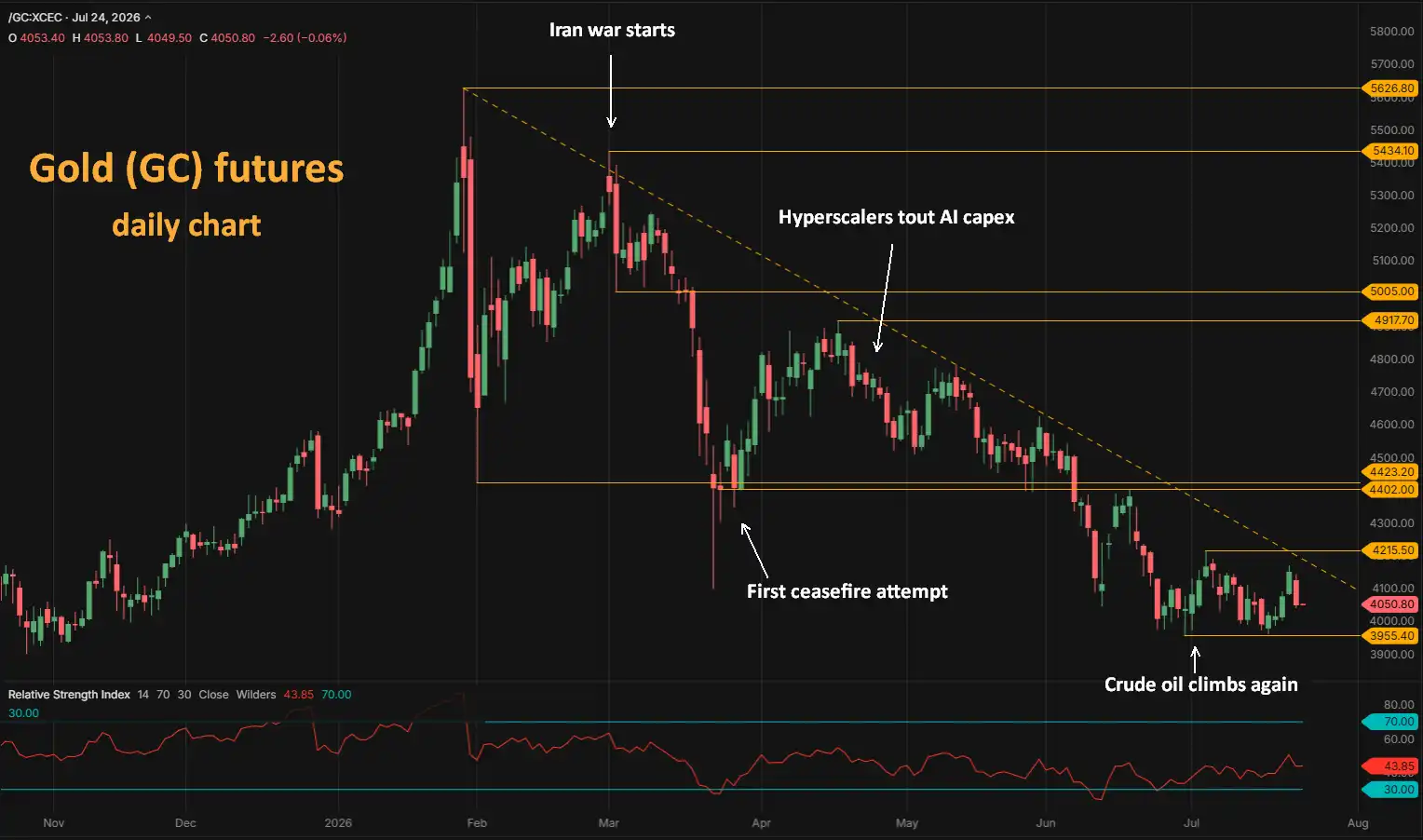
Gold prices are the last piece of the puzzle. They are pointedly refusing to sell off with conviction despite soaring real rates – typically toxic for the non-yielding metal – and opting to spend July oscillating in a narrow range instead. This may be a tell that the economy is already wounded critically. The Atlanta Fed’s GDPNow model puts second-quarter growth at 1.7%, down from 2.1% previously. Most strikingly, incoming economic data flow has pushed the “nowcast” steadily lower for three months, from well above 3% at the start of May.
Against this backdrop, heady AI capex plans seem like more heat fueling real interest rates’ trek higher, transforming them from a source of optimism to one of worry as de-facto tightening chokes off growth. Stocks may continue to suffer as markets quiver at the implications, but bonds may suddenly snap higher alongside gold while the US dollar drops if mounting economic pressure tells the markets to unwind rate hike speculation.
Ilya Spivak, tastylive Head of Global Macro, has over 15 years of experience in trading strategy. He specializes in identifying thematic moves in currencies, commodities, interest rates and equities. He hosts Macro Money and co-hosts Overtime, Monday-Thursday. @Ilyaspivak
For live daily programming, market news and commentary, visit tastylive.com or @tastyliveshow on YouTube
Trade with a better broker, open a tastytrade account today. tastylive, Inc. and tastytrade, Inc. are separate but affiliated companies.
Options involve risk and are not suitable for all investors. Please read Characteristics and Risks of Standardized Options before deciding to invest in options.
tastylive content is created, produced, and provided solely by tastylive, Inc. (“tastylive”) and is for informational and educational purposes only. It is not, nor is it intended to be, trading or investment advice or a recommendation that any security, futures contract, digital asset, other product, transaction, or investment strategy is suitable for any person. Trading securities, futures products, and digital assets involve risk and may result in a loss greater than the original amount invested. tastylive, through its content, financial programming or otherwise, does not provide investment or financial advice or make investment recommendations. Investment information provided may not be appropriate for all investors and is provided without respect to individual investor financial sophistication, financial situation, investing time horizon or risk tolerance. tastylive is not in the business of transacting securities trades, nor does it direct client commodity accounts or give commodity trading advice tailored to any particular client’s situation or investment objectives. Supporting documentation for any claims (including claims made on behalf of options programs), comparisons, statistics, or other technical data, if applicable, will be supplied upon request. tastylive is not a licensed financial adviser, registered investment adviser, or a registered broker-dealer. Options, futures, and futures options are not suitable for all investors. Prior to trading securities, options, futures, or futures options, please read the applicable risk disclosures, including, but not limited to, the Characteristics and Risks of Standardized Options Disclosure and the Futures and Exchange-Traded Options Risk Disclosure found on tastytrade.com/disclosures.
tastytrade, Inc. ("tastytrade”) is a registered broker-dealer and member of FINRA, NFA, and SIPC. tastytrade was previously known as tastyworks, Inc. (“tastyworks”). tastytrade offers self-directed brokerage accounts to its customers. tastytrade does not give financial or trading advice, nor does it make investment recommendations. You alone are responsible for making your investment and trading decisions and for evaluating the merits and risks associated with the use of tastytrade’s systems, services or products. tastytrade is a wholly-owned subsidiary of tastylive, Inc.
tastytrade has entered into a Marketing Agreement with tastylive (“Marketing Agent”) whereby tastytrade pays compensation to Marketing Agent to recommend tastytrade’s brokerage services. The existence of this Marketing Agreement should not be deemed as an endorsement or recommendation of Marketing Agent by tastytrade. tastytrade and Marketing Agent are separate entities with their own products and services. tastylive is the parent company of tastytrade.
tastyfx, LLC (“tastyfx”) is a Commodity Futures Trading Commission (“CFTC”) registered Retail Foreign Exchange Dealer (RFED) and Introducing Broker (IB) and Forex Dealer Member (FDM) of the National Futures Association (“NFA”) (NFA ID 0509630). Leveraged trading in foreign currency or off-exchange products on margin carries significant risk and may not be suitable for all investors. We advise you to carefully consider whether trading is appropriate for you based on your personal circumstances as you may lose more than you invest.
tastycrypto is provided solely by tasty Software Solutions, LLC. tasty Software Solutions, LLC is a separate but affiliate company of tastylive, Inc. Neither tastylive nor any of its affiliates are responsible for the products or services provided by tasty Software Solutions, LLC. Cryptocurrency trading is not suitable for all investors due to the number of risks involved. The value of any cryptocurrency, including digital assets pegged to fiat currency, commodities, or any other asset, may go to zero.
© copyright 2013 - 2026 tastylive, Inc. All Rights Reserved. Applicable portions of the Terms of Use on tastylive.com apply. Reproduction, adaptation, distribution, public display, exhibition for profit, or storage in any electronic storage media in whole or in part is prohibited under penalty of law, provided that you may download tastylive’s podcasts as necessary to view for personal use. tastylive was previously known as tastytrade, Inc. tastylive is a trademark/servicemark owned by tastylive, Inc.
Your privacy choices