Stocks and Gold Faked Out This Week. What’s the Market Saying?

Stocks and Gold Faked Out This Week. What’s the Market Saying?
By:Ilya Spivak
Stocks gave up their breakout, gold undid its breakdown, and Treasury bonds surged amid worries about OpenAI’s revenue. Is the AI trade losing its grip?
- The S&P 500 erased its breakout to a record high after a report that OpenAI may earn less than expected
- Long-term Treasury yields fell sharply, seemingly as the AI stumble eased pressure on borrowing markets
- US consumer confidence data is in focus as markets bet on 50bps more in Fed rate hikes than officials will own
Two of this week’s biggest market breaks did not stick. The S&P 500 pushed to a record high early in the week, then slipped back into its prior range. Gold looked like it had broken below a short-term range floor, but it has now reclaimed lost ground.
The stock market’s stumble followed a Financial Times (FT) report that OpenAI may bring in roughly $50 billion in revenue, short of the $70 billion or so previously expected. By the standards of the AI boom, a $20 billion shortfall is modest. Hyperscalers have committed hundreds of billions of dollars to capital spending, and markets have long tolerated that the leading AI developers at the center of the ecosystem are not yet profitable. That a relatively small revision moved markets may say more about how fragile sentiment has become than about OpenAI itself. The tech-heavy Nasdaq 100 looked shaky too, though it has held support for now.
Bonds rallied as the AI trade stumbled
A more striking shift came in the bond market. Long-term Treasuries staged a spirited rally, interrupting a slide that began with the US-Iran war in late February and resumed with a fresh leg lower in late September. Yields fell accordingly.
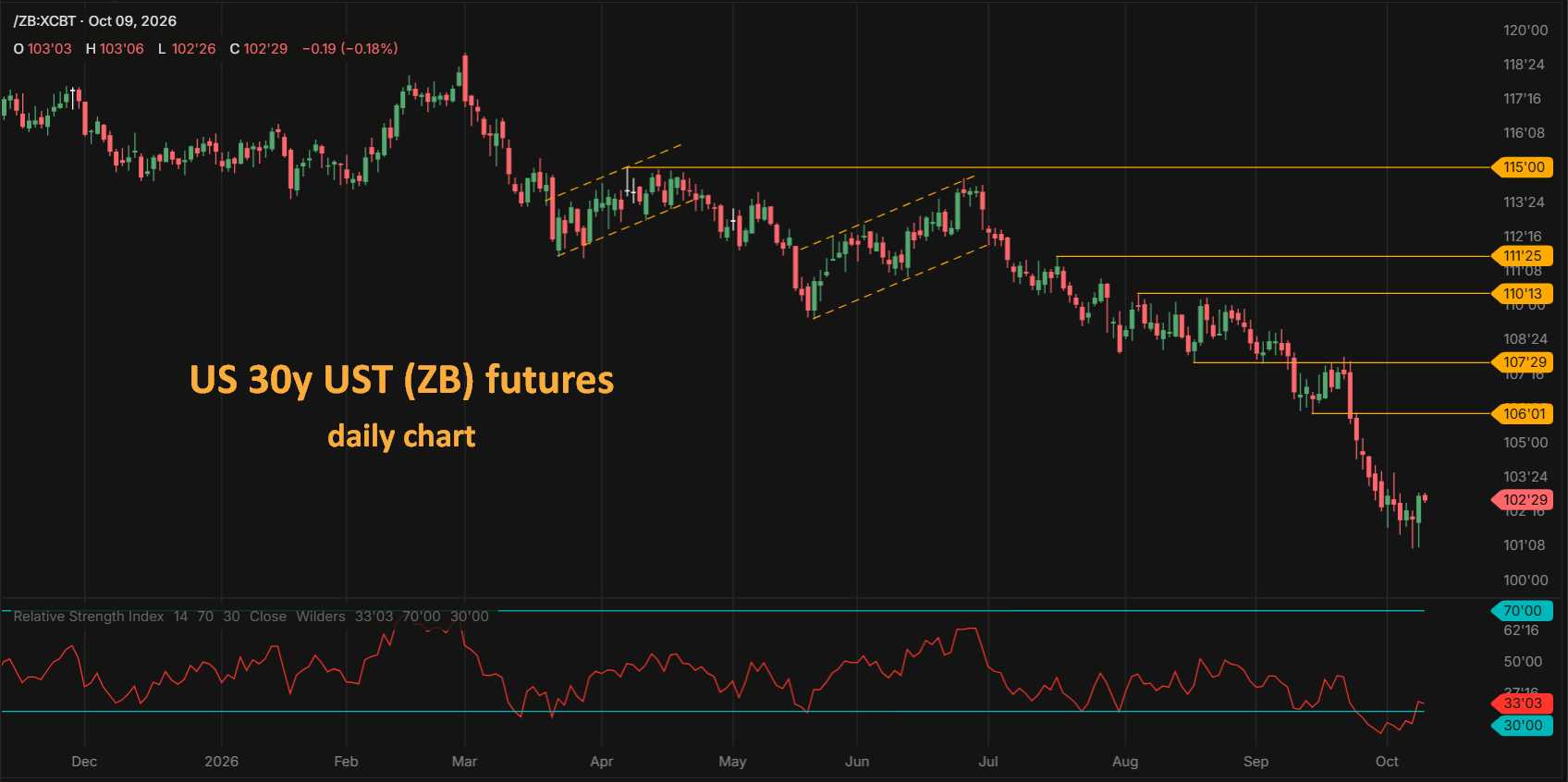
The usual suspects do not seem to explain it. Crude oil edged higher within its recent range, dismissing an easing of wartime inflation fears as a catalyst. Growth fears are an unlikely culprit too. The small-cap Russell 2000, which has sunk alongside rising two-year yields since Fed Chair Kevin Warsh’s hawkish speech at the Jackson Hole symposium in August, held up comparatively well. The US dollar barely moved, even against a euro facing renewed sovereign bond stress, suggesting Fed policy expectations were not the driver either.
One explanation ties the move to the AI trade itself. Long-term borrowing costs have been climbing relentlessly in the US and globally as governments running expansive fiscal policies compete for funds with hyperscalers raising money for the AI buildout. Both draw on the same pool of savings at enormous scale, straining the supply of loanable funds in a way that pushes yields higher. If enthusiasm for the buildout cools, some of that pressure may ease. The bond rally tellingly arrived alongside the FT’s OpenAI report.
That would make this a sentiment-first story, and other markets seem to agree. Silver, which is more sensitive to risk appetite than gold, looks to be breaking lower despite the drop in yields, while gold is holding up better. Bitcoin turned lower and is testing support.
What happens to stocks if the AI cushion wears thin?
Tech has been doing the heavy lifting. Since mid-August, the Invesco S&P 500 Equal Weight ETF (RSP) and the ProShares S&P 500 Ex-Technology ETF (SPXT) have tracked the Russell lower as front-end yields climbed. The headline S&P 500 and Nasdaq 100 have held up largely because of tech.
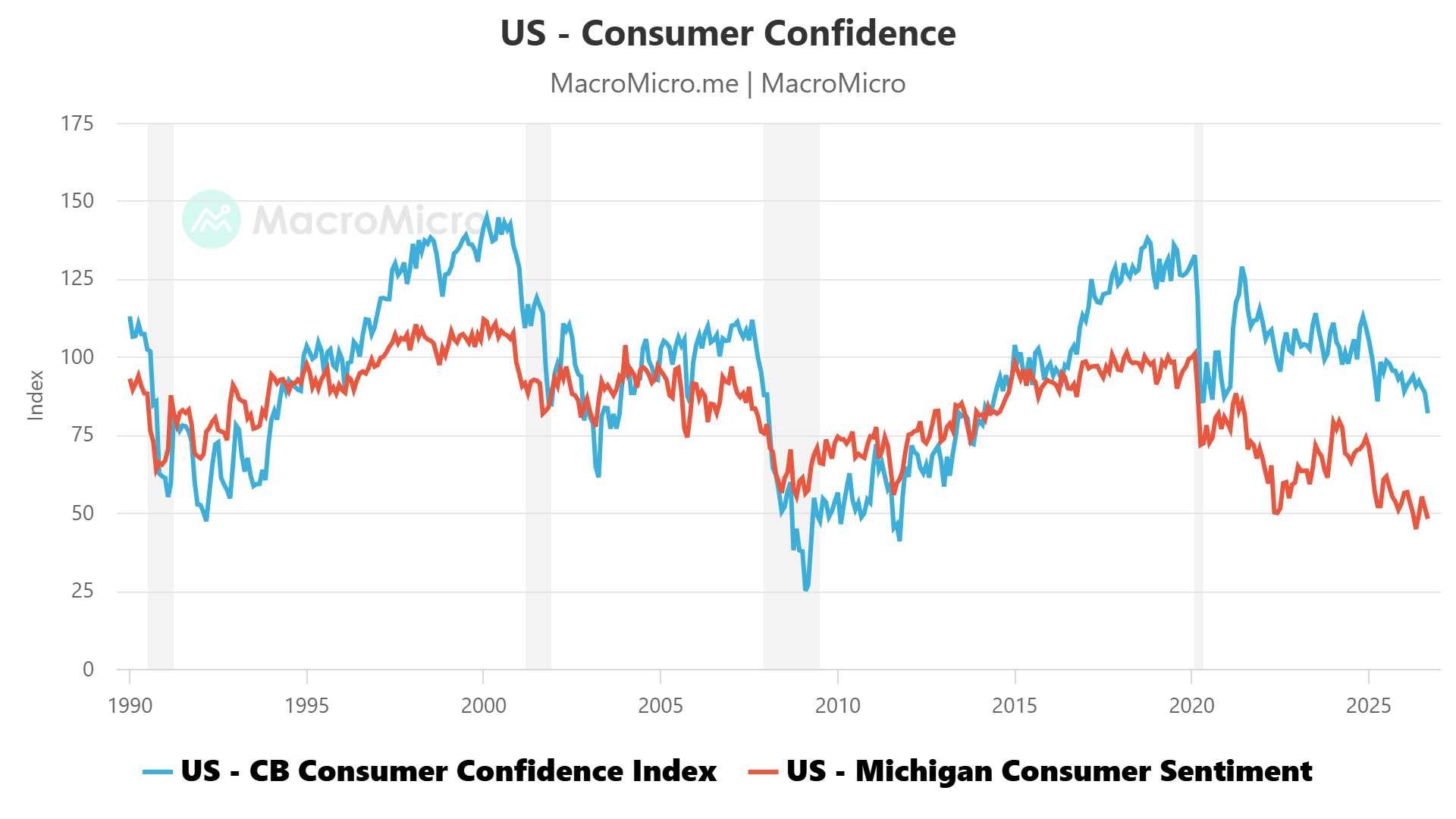
That maps onto an economy where the AI buildout is offsetting an increasingly pessimistic consumer. Household spending accounts for roughly 68% of US economic output, while nonresidential business investment, where the AI buildout lives, is about 14%. If the larger part retrenches, AI spending would have to grow very fast to compensate. The outsized reaction to the OpenAI report hints that markets may have overestimated how far it can.
The data point toward a softer economy. The University of Michigan’s consumer sentiment index is expected to slip to 47.6 from 48.1 on Friday, which would be the second-lowest reading since May’s record low of 44.8. The Conference Board’s gauge fell to its weakest since 2014 last week, and the Atlanta Fed’s GDPNow model ticked lower again in its latest revision. Meanwhile, three-month annualized inflation in the personal consumption expenditures (PCE) price index, the Fed’s preferred gauge, is already at the 2% target, and the smoother six-month rate has been easing. Consumer and producer price index (CPI and PPI) data arrive next week.
Markets still lean hawkish. Fed funds futures put the odds of no change in October at 82% and fully price a 25-basis-point (bps) hike in December, in line with the Fed’s projections and the minutes from its September meeting. For 2027, traders price another hike by March and one more by September, a full 50bps more than the Fed projects.
If weakening confidence pushes markets to concede that the Fed is right about 2027 because the economy is turning, just as the AI cushion thins, that retreat from rate hike bets would offer stocks little comfort, pointing to a cyclical threat to earnings.
Ilya Spivak, tastylive Head of Global Macro, has over 15 years of experience in trading strategy. He specializes in identifying thematic moves in currencies, commodities, interest rates and equities. He hosts Macro Money and co-hosts Overtime, Monday-Thursday. @Ilyaspivak
For live daily programming, market news and commentary, visit tastylive.com or @tastyliveshow on YouTube
Trade with a better broker, open a tastytrade account today. tastylive, Inc. and tastytrade, Inc. are separate but affiliated companies.
Options involve risk and are not suitable for all investors. Please read Characteristics and Risks of Standardized Options before deciding to invest in options.
tastylive content is created, produced, and provided solely by tastylive, Inc. (“tastylive”) and is for informational and educational purposes only. It is not, nor is it intended to be, trading or investment advice or a recommendation that any security, futures contract, digital asset, other product, transaction, or investment strategy is suitable for any person. Trading securities, futures products, and digital assets involve risk and may result in a loss greater than the original amount invested. tastylive, through its content, financial programming or otherwise, does not provide investment or financial advice or make investment recommendations. Investment information provided may not be appropriate for all investors and is provided without respect to individual investor financial sophistication, financial situation, investing time horizon or risk tolerance. tastylive is not in the business of transacting securities trades, nor does it direct client commodity accounts or give commodity trading advice tailored to any particular client’s situation or investment objectives. Supporting documentation for any claims (including claims made on behalf of options programs), comparisons, statistics, or other technical data, if applicable, will be supplied upon request. tastylive is not a licensed financial adviser, registered investment adviser, or a registered broker-dealer. Options, futures, and futures options are not suitable for all investors. Prior to trading securities, options, futures, or futures options, please read the applicable risk disclosures, including, but not limited to, the Characteristics and Risks of Standardized Options Disclosure and the Futures and Exchange-Traded Options Risk Disclosure found on tastytrade.com/disclosures.
tastytrade, Inc. ("tastytrade”) is a registered broker-dealer and member of FINRA, NFA, and SIPC. tastytrade was previously known as tastyworks, Inc. (“tastyworks”). tastytrade offers self-directed brokerage accounts to its customers. tastytrade does not give financial or trading advice, nor does it make investment recommendations. You alone are responsible for making your investment and trading decisions and for evaluating the merits and risks associated with the use of tastytrade’s systems, services or products. tastytrade is a wholly-owned subsidiary of tastylive, Inc.
tastytrade has entered into a Marketing Agreement with tastylive (“Marketing Agent”) whereby tastytrade pays compensation to Marketing Agent to recommend tastytrade’s brokerage services. The existence of this Marketing Agreement should not be deemed as an endorsement or recommendation of Marketing Agent by tastytrade. tastytrade and Marketing Agent are separate entities with their own products and services. tastylive is the parent company of tastytrade.
tastyfx, LLC (“tastyfx”) is a Commodity Futures Trading Commission (“CFTC”) registered Retail Foreign Exchange Dealer (RFED) and Introducing Broker (IB) and Forex Dealer Member (FDM) of the National Futures Association (“NFA”) (NFA ID 0509630). Leveraged trading in foreign currency or off-exchange products on margin carries significant risk and may not be suitable for all investors. We advise you to carefully consider whether trading is appropriate for you based on your personal circumstances as you may lose more than you invest.
tastycrypto is provided solely by tasty Software Solutions, LLC. tasty Software Solutions, LLC is a separate but affiliate company of tastylive, Inc. Neither tastylive nor any of its affiliates are responsible for the products or services provided by tasty Software Solutions, LLC. Cryptocurrency trading is not suitable for all investors due to the number of risks involved. The value of any cryptocurrency, including digital assets pegged to fiat currency, commodities, or any other asset, may go to zero.
© copyright 2013 - 2026 tastylive, Inc. All Rights Reserved. Applicable portions of the Terms of Use on tastylive.com apply. Reproduction, adaptation, distribution, public display, exhibition for profit, or storage in any electronic storage media in whole or in part is prohibited under penalty of law, provided that you may download tastylive’s podcasts as necessary to view for personal use. tastylive was previously known as tastytrade, Inc. tastylive is a trademark/servicemark owned by tastylive, Inc.
Your privacy choices