Stocks Sank as Bond Yields Hit a 19-Year High. Can the Fed Help?

Stocks Sank as Bond Yields Hit a 19-Year High. Can the Fed Help?
By:Ilya Spivak
Stocks swooned as long-term Treasury bond yields jumped to the highest in almost two decades. Can a soothing Fed revive markets?
- The 30-year Treasury yield touched its highest since 2007, unsettling a stock market already short on conviction
- Yields are surging worldwide, and the countries hit hardest are the ones with the heaviest debt burdens
- If the strain is global, American bonds could paradoxically end up the place investors run to
US stocks slipped, though the damage looks more like digestion than a turn. The bellwether S&P 500 and the tech-heavy Nasdaq 100 are still holding the ground they gained in the breakout that carried them higher at the turn of the month, even if volume picked up on the way down. Soggy, in other words, without yet being ominous.
Meanwhile, crude oil is refusing to cooperate with the headlines. Talks between Washington and Tehran are falling apart, with Iran signaling no appetite for a ceasefire and US President Trump musing that the Strait of Hormuz ought to be American territory. Prices nudged higher, yet the move was restrained. Since the US-Iran war erupted in late February, both the highs and lows in crude have narrowed inward, with the market seemingly acclimating to the idea of a long slog ahead.
A 2007 high in long-term borrowing costs
The real disturbance came from the bond market. The 30-year Treasury yield spiked to its highest level since 2007, a dramatic test of long-term US borrowing costs at levels untouched in nearly two decades. That is just the sort of headline that might give equities pause, and so it did. Critically, this is not just a US story, but a global one.
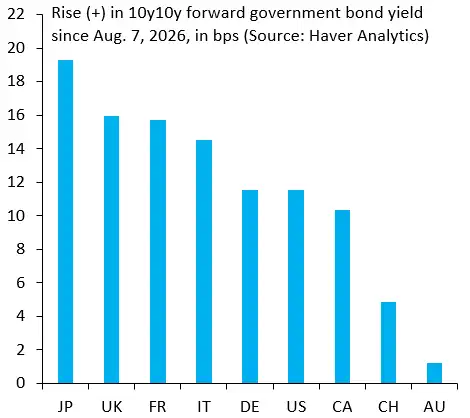
Long-term borrowing costs have climbed across major bond markets, and the order of the damage seems to matter. Robin J. Brooks – the former top economist at the IIF and chief FX strategist at Goldman Sachs – helpfully highlights that since August 7, the steepest increases in 10-year forward government bond yields came in Japan, followed by the UK, France, Italy and Germany. The US placed only sixth. The mildest moves came from places like Switzerland, where the public finances are in better shape.
That ordering tracks fiscal vulnerability, and hints that markets may be anticipating what governments would be forced to do if stubborn inflation squeezes households such that a downturn gathers. With price growth still above target for most major economies, central banks are in no position to cut aggressively, so the burden of fighting any slump would probably fall on the fiscal side.
The economy behind the fear
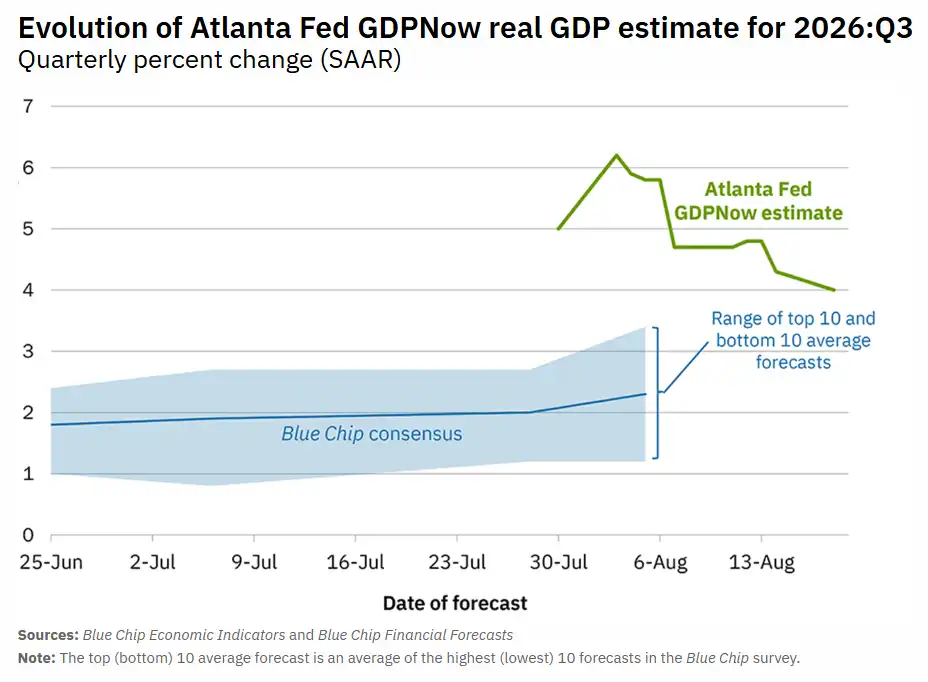
The risk of a downturn is far from hypothetical. The Atlanta Fed’s GDPNow model has cut its third-quarter growth estimate from around 6% in late July to 4.0% today, trimmed from 4.3% just yesterday after another batch of broadly disappointing US economic data. The “nowcast” will move many more times before the actual figures land in late October. However, the 2% slide in a mere three weeks is an ominous sign of where recent news-flow has been pointing.
Indeed, the latest inputs have been grim. July’s payrolls data came in negative and the prior two months were revised sharply lower. Consumer inflation has eased, but only half of last month’s decline came from the widely expected washing out of the Iran war oil shock. The rest came from core services, a worrying sign for domestic demand. Wholesale prices were soggier still, and measures of retail sales and consumer confidence proved disappointing.
Citigroup’s economic surprise index turned sharply lower this month, warning that economic news-flow is deteriorating relative to forecasts. All the while, breakeven inflation rates embedded in Treasury bond pricing have surrendered the entire wartime oil disruption uplift and now refuse to budge even as crude prices rebound. This warns that the markets are sniffing out a potent disinflationary headwind on the horizon.
The US alone accounts for a hefty 26% of global GDP. July’s purchasing managers index (PMI) data from S&P Global shows it also boasts much faster economic activity growth than the two runners up, China at 17% and the Eurozone at 15% of the worldwide total. This means that if the US economy were to falter, it would probably sink global growth too.
Precious metals seemed to have worked this out earlier than the rest. Gold and silver prices pointedly steadied through July, refusing to decline even as real interest rates surged. That is typically a recipe for pain for non-yielding bullion. The US dollar sold off through the same stretch, even as the real return on holding it ostensibly improved. Both markets seem to be sniffing out that the Federal Reserve might have less room to tighten than the consensus believed.
What the Fed minutes could unleash
Minutes from July’s FOMC policy meeting are the next test. That decision split 9-3, with Beth Hammack, Neel Kashkari and Lorie Logan pushing for a 25-basis-point (bps) hike while the majority held firm. The accompanying statement said activity was expanding solidly, job gains were keeping pace with the workforce, and inflation was still elevated. That sounded hawkish, revealing a committee focused on the fight for price stability.
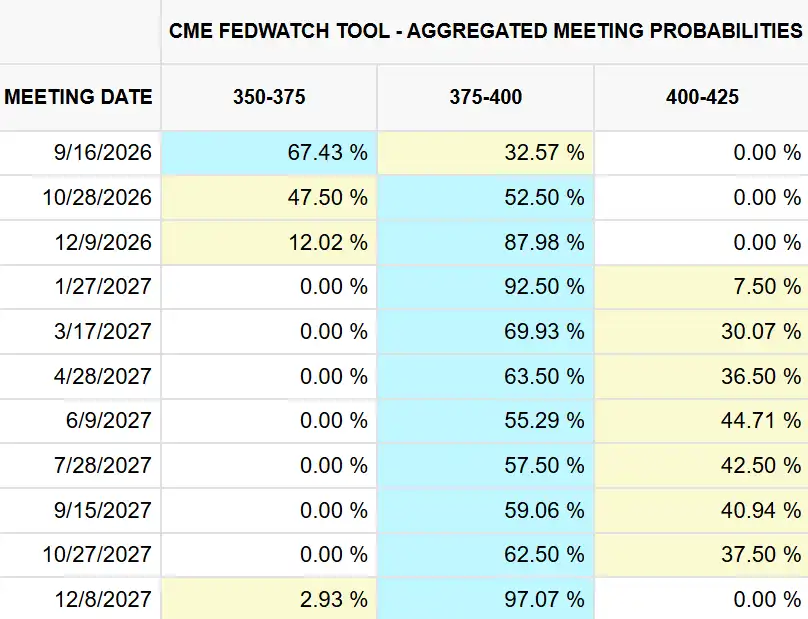
Nevertheless, the spate of weak economic data since the beginning of this month have eaten away at rate hike bets. Fed Funds futures now price in 22bps in tightening this year, down from 42bps on the eve of the central bank’s July 28-29 conclave. That means a hike by December still looks likely, but no sooner. Moreover, pricing for further tightening in 2027 has been abandoned.
Should the minutes fail to revive the markets’ sense of rate hike urgency, a key event risk marker will have been passed, which may give the green light for tightening bets to unwind further. That may continue to flatter gold and silver prices as well as apply more downside pressure on the dollar. Stocks have yet to reckon with the idea that rate hikes are vanishing from traders’ outlook for all the wrong reasons. They seem to have room to weaken further if growth concerns metastasize.
Why America might end up as the refuge
In a curious twist, US Treasury bonds may end up rising even as traders fret about fiscal stress amid an economic downturn. If the problem is truly global, US government debt might emerge as the least bad alternative. Money fleeing French, Italian, German or Japanese paper has to land somewhere, and the list of alternatives able to absorb it is short to the point of singularity.
Historical precedent on this score is instructive: the greenback rallied ferociously through 2008 even though that year’s crisis was American in origin, because it was the deepest pool of liquidity to cash out into. Treasury bonds could similarly rally if widespread fiscal stress triggers a flight to quality. Tellingly, the 30-year Treasury bond erased losses and closed higher on the session after spiking to a 19-year low intraday.
Ilya Spivak, tastylive Head of Global Macro, has over 15 years of experience in trading strategy. He specializes in identifying thematic moves in currencies, commodities, interest rates and equities. He hosts Macro Money and co-hosts Overtime, Monday-Thursday. @Ilyaspivak
For live daily programming, market news and commentary, visit tastylive.com or @tastyliveshow on YouTube
Trade with a better broker, open a tastytrade account today. tastylive, Inc. and tastytrade, Inc. are separate but affiliated companies.
Options involve risk and are not suitable for all investors. Please read Characteristics and Risks of Standardized Options before deciding to invest in options.
tastylive content is created, produced, and provided solely by tastylive, Inc. (“tastylive”) and is for informational and educational purposes only. It is not, nor is it intended to be, trading or investment advice or a recommendation that any security, futures contract, digital asset, other product, transaction, or investment strategy is suitable for any person. Trading securities, futures products, and digital assets involve risk and may result in a loss greater than the original amount invested. tastylive, through its content, financial programming or otherwise, does not provide investment or financial advice or make investment recommendations. Investment information provided may not be appropriate for all investors and is provided without respect to individual investor financial sophistication, financial situation, investing time horizon or risk tolerance. tastylive is not in the business of transacting securities trades, nor does it direct client commodity accounts or give commodity trading advice tailored to any particular client’s situation or investment objectives. Supporting documentation for any claims (including claims made on behalf of options programs), comparisons, statistics, or other technical data, if applicable, will be supplied upon request. tastylive is not a licensed financial adviser, registered investment adviser, or a registered broker-dealer. Options, futures, and futures options are not suitable for all investors. Prior to trading securities, options, futures, or futures options, please read the applicable risk disclosures, including, but not limited to, the Characteristics and Risks of Standardized Options Disclosure and the Futures and Exchange-Traded Options Risk Disclosure found on tastytrade.com/disclosures.
tastytrade, Inc. ("tastytrade”) is a registered broker-dealer and member of FINRA, NFA, and SIPC. tastytrade was previously known as tastyworks, Inc. (“tastyworks”). tastytrade offers self-directed brokerage accounts to its customers. tastytrade does not give financial or trading advice, nor does it make investment recommendations. You alone are responsible for making your investment and trading decisions and for evaluating the merits and risks associated with the use of tastytrade’s systems, services or products. tastytrade is a wholly-owned subsidiary of tastylive, Inc.
tastytrade has entered into a Marketing Agreement with tastylive (“Marketing Agent”) whereby tastytrade pays compensation to Marketing Agent to recommend tastytrade’s brokerage services. The existence of this Marketing Agreement should not be deemed as an endorsement or recommendation of Marketing Agent by tastytrade. tastytrade and Marketing Agent are separate entities with their own products and services. tastylive is the parent company of tastytrade.
tastyfx, LLC (“tastyfx”) is a Commodity Futures Trading Commission (“CFTC”) registered Retail Foreign Exchange Dealer (RFED) and Introducing Broker (IB) and Forex Dealer Member (FDM) of the National Futures Association (“NFA”) (NFA ID 0509630). Leveraged trading in foreign currency or off-exchange products on margin carries significant risk and may not be suitable for all investors. We advise you to carefully consider whether trading is appropriate for you based on your personal circumstances as you may lose more than you invest.
tastycrypto is provided solely by tasty Software Solutions, LLC. tasty Software Solutions, LLC is a separate but affiliate company of tastylive, Inc. Neither tastylive nor any of its affiliates are responsible for the products or services provided by tasty Software Solutions, LLC. Cryptocurrency trading is not suitable for all investors due to the number of risks involved. The value of any cryptocurrency, including digital assets pegged to fiat currency, commodities, or any other asset, may go to zero.
© copyright 2013 - 2026 tastylive, Inc. All Rights Reserved. Applicable portions of the Terms of Use on tastylive.com apply. Reproduction, adaptation, distribution, public display, exhibition for profit, or storage in any electronic storage media in whole or in part is prohibited under penalty of law, provided that you may download tastylive’s podcasts as necessary to view for personal use. tastylive was previously known as tastytrade, Inc. tastylive is a trademark/servicemark owned by tastylive, Inc.
Your privacy choices