The US Economy is Wobbling. Stocks Haven’t Noticed Yet.

The US Economy is Wobbling. Stocks Haven’t Noticed Yet.
By:Ilya Spivak
Stocks are near record highs on razor-thin volume even as signs of economic trouble become more obvious. What could go wrong?
- Last week brought the lightest S&P 500 futures volume since Christmas, hinting the rally has almost no conviction behind it
- The Atlanta Fed’s third-quarter growth estimate has shed nearly two percentage points since the start of August
- Gold spotted the shift first, refusing to fall through a jump in real interest rates that should have punished it
The bellwether S&P 500 continues to hover near the record highs it reached at the start of August, but the conviction underpinning that perch seems absent. Last week saw the lightest volume in S&P 500 futures since Christmas week of last December, and participation has been fading throughout the latest advance.
The picture is no better in other major markets. The tech-heavy Nasdaq 100, which remains stuck in the chop beneath its early-June highs, its August rally likewise built on thinning participation. Crude oil sits roughly in the middle of the range it has occupied since the US-Iran war began in late February. Treasury bonds are consolidating, unwilling to resume the steep march toward higher yields that defined the war’s early months yet also unwilling to break the other way.
The rate-hike case is unravelling
Under the surface of this would-be standstill, Federal Reserve policy expectations are shifting quickly. Futures now put the odds of a 25-basis-point (bps) rate hike in September at roughly 70/30 against, with October close to a coin flip. A hike by December is still favored, but conviction has ebbed. At the start of last week it was treated as a given, and a second increase in 2027 was fully discounted on top of it. That second hike has now seemingly evaporated from the outlook. Across the curve, the probability of tightening has fallen meaningfully since late July.
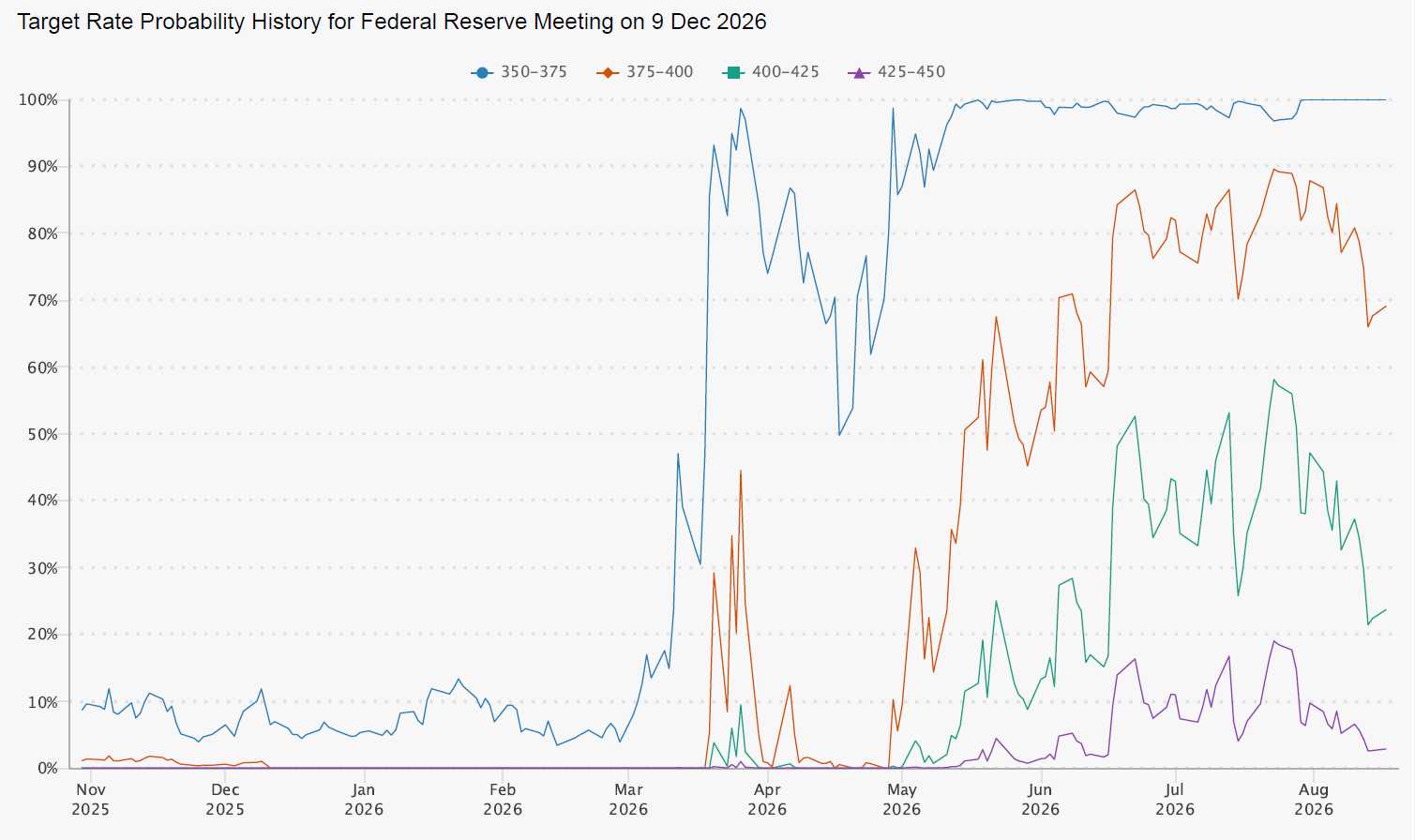
The data behind the rethink
The trigger is a genuine deterioration in the economic data. The Atlanta Fed’s GDPNow model, which updates its growth estimate as figures arrive, stood north of 6% for the third quarter when August began and now reads above 4%. The level will move plenty before actual data lands months from now, so the direction of travel is what matters: nearly two percentage points shaved off in under three weeks.
The inputs explain it. The latest payrolls data came in outright negative, with the economy shedding jobs and the prior two months revised down by a combined 103,000. Consumer and wholesale price readings were both soft, and the detail matters more than the headline: roughly half the decline in consumer inflation traced to weaker demand in core services rather than the Iran war’s crude oil shock washing out of the numbers.
That is a very different animal. It suggests that higher prices earlier in the year have already begun crowding out household spending, and that the disinflation now arriving may prove far more durable than a passing adjustment. Citigroup’s economic surprise index, which tracks data outcomes against forecasts, has turned sharply lower this month, and breakeven inflation rates have refused to rebound even as crude climbed back toward the middle of its wartime range.
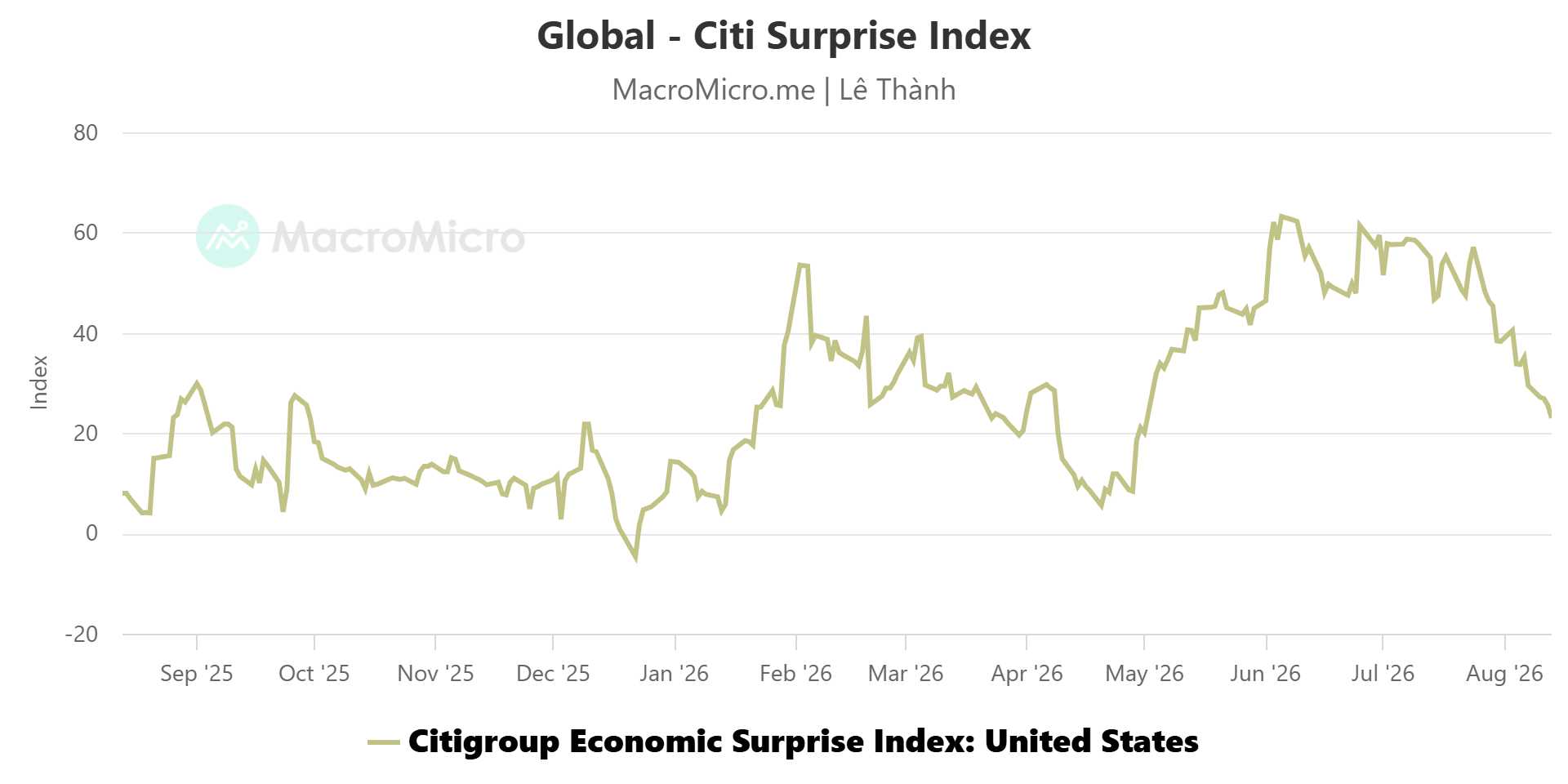
The growth mix is what makes this dangerous. In the first quarter, non-residential fixed investment — the data center buildout — supplied almost all the expansion while consumption, at 68% of the economy, contributed almost nothing by comparison. The second quarter brought a consumer rebound, though the World Cup was being staged in North America at the time, so it may prove an aberration rather than a recovery. With household spending roughly five times the size of the investment sector at 14%, even a small retrenchment could swamp whatever the data center boom delivers.
Gold saw it coming
Precious metals worked it out well before the rest. Since early July, gold has refused to fall even as real interest rates — borrowing costs after inflation — climbed a further 3% through the month. Rising real rates are usually kryptonite for an asset that yields nothing, yet neither gold nor silver buckled, and both have since powered higher. The US dollar has traced the mirror image, stabilizing through most of July before selling off sharply into August, surrendering an almost three-month uptrend. Two markets that should have bent to the rising rates story pushed back against it instead.
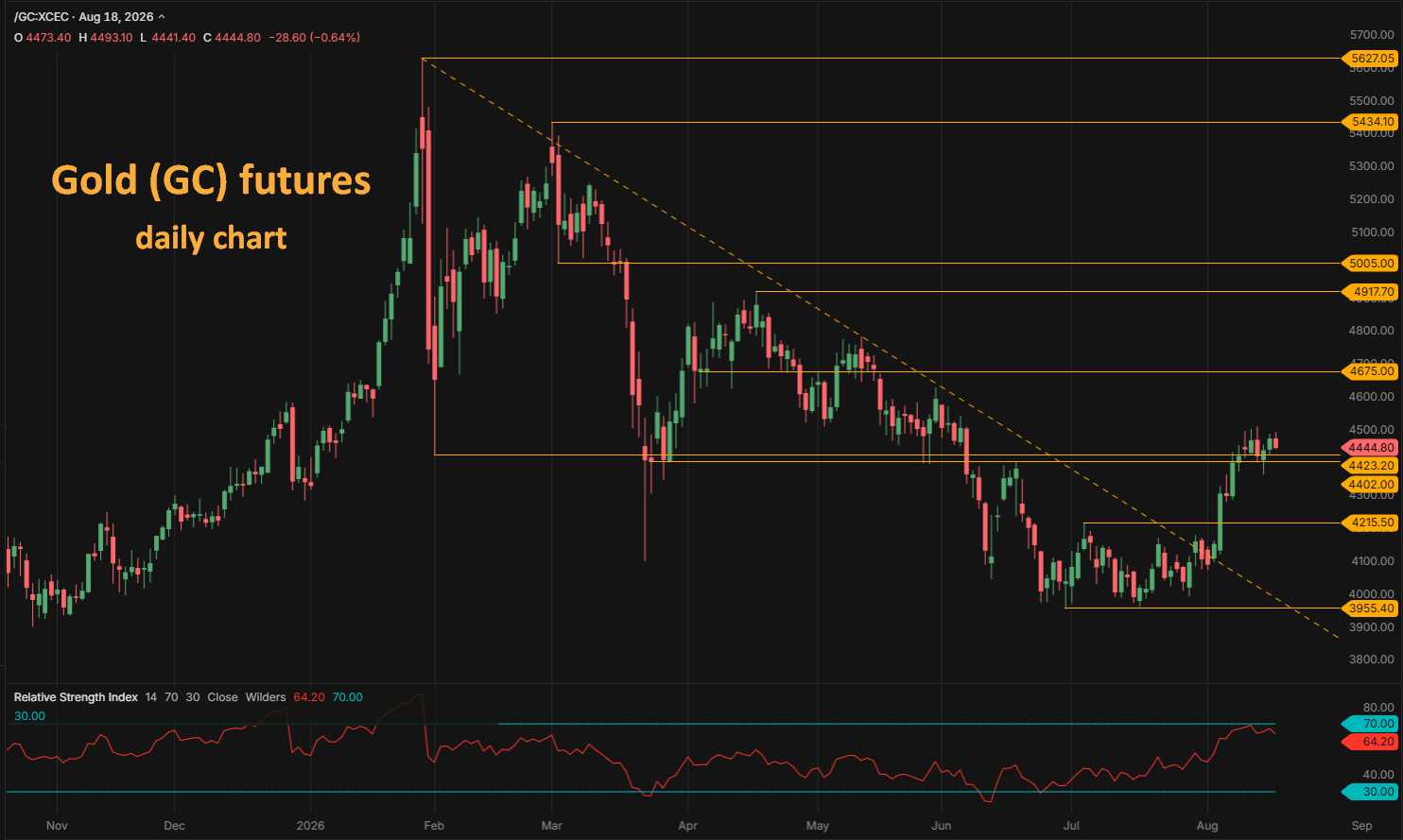
What the week could confirm
Two events should sharpen the picture. Minutes from the last Fed meeting arrive midweek, and the tone matters: policymakers signaling patience over urgency on hikes would accelerate the erosion in tightening bets, lifting gold and silver further while pressing the dollar lower. Purchasing managers index (PMI) surveys follow at the end of the week, offering a timely read on the business cycle. Forecasts point to slightly slower growth – nothing alarming on its face – but another downside surprise would add to the evidence that the pressure on this economy runs deeper than an oil spike getting stale.
That is the trap sitting under a becalmed market. Stocks have spent August enjoying cooler inflation and a Fed that suddenly looks unlikely to tighten, treating both as reasons to stay near record highs. Gold, the dollar, and the growth trackers are telling a less comfortable story: that prices are cooling because demand is faltering, and that the Fed may hold fire because the economy can no longer take the strain. Moreover, a market this thinly traded has little to cushion the moment investors work out that the disinflation they have been celebrating is arriving for entirely the wrong reasons.
Ilya Spivak, tastylive Head of Global Macro, has over 15 years of experience in trading strategy. He specializes in identifying thematic moves in currencies, commodities, interest rates and equities. He hosts Macro Money and co-hosts Overtime, Monday-Thursday. @Ilyaspivak
For live daily programming, market news and commentary, visit tastylive.com or @tastyliveshow on YouTube
Trade with a better broker, open a tastytrade account today. tastylive, Inc. and tastytrade, Inc. are separate but affiliated companies.
Options involve risk and are not suitable for all investors. Please read Characteristics and Risks of Standardized Options before deciding to invest in options.
tastylive content is created, produced, and provided solely by tastylive, Inc. (“tastylive”) and is for informational and educational purposes only. It is not, nor is it intended to be, trading or investment advice or a recommendation that any security, futures contract, digital asset, other product, transaction, or investment strategy is suitable for any person. Trading securities, futures products, and digital assets involve risk and may result in a loss greater than the original amount invested. tastylive, through its content, financial programming or otherwise, does not provide investment or financial advice or make investment recommendations. Investment information provided may not be appropriate for all investors and is provided without respect to individual investor financial sophistication, financial situation, investing time horizon or risk tolerance. tastylive is not in the business of transacting securities trades, nor does it direct client commodity accounts or give commodity trading advice tailored to any particular client’s situation or investment objectives. Supporting documentation for any claims (including claims made on behalf of options programs), comparisons, statistics, or other technical data, if applicable, will be supplied upon request. tastylive is not a licensed financial adviser, registered investment adviser, or a registered broker-dealer. Options, futures, and futures options are not suitable for all investors. Prior to trading securities, options, futures, or futures options, please read the applicable risk disclosures, including, but not limited to, the Characteristics and Risks of Standardized Options Disclosure and the Futures and Exchange-Traded Options Risk Disclosure found on tastytrade.com/disclosures.
tastytrade, Inc. ("tastytrade”) is a registered broker-dealer and member of FINRA, NFA, and SIPC. tastytrade was previously known as tastyworks, Inc. (“tastyworks”). tastytrade offers self-directed brokerage accounts to its customers. tastytrade does not give financial or trading advice, nor does it make investment recommendations. You alone are responsible for making your investment and trading decisions and for evaluating the merits and risks associated with the use of tastytrade’s systems, services or products. tastytrade is a wholly-owned subsidiary of tastylive, Inc.
tastytrade has entered into a Marketing Agreement with tastylive (“Marketing Agent”) whereby tastytrade pays compensation to Marketing Agent to recommend tastytrade’s brokerage services. The existence of this Marketing Agreement should not be deemed as an endorsement or recommendation of Marketing Agent by tastytrade. tastytrade and Marketing Agent are separate entities with their own products and services. tastylive is the parent company of tastytrade.
tastyfx, LLC (“tastyfx”) is a Commodity Futures Trading Commission (“CFTC”) registered Retail Foreign Exchange Dealer (RFED) and Introducing Broker (IB) and Forex Dealer Member (FDM) of the National Futures Association (“NFA”) (NFA ID 0509630). Leveraged trading in foreign currency or off-exchange products on margin carries significant risk and may not be suitable for all investors. We advise you to carefully consider whether trading is appropriate for you based on your personal circumstances as you may lose more than you invest.
tastycrypto is provided solely by tasty Software Solutions, LLC. tasty Software Solutions, LLC is a separate but affiliate company of tastylive, Inc. Neither tastylive nor any of its affiliates are responsible for the products or services provided by tasty Software Solutions, LLC. Cryptocurrency trading is not suitable for all investors due to the number of risks involved. The value of any cryptocurrency, including digital assets pegged to fiat currency, commodities, or any other asset, may go to zero.
© copyright 2013 - 2026 tastylive, Inc. All Rights Reserved. Applicable portions of the Terms of Use on tastylive.com apply. Reproduction, adaptation, distribution, public display, exhibition for profit, or storage in any electronic storage media in whole or in part is prohibited under penalty of law, provided that you may download tastylive’s podcasts as necessary to view for personal use. tastylive was previously known as tastytrade, Inc. tastylive is a trademark/servicemark owned by tastylive, Inc.
Your privacy choices