Trump’s Defense Remarks: Implications for Lockheed Martin (LMT), Northrop (NOC), Raytheon (RTX), Palantir (PLTR), and More
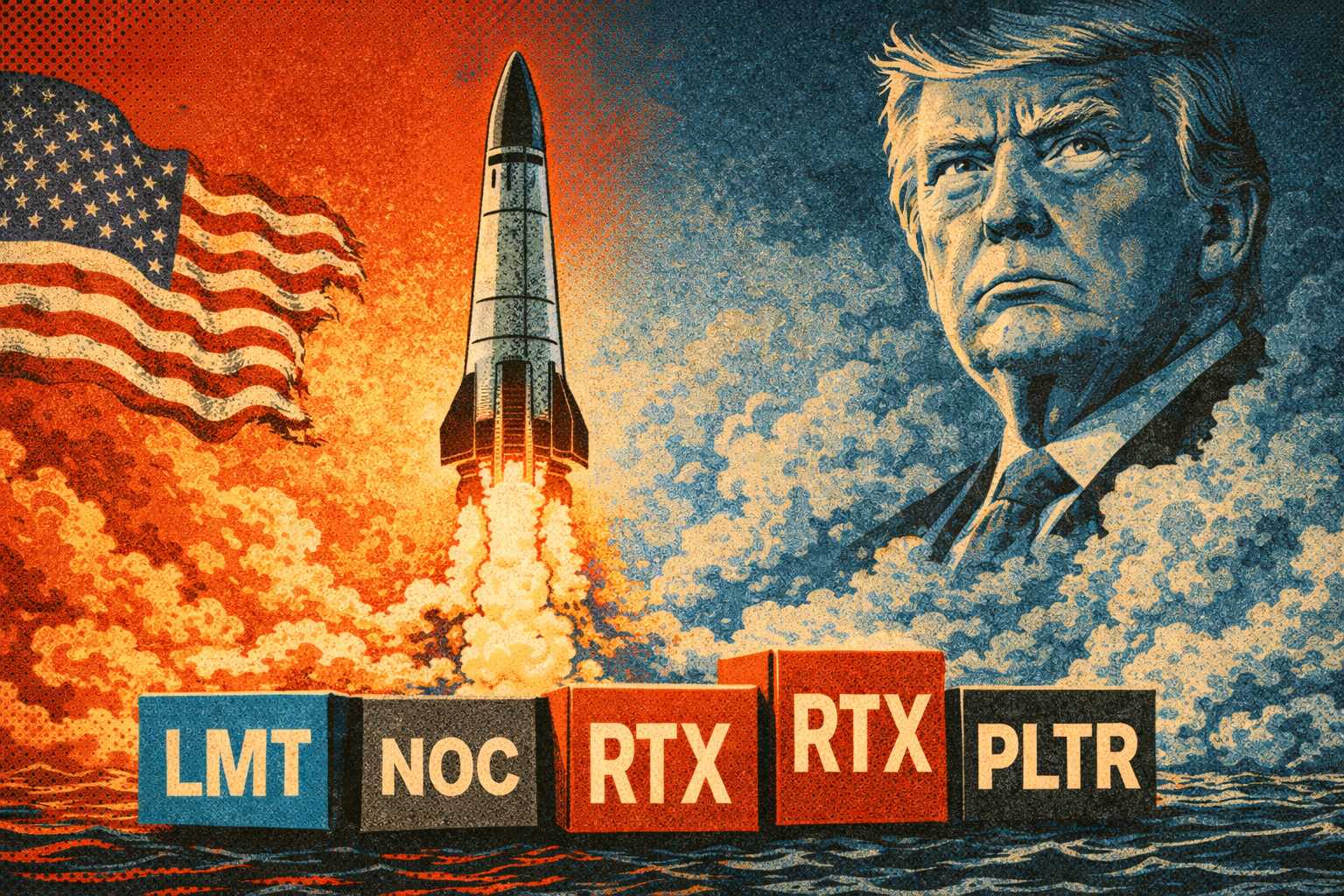
Trump’s Defense Remarks: Implications for Lockheed Martin (LMT), Northrop (NOC), Raytheon (RTX), Palantir (PLTR), and More
By:Gus Downing
President Trump’s executive order bars defense contractors from dividends and buybacks until output improves, and ties awards and executive pay to on-time delivery, while adding penalties for delays.
Company impact: LMT and NOC face near-term cash-return pressure but have large backlogs; RTX carries the highest headline risk after being singled out; PLTR is less exposed to payout limits, but must meet tighter delivery SLAs.
What to watch: agency implementation details and waivers, company disclosures on pausing payouts and updating schedules, and how the rules interact with 2026 budget outlays.
The Executive Order: What’s New and What’s at Stake
The White House has announced an executive order which bars domestic defense contractors from paying out dividends or conducting stock buybacks until they improve weapons output and efficiency. It also directs such companies to tie executive pay and future awards to on-time delivery, and lays out penalties for underperformance.
Recently, Raytheon (RTX) was singled out specifically for scrutiny, and defense shares initially wavered on the headlines. The order also contemplates putting a hard cap on executive pay, with reporting citing $5 million as a potential amount for said cap. Federal agencies have been instructed to identify firms that prioritize distributions over production capacity.
The criticism primarily focuses on “massive” buybacks and dividends issued by defense contractors, and perceived delays in output. Markets are now faced with trying to price in two very different but equally likely paths: (a) tougher procurement terms that pressure near-term returns, or (b) an eventual budget plus policy mix that rewards output and speed.
Ticker-by-Ticker Impact: LMT, NOC, RTX, PLTR and Company
Lockheed Martin (LMT) would be hurt by a pause or ban on dividends and buybacks, as such a pause would hit capital-return plans that have defined the company’s equity story. Procurement could add stricter deadlines and increase costs on F-35s, missiles, and C2 programs. The offset for LMT comes via a large funded backlog and demand for munitions and interceptors, which would provide volume visibility if production incentives are monetized.
Northrop Grumman (NOC) would see a similar near-term effect on returns, as bomber, space, and missile-defense programs would face tighter milestone gating and clawbacks in the event that deliveries are late or production goes over budget to ensure on-time deliveries. Their offset is also similar to that of Lockheed, and comes via their space and defense backlogs that could benefit from schedule-bonus structures.
Raytheon (RTX) has the highest headline risk after being singled out by name, and could face major contract consequences if they do not half buybacks and speed up deliveries, adding uncertainty to margins and returns. Any disclosure on repurchasing pauses, revised delivery timetables, or agency-required remediation plans could have a tangible impact on share price.
Palantir (PLTR) may not be affected as heavily due to less binding capital return limits, but compensation and performance linkages along with tougher delivery SLAs could still come around to bite. If procurement favors rapid deployment of AI and analytics, Palantir could see tailwinds, provided that they are able to meet new schedule metrics.
Other names to watch include General Dynamics (GD), L3Harris (LHX), Huntington Ingalls (HII), and Boeing (BA), who all could face similar cash return constraints to Lockheed and Northrop if shipyards and aircraft lines also face stronger on-time clauses. However, if incentives reward throughput, they could all see increased upside.
Near-Term Catalysts and Decision Points
Agency guidance in implementation, including timing, scope, and any waivers or “cure” periods would shed light on which direction these companies may move.
Additionally, disclosures from the companies themselves regarding explicit pauses of buybacks and dividends, updated 2026 capital allocation frameworks, or revised delivery schedules could all be impactful variables.
Budget interaction rounds out the watchlist; how these rules pair with the record defense outlays already authorized, as well as any incremental topline the administration pursues, could move shares.
The bottom line is that this is a policy shift from rewarding capital returns to rewarding output. In the near-term, it compresses cash return premium, especially for the names specifically called out by the White House. In the medium-term, it could favor contractors that can demonstrably build and deliver faster under tougher terms.
Gus Downing is host of the tastylive Network show Risk and Reward. @GainsByGus
For live daily programming, market news and commentary, visit tastylive or the tastylive YouTube channel.
Trade with a better broker, open a tastytrade account today. tastylive Inc. and tastytrade Inc. are separate but affiliated companies.
Options involve risk and are not suitable for all investors. Please read Characteristics and Risks of Standardized Options before deciding to invest in options.
tastylive content is created, produced, and provided solely by tastylive, Inc. (“tastylive”) and is for informational and educational purposes only. It is not, nor is it intended to be, trading or investment advice or a recommendation that any security, futures contract, digital asset, other product, transaction, or investment strategy is suitable for any person. Trading securities, futures products, and digital assets involve risk and may result in a loss greater than the original amount invested. tastylive, through its content, financial programming or otherwise, does not provide investment or financial advice or make investment recommendations. Investment information provided may not be appropriate for all investors and is provided without respect to individual investor financial sophistication, financial situation, investing time horizon or risk tolerance. tastylive is not in the business of transacting securities trades, nor does it direct client commodity accounts or give commodity trading advice tailored to any particular client’s situation or investment objectives. Supporting documentation for any claims (including claims made on behalf of options programs), comparisons, statistics, or other technical data, if applicable, will be supplied upon request. tastylive is not a licensed financial adviser, registered investment adviser, or a registered broker-dealer. Options, futures, and futures options are not suitable for all investors. Prior to trading securities, options, futures, or futures options, please read the applicable risk disclosures, including, but not limited to, the Characteristics and Risks of Standardized Options Disclosure and the Futures and Exchange-Traded Options Risk Disclosure found on tastytrade.com/disclosures.
tastytrade, Inc. ("tastytrade”) is a registered broker-dealer and member of FINRA, NFA, and SIPC. tastytrade was previously known as tastyworks, Inc. (“tastyworks”). tastytrade offers self-directed brokerage accounts to its customers. tastytrade does not give financial or trading advice, nor does it make investment recommendations. You alone are responsible for making your investment and trading decisions and for evaluating the merits and risks associated with the use of tastytrade’s systems, services or products. tastytrade is a wholly-owned subsidiary of tastylive, Inc.
tastytrade has entered into a Marketing Agreement with tastylive (“Marketing Agent”) whereby tastytrade pays compensation to Marketing Agent to recommend tastytrade’s brokerage services. The existence of this Marketing Agreement should not be deemed as an endorsement or recommendation of Marketing Agent by tastytrade. tastytrade and Marketing Agent are separate entities with their own products and services. tastylive is the parent company of tastytrade.
tastyfx, LLC (“tastyfx”) is a Commodity Futures Trading Commission (“CFTC”) registered Retail Foreign Exchange Dealer (RFED) and Introducing Broker (IB) and Forex Dealer Member (FDM) of the National Futures Association (“NFA”) (NFA ID 0509630). Leveraged trading in foreign currency or off-exchange products on margin carries significant risk and may not be suitable for all investors. We advise you to carefully consider whether trading is appropriate for you based on your personal circumstances as you may lose more than you invest.
tastycrypto is provided solely by tasty Software Solutions, LLC. tasty Software Solutions, LLC is a separate but affiliate company of tastylive, Inc. Neither tastylive nor any of its affiliates are responsible for the products or services provided by tasty Software Solutions, LLC. Cryptocurrency trading is not suitable for all investors due to the number of risks involved. The value of any cryptocurrency, including digital assets pegged to fiat currency, commodities, or any other asset, may go to zero.
© copyright 2013 - 2026 tastylive, Inc. All Rights Reserved. Applicable portions of the Terms of Use on tastylive.com apply. Reproduction, adaptation, distribution, public display, exhibition for profit, or storage in any electronic storage media in whole or in part is prohibited under penalty of law, provided that you may download tastylive’s podcasts as necessary to view for personal use. tastylive was previously known as tastytrade, Inc. tastylive is a trademark/servicemark owned by tastylive, Inc.
Your privacy choices