US CPI: Do the Markets Really Want Lower Inflation?

US CPI: Do the Markets Really Want Lower Inflation?
By:Ilya Spivak
Stocks cling to record highs despite shrinking participation, but gold and the dollar warn the inflation story has flipped into something sinister as key US CPI data looms ahead.
- The S&P 500 surge to record highs came on fading volume and flat momentum, driven by a Hormuz deal that is already unraveling
- June’s CPI data miss was the largest against the Cleveland Fed’s forecast in about two decades, and energy cannot fully explain it
- After a shock drop in payrolls, another soft inflation print may say that bets on Fed interest rate hikes by year-end are badly misplaced
The S&P 500 is hovering within a hair of record highs, but the internals make the achievement appear fragile. The rally from the lows in late July arrived on steadily shrinking volume while the relative strength index (RSI) – a measure of momentum – has tellingly flatlined even as prices set higher highs. That’s the kind of negative divergence that signals conviction may be draining away beneath a strong-looking tape.
More telling still is what drove the upswing. Hope for a deal to reopen the Strait of Hormuz seemed like the main catalyst, a hope that has since curdled as the shooting resumed. The tech-heavy Nasdaq 100 saw a noticeably soggier bounce than the broader S&P. It remains capped below its early-summer highs, suggesting the market’s heretofore main bullish narrative centered on the artificial intelligence (AI) trade is struggling.
Gold and the dollar smell something
The more revealing moves are elsewhere. Gold, hammered all year by the war-trade logic that higher oil means higher inflation and a Federal Reserve forced to tighten, has been refusing to fall since early July and is now pushing decisively higher out of that congestion. The US dollar has done the reverse, surrendering the uptrend built since spring and June’s break of a year-old range top. Bonds, for their part, sit becalmed. Still, gold rising while the greenback slides is the signature of a market beginning to doubt the rate-hike story it has been trading all year.
US CPI inflation: July data in focus after June’s epic miss
The spotlight now turns to July’s consumer price index (CPI) report. It is expected to show that headline inflation cooled for a second month straight, down to 3.4% year-on-year. That would amount to a four-month low. The core measure excluding volatile food and energy prices is seen ticking down to 2.5% year-on-year, the lowest since February.
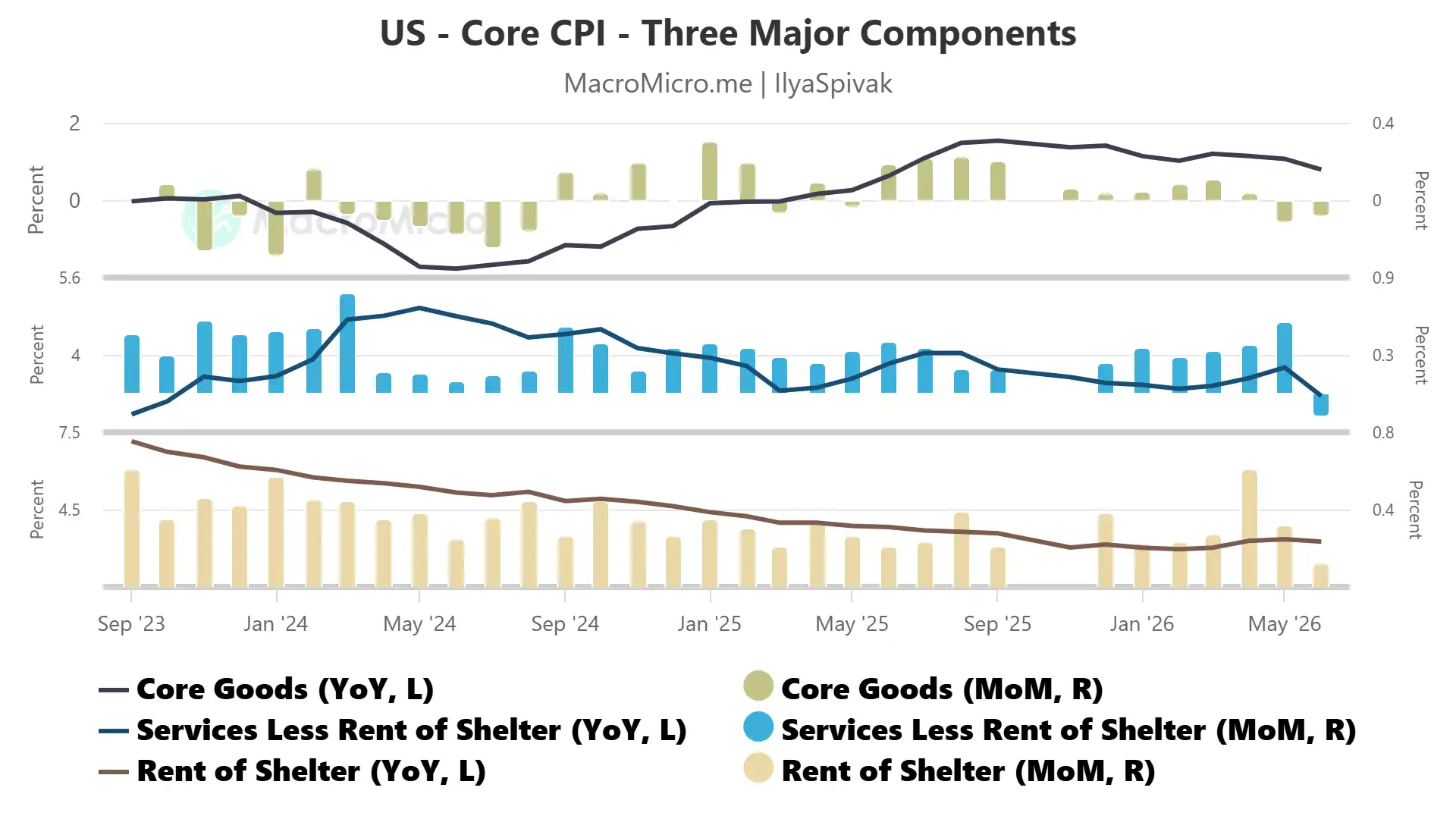
June’s figures brought a widely expected drop in energy’s price growth contribution: its fall subtracted nearly half of a percentage point from the headline rate as crude oil moderated. But there was more to that month’s disinflation than energy alone can explain: core service sector prices fell on the month for the first time since January 2021. That category is by far the largest slice of overall CPI – it is where American households do most of their spending, with private consumption accounting for roughly 68% of the economy aimed largely at domestic services providers.
Moreover, June’s headline results marked an extraordinary downside surprise relative to the closely watched CPI “nowcast” published by the Cleveland Fed. It overshot the actual result by the widest margin in at least 22 years. A large divergence for this model usually means a quarter of a percentage point; this one approached double that.
The war’s inflation shock has flipped?
That might point to early signs of demand retrenchment rather than just an energy shock story running its course. Expensive oil squeezed households for months, and the second-round effect of that squeeze may now showing up as weaker spending on the services that dominate consumption — disinflation produced by an economy losing steam. That is, the war’s inflationary jolt may now be flipping into its opposite.
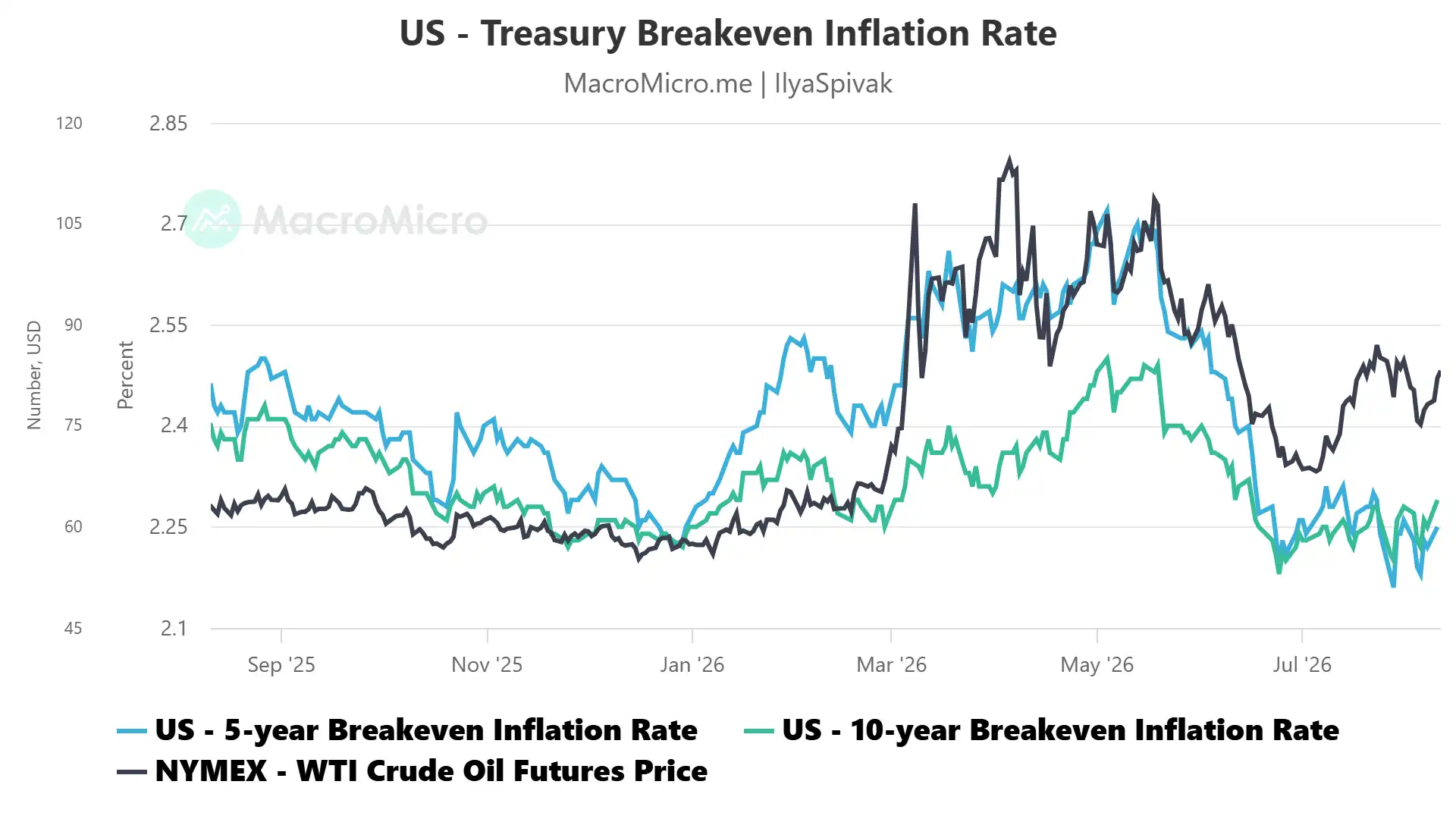
Two other readings point the same way. First, last week’s jobs report delivered a shock decline in payrolls, and the prior two months were revised down by a combined 103,000, the steepest two-month markdown in about a year. Next, breakeven inflation rates, the price growth expectations embedded in bond prices, have stopped tracking crude altogether. They marched higher with oil when the war began; now they hover at levels as low as the start of the year, having recently dipped even lower, even as crude perks up again. The bond market may have concluded that something is overpowering the oil impetus on prices.
The growth arithmetic explains why that matters. Second-quarter output slowed to about 1.5% annualized from 2.1%, and while consumption rebounded, the World Cup was in North America for much of the quarter. Strip that away and the first quarter, when the AI buildout supplied nearly all the growth while the consumer contributed little by comparison, may be the truer picture. Since consumption is roughly five times the size of business investment, it would take only modest further weakness in households to swamp even a tech capex boom growing above a 10% annualized clip.
The rate-hike bet that may be wrong
Against that backdrop, the markets Fed rates outlook seems stretched. Futures markets put the odds of at least one rate hike by year-end at better than 80%, with September near a coin flip and the case firming through October and December and further tightening priced well into next year. That structure is a legacy of the war, when the inflation shock flipped expectations from cuts to hikes. If the disinflation now emerging is the product of demand destruction, those bets will have to be unwound, and for thoroughly unwelcome reasons.
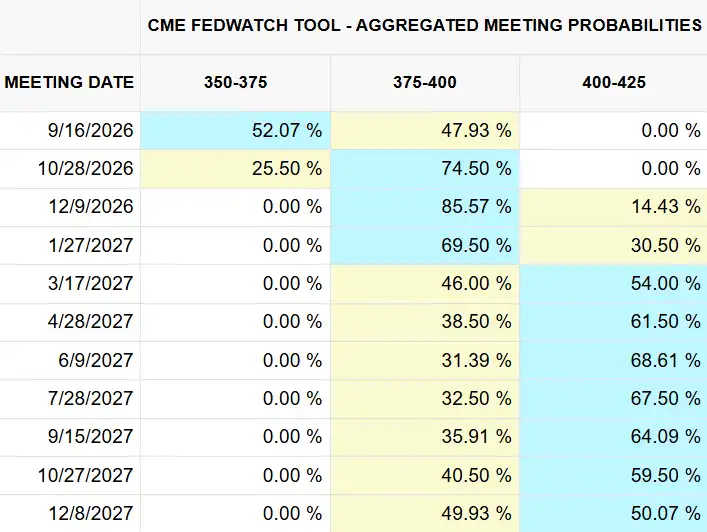
That is what makes the coming inflation report so charged. Another downside surprise would tell markets that the economy, and not just the oil price, is what has changed. Gold’s breakout and the dollar’s slide would have room to extend, bonds could finally shift higher as tightening bets drain away, and crude might simply carry on with its own geopolitical drama. The most exposed market might be the one sitting at record highs on the thinnest of conviction. A stock market that rallied on a Hormuz deal which never materialized has little cushion if traders decide the story all along was the growth quietly seeping out of the economy beneath them.
Ilya Spivak, tastylive Head of Global Macro, has over 15 years of experience in trading strategy. He specializes in identifying thematic moves in currencies, commodities, interest rates and equities. He hosts Macro Money and co-hosts Overtime, Monday-Thursday. @Ilyaspivak
For live daily programming, market news and commentary, visit tastylive.com or @tastyliveshow on YouTube
Trade with a better broker, open a tastytrade account today. tastylive, Inc. and tastytrade, Inc. are separate but affiliated companies.
Options involve risk and are not suitable for all investors. Please read Characteristics and Risks of Standardized Options before deciding to invest in options.
tastylive content is created, produced, and provided solely by tastylive, Inc. (“tastylive”) and is for informational and educational purposes only. It is not, nor is it intended to be, trading or investment advice or a recommendation that any security, futures contract, digital asset, other product, transaction, or investment strategy is suitable for any person. Trading securities, futures products, and digital assets involve risk and may result in a loss greater than the original amount invested. tastylive, through its content, financial programming or otherwise, does not provide investment or financial advice or make investment recommendations. Investment information provided may not be appropriate for all investors and is provided without respect to individual investor financial sophistication, financial situation, investing time horizon or risk tolerance. tastylive is not in the business of transacting securities trades, nor does it direct client commodity accounts or give commodity trading advice tailored to any particular client’s situation or investment objectives. Supporting documentation for any claims (including claims made on behalf of options programs), comparisons, statistics, or other technical data, if applicable, will be supplied upon request. tastylive is not a licensed financial adviser, registered investment adviser, or a registered broker-dealer. Options, futures, and futures options are not suitable for all investors. Prior to trading securities, options, futures, or futures options, please read the applicable risk disclosures, including, but not limited to, the Characteristics and Risks of Standardized Options Disclosure and the Futures and Exchange-Traded Options Risk Disclosure found on tastytrade.com/disclosures.
tastytrade, Inc. ("tastytrade”) is a registered broker-dealer and member of FINRA, NFA, and SIPC. tastytrade was previously known as tastyworks, Inc. (“tastyworks”). tastytrade offers self-directed brokerage accounts to its customers. tastytrade does not give financial or trading advice, nor does it make investment recommendations. You alone are responsible for making your investment and trading decisions and for evaluating the merits and risks associated with the use of tastytrade’s systems, services or products. tastytrade is a wholly-owned subsidiary of tastylive, Inc.
tastytrade has entered into a Marketing Agreement with tastylive (“Marketing Agent”) whereby tastytrade pays compensation to Marketing Agent to recommend tastytrade’s brokerage services. The existence of this Marketing Agreement should not be deemed as an endorsement or recommendation of Marketing Agent by tastytrade. tastytrade and Marketing Agent are separate entities with their own products and services. tastylive is the parent company of tastytrade.
tastyfx, LLC (“tastyfx”) is a Commodity Futures Trading Commission (“CFTC”) registered Retail Foreign Exchange Dealer (RFED) and Introducing Broker (IB) and Forex Dealer Member (FDM) of the National Futures Association (“NFA”) (NFA ID 0509630). Leveraged trading in foreign currency or off-exchange products on margin carries significant risk and may not be suitable for all investors. We advise you to carefully consider whether trading is appropriate for you based on your personal circumstances as you may lose more than you invest.
tastycrypto is provided solely by tasty Software Solutions, LLC. tasty Software Solutions, LLC is a separate but affiliate company of tastylive, Inc. Neither tastylive nor any of its affiliates are responsible for the products or services provided by tasty Software Solutions, LLC. Cryptocurrency trading is not suitable for all investors due to the number of risks involved. The value of any cryptocurrency, including digital assets pegged to fiat currency, commodities, or any other asset, may go to zero.
© copyright 2013 - 2026 tastylive, Inc. All Rights Reserved. Applicable portions of the Terms of Use on tastylive.com apply. Reproduction, adaptation, distribution, public display, exhibition for profit, or storage in any electronic storage media in whole or in part is prohibited under penalty of law, provided that you may download tastylive’s podcasts as necessary to view for personal use. tastylive was previously known as tastytrade, Inc. tastylive is a trademark/servicemark owned by tastylive, Inc.
Your privacy choices