US Jobs Report: One Problem Too Many for the Stock Market?

US Jobs Report: One Problem Too Many for the Stock Market?
By:Ilya Spivak
The stock market is hanging by a thread as surging oil prices stoke inflation fears. Will US jobs data topple it?
- Crude oil climbs above $82 as war in Iran threatens supply
- Stocks struggle to hold gains as rate-cut expectations fade
- US jobs report now in focus as traders search for a catalyst
Financial markets seem to be increasingly fixated on a single theme: inflation driven by surging crude oil prices. While equities have so far managed to absorb the shock, the resilience may prove difficult to sustain if higher energy costs feed into price growth data and force the Federal Reserve to delay interest rate cuts.
The benchmark S&P 500 has remained trapped in a broad consolidation range even as volatility increases. Stocks have repeatedly probed down to lower levels without delivering a decisive breakdown, but upside momentum has also been difficult to sustain. This hesitation appears to reflect growing unease about the macro backdrop.
Crude oil prices are at the center of the story. The WTI benchmark pushed above $82 per barrel, hitting the highest levels since July 2022, to extend a rally that has been building since the beginning of the year. The latest push higher followed reports that China has instructed domestic refiners to curb exports, signaling concern about tightening supply.
The immediate threat is the ongoing war between the United States, Israel and Iran, which has severely disrupted shipping through the Strait of Hormuz. Insurers have reportedly been unwilling to cover vessels passing through the corridor, effectively halting a key route for Persian Gulf oil exports.
Crude oil prices were already a risk before the US-Iran war
Yet the rally in crude began well before the outbreak of hostilities. A cluster of overlapping developments have been setting the stage for an oil rally since late 2025.
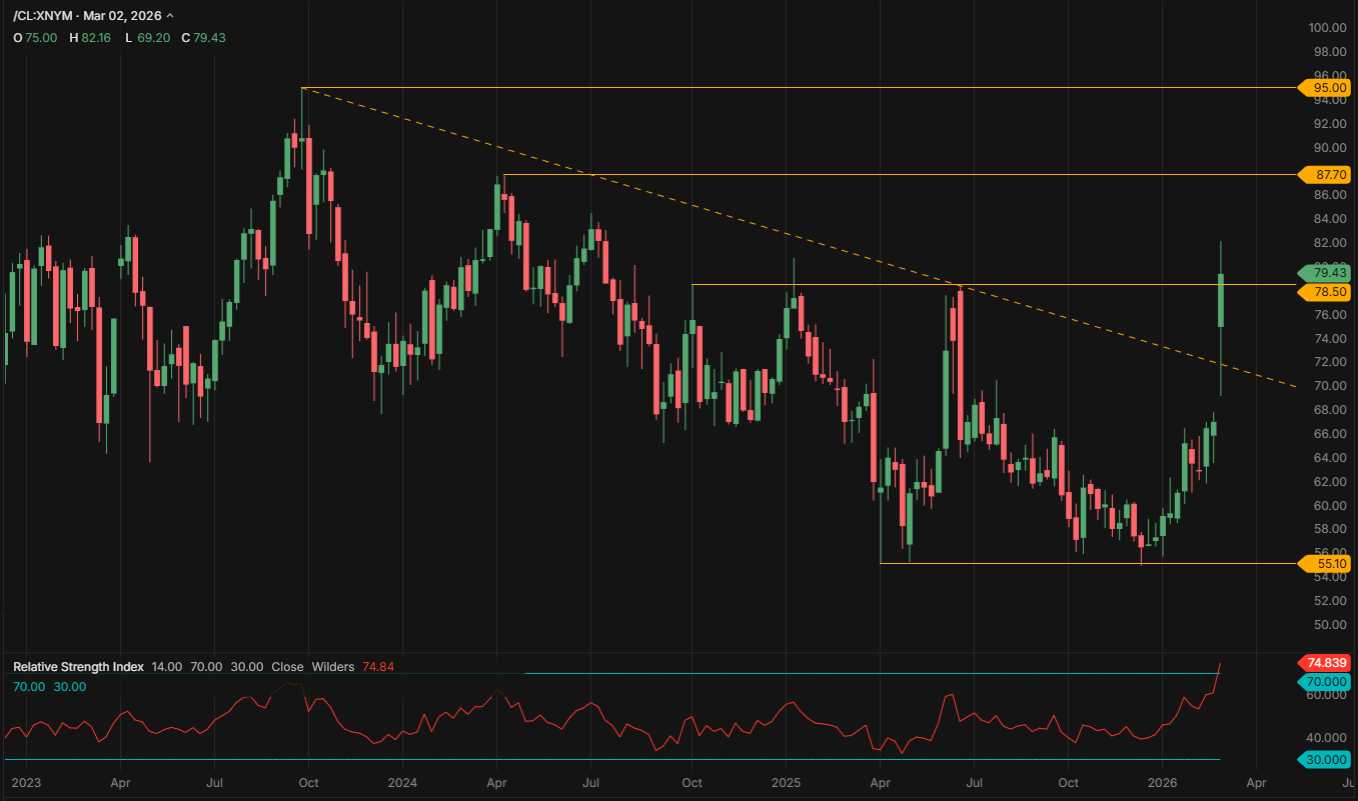
Iran has been teetering on the brink of regime collapse following a violent crackdown on a popular uprising. The United States has intensified efforts to seize Russia’s so-called “shadow fleet” oil tankers transporting sanctioned crude, and Washington’s intervention in Venezuela has further disrupted supply from another cut-rate producer.
Together, these moves threaten the flow of discounted oil to China. The world’s largest crude importer will need to tap supplies from producers such as Saudi Arabia, Iraq or Brazil to replace those barrels, tightening inventories that were not positioned for the shift and paying full market prices.
The inflation implications are significant. Historically, changes in crude oil prices take roughly one month to filter into headline US consumer price index (CPI) readings. With inflation already running above the Fed’s 2% target, sustained oil gains could reinforce policymakers’ reluctance to deliver the rate cuts that markets continue to anticipate.
Will the US jobs report push stock markets over the edge?
Bond markets are already responding. Treasury yields have climbed sharply in recent sessions, reflecting expectations that higher energy costs will keep inflation elevated and delay policy easing. That dynamic has weighed on gold, which tends to struggle when interest rates rise, while boosting the US dollar as higher yields make dollar-denominated assets more attractive.
Traders have adjusted their expectations accordingly. They now price in 35 basis points (bps) of rate cuts for 2026, implying only one fully priced 25bp reduction and less-than-even odds of a second. At the same time, easing expectations for 2027 have increased, reflecting the view that if the Fed cannot cut this year it may need to do more later.
Stocks have not welcomed the shift. The S&P 500 has been stuck near the bottom of a range carved out since late October, when Fed Chair Jerome Powell put in the top for the Wall Street benchmark with a stern warning to investors against over-extrapolating the pace of rate cuts.
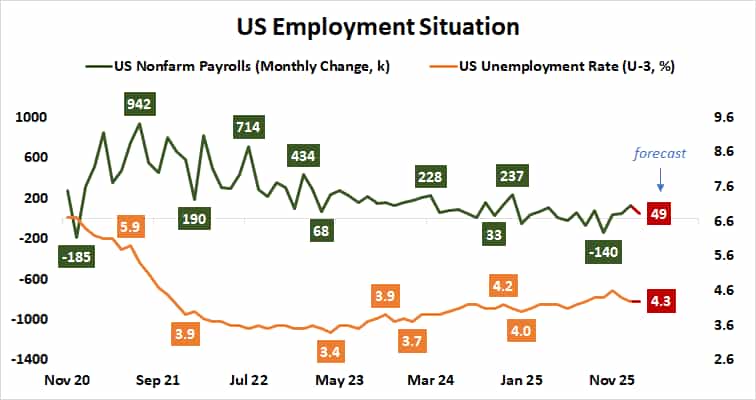
Attention now turns to the US jobs report, which could provide the next catalyst in this saga. Economists expect nonfarm payrolls growth to slow to 49,000 in February from 130,000 in the prior month, while the unemployment rate is projected to hold steady at 4.3%.
A stream of upbeat labor market data this week – from a perky ISM service-sector survey to an ADP release showing stronger-than-expected hiring in the private sector – hints that official figures may be stronger than expected. In that scenario, the stock market’s hopes for a Fed rate-cut safety net may face another difficult test.
Ilya Spivak, tastylive head of global macro, has over 15 years of experience in trading strategy, and he specializes in identifying thematic moves in currencies, commodities, interest rates and equities. He hosts Macro Money and co-hosts Overtime, Monday-Thursday. @Ilyaspivak
For live daily programming, market news and commentary, visit tastylive.com or @tastyliveshow on YouTube
Trade with a better broker, open a tastytrade account today. tastylive, Inc. and tastytrade, Inc. are separate but affiliated companies.
Options involve risk and are not suitable for all investors. Please read Characteristics and Risks of Standardized Options before deciding to invest in options.
tastylive content is created, produced, and provided solely by tastylive, Inc. (“tastylive”) and is for informational and educational purposes only. It is not, nor is it intended to be, trading or investment advice or a recommendation that any security, futures contract, digital asset, other product, transaction, or investment strategy is suitable for any person. Trading securities, futures products, and digital assets involve risk and may result in a loss greater than the original amount invested. tastylive, through its content, financial programming or otherwise, does not provide investment or financial advice or make investment recommendations. Investment information provided may not be appropriate for all investors and is provided without respect to individual investor financial sophistication, financial situation, investing time horizon or risk tolerance. tastylive is not in the business of transacting securities trades, nor does it direct client commodity accounts or give commodity trading advice tailored to any particular client’s situation or investment objectives. Supporting documentation for any claims (including claims made on behalf of options programs), comparisons, statistics, or other technical data, if applicable, will be supplied upon request. tastylive is not a licensed financial adviser, registered investment adviser, or a registered broker-dealer. Options, futures, and futures options are not suitable for all investors. Prior to trading securities, options, futures, or futures options, please read the applicable risk disclosures, including, but not limited to, the Characteristics and Risks of Standardized Options Disclosure and the Futures and Exchange-Traded Options Risk Disclosure found on tastytrade.com/disclosures.
tastytrade, Inc. ("tastytrade”) is a registered broker-dealer and member of FINRA, NFA, and SIPC. tastytrade was previously known as tastyworks, Inc. (“tastyworks”). tastytrade offers self-directed brokerage accounts to its customers. tastytrade does not give financial or trading advice, nor does it make investment recommendations. You alone are responsible for making your investment and trading decisions and for evaluating the merits and risks associated with the use of tastytrade’s systems, services or products. tastytrade is a wholly-owned subsidiary of tastylive, Inc.
tastytrade has entered into a Marketing Agreement with tastylive (“Marketing Agent”) whereby tastytrade pays compensation to Marketing Agent to recommend tastytrade’s brokerage services. The existence of this Marketing Agreement should not be deemed as an endorsement or recommendation of Marketing Agent by tastytrade. tastytrade and Marketing Agent are separate entities with their own products and services. tastylive is the parent company of tastytrade.
tastyfx, LLC (“tastyfx”) is a Commodity Futures Trading Commission (“CFTC”) registered Retail Foreign Exchange Dealer (RFED) and Introducing Broker (IB) and Forex Dealer Member (FDM) of the National Futures Association (“NFA”) (NFA ID 0509630). Leveraged trading in foreign currency or off-exchange products on margin carries significant risk and may not be suitable for all investors. We advise you to carefully consider whether trading is appropriate for you based on your personal circumstances as you may lose more than you invest.
tastycrypto is provided solely by tasty Software Solutions, LLC. tasty Software Solutions, LLC is a separate but affiliate company of tastylive, Inc. Neither tastylive nor any of its affiliates are responsible for the products or services provided by tasty Software Solutions, LLC. Cryptocurrency trading is not suitable for all investors due to the number of risks involved. The value of any cryptocurrency, including digital assets pegged to fiat currency, commodities, or any other asset, may go to zero.
© copyright 2013 - 2026 tastylive, Inc. All Rights Reserved. Applicable portions of the Terms of Use on tastylive.com apply. Reproduction, adaptation, distribution, public display, exhibition for profit, or storage in any electronic storage media in whole or in part is prohibited under penalty of law, provided that you may download tastylive’s podcasts as necessary to view for personal use. tastylive was previously known as tastytrade, Inc. tastylive is a trademark/servicemark owned by tastylive, Inc.
Your privacy choices