Will the Stock Market Notice the US Economy is Overheating?

Will the Stock Market Notice the US Economy is Overheating?
By:Ilya Spivak
US manufacturing is booming, but an inflation melt-up makes that look more like overheating than healthy growth. Will the stock market notice?
- US stocks ground higher as the S&P 500 hit another record on fading volume and weakening momentum
- ISM manufacturing PMI surged to its strongest since 2022, alongside a post-COVID-scale inflation spike
- Will ISM services PMI and US jobs data force equities to confront the same headwinds other markets fear?
Stock markets seem to have forgotten they used to care about crude oil. Prices jumped again today as a deal over the Strait of Hormuz remained elusive, yet Wall Street shrugged. The bellwether S&P 500 ground out yet another record high while every other major market kept pricing the inflationary fallout from the US-Iran war. The disconnect is now weeks old — and a busy macro calendar may finally test how long it can last.
Stocks stand alone as the war trade rolls on
The grind higher in stocks has the hallmarks of exhaustion. Gains have come on steadily diminishing volume — now fading sharply on the most recent leg higher — and the relative strength index (RSI) is flashing negative divergence, setting lower momentum readings even as price sets higher highs. That is not an outright topping signal, but it suggests the trend is losing steam. The level to watch is former resistance turned support just above 7500 – a break back below that may mark a genuine change of character.
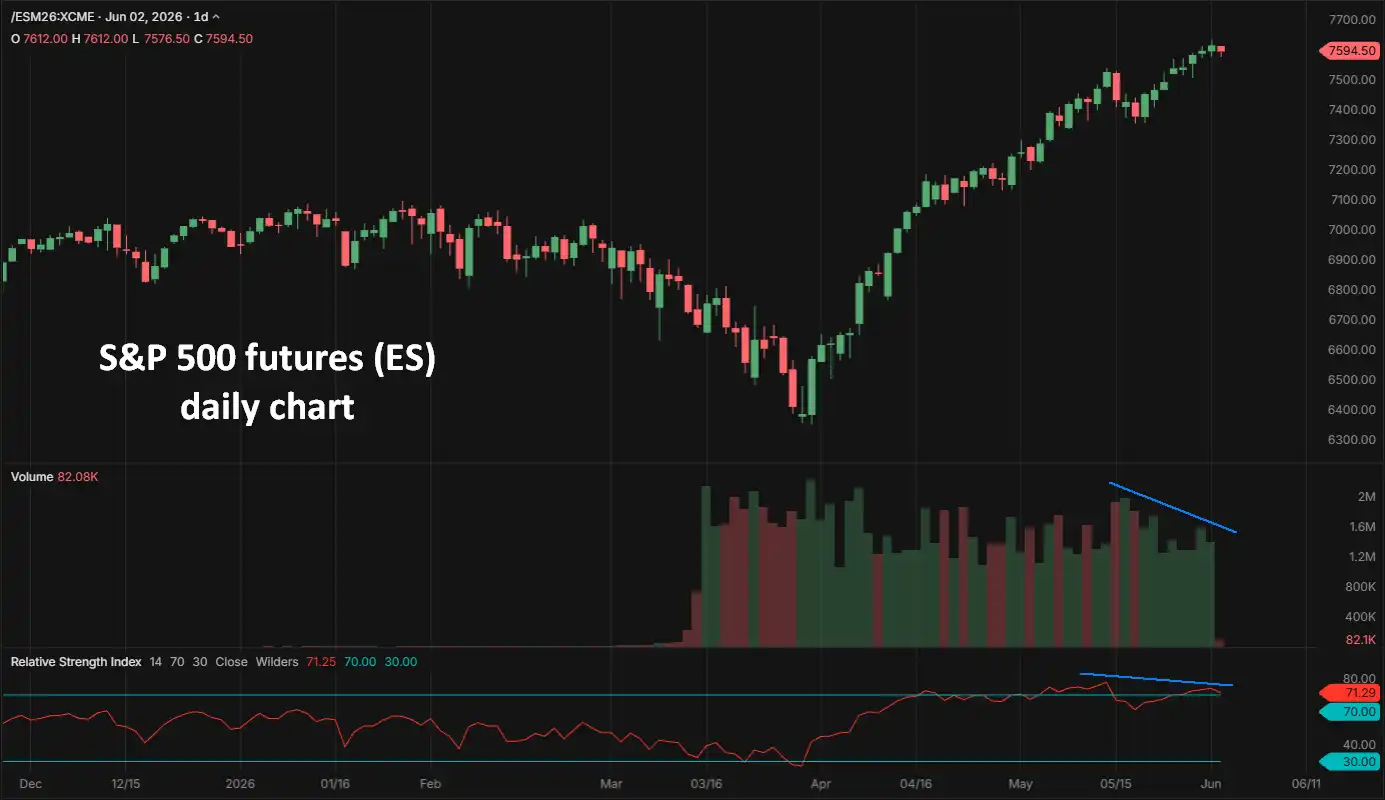
Everywhere else, the “Iran war trade” rolls on. Crude oil bounced off what has become a wartime floor near $80 to $85 a barrel for West Texas Intermediate (WTI), rejecting weekend hopes of a 60-day ceasefire extension that never materialized as Washington and Tehran dug into their red lines. Treasury bond prices kept sliding. Gold continued its slow drip lower and the US dollar hugged the top of its range. These markets are telling the same story: a wartime energy price shock has evolved into a lasting inflation risk and beckons higher rates. Only stocks seem disinterested.
The manufacturing “boom” is really an overheating signal
Today’s macro data appeared to hand the bulls a gift. The Institute for Supply Management (ISM) manufacturing index surged to its strongest level since mid-2022. The final revision of the S&P Global manufacturing purchasing managers index (PMI) confirmed much of the same. On its surface, that looks like robust growth. The worrying part is what sits underneath.
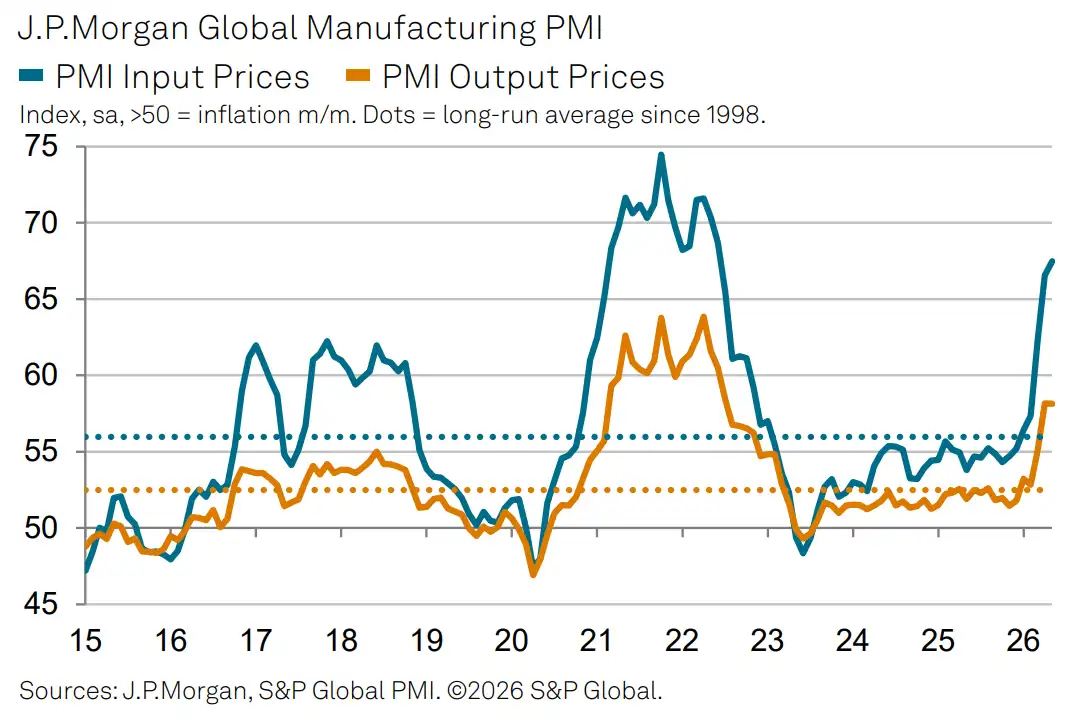
Much of the surge reflects stockpiling of inputs rather than end demand — manufacturers front-running an expected long pipeline of AI data center construction, tariff uncertainty after recent legal challenges, and the supply disruptions flowing from the closed Strait of Hormuz. Alongside it, the surveys show an inflationary melt-up to rival the post-COVID-19 pandemic peak. That earlier episode was the architecture for the aggressive 2022 rate-hike cycle that sent stocks lower all year. The JPMorgan global manufacturing PMI tells the same story worldwide: input and output prices running far above their long-run averages. This looks more like the profile of an economy overheating, not one that is growing in a healthy and sustainable way.
Last week’s downward revision to first-quarter US gross domestic product (GDP) data — cut to 1.6% from 2% annualized growth — reinforces the point. The markdown came almost entirely from softer consumer spending and business investment, the two essential engines of the economy. Consumption, 68% of GDP, was already contributing less to growth than fixed nonresidential investment at just 14%, thanks to the AI buildout. But both were revised down. Consumers are hamstrung by higher energy, higher input costs, and dearer credit — and so are the data center builders.
This week’s data will test the disconnect
Two tests stand out on a busy calendar. The ISM services PMI survey lands Wednesday. Compared with manufacturing, the sector drives a larger share of US employment and output. Recent consumer and producer price data have shown the energy shock already seeping into service-sector costs. Consensus looks for a relatively steady headline reading, but traders will comb through what lurks below the surface to gauge the inflationary threat.
The week closes with the US jobs report on Friday. Forecasts call for a rise of 96,000 in nonfarm payrolls for May, the smallest in three months, with the unemployment rate seen holding at 4.3%. A soft print would speak to gathering headwinds menacing the economy just as borrowing costs climb.
How long can stocks look the other way?
The bond market’s inflation expectations — the breakeven rates derived from the gap between nominal and inflation-protected yields — remain locked in step with crude oil and stuck near recent highs. The implication for policy is unambiguous: Fed funds futures now price about a 68% chance of a Federal Reserve rate hike this year, a stunning reversal from the 50 basis points (bps) of cuts the market expected before the war. The outlook for nearly every other major central bank has shifted to a more hawkish view in tandem.
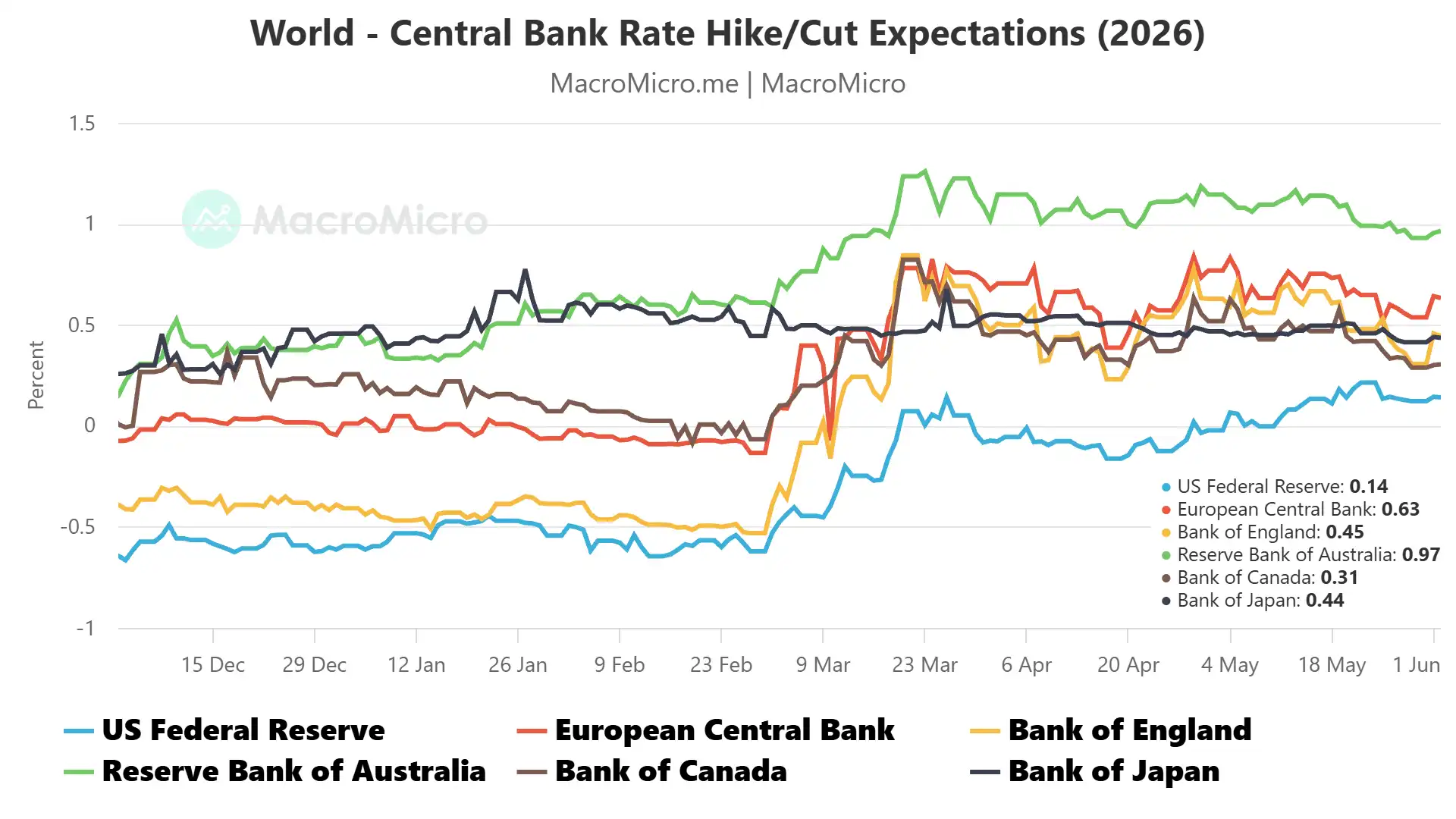
That leaves equities on an island. The narrow rally has run on fading volume and ebbing momentum, sustained by an AI buildout story that the manufacturing data now reframes as part of the very inflation problem other markets are pricing. If service-sector ISM data confirms that cost pressure is spreading into the bulk of the economy, and Friday’s payrolls reveal a softening labor market, the case for a 14% slice of GDP to keep outpacing a hamstrung 68% slice grows thinner still. Stocks have ignored the message for weeks. The longer the disconnect persists, the more violent the reckoning is likely to be when it finally arrives.
Ilya Spivak, tastylive Head of Global Macro, has over 15 years of experience in trading strategy. He specializes in identifying thematic moves in currencies, commodities, interest rates and equities. He hosts Macro Money and co-hosts Overtime, Monday-Thursday. @Ilyaspivak
For live daily programming, market news and commentary, visit tastylive.com or @tastyliveshow on YouTube
Trade with a better broker, open a tastytrade account today. tastylive, Inc. and tastytrade, Inc. are separate but affiliated companies.
Options involve risk and are not suitable for all investors. Please read Characteristics and Risks of Standardized Options before deciding to invest in options.
tastylive content is created, produced, and provided solely by tastylive, Inc. (“tastylive”) and is for informational and educational purposes only. It is not, nor is it intended to be, trading or investment advice or a recommendation that any security, futures contract, digital asset, other product, transaction, or investment strategy is suitable for any person. Trading securities, futures products, and digital assets involve risk and may result in a loss greater than the original amount invested. tastylive, through its content, financial programming or otherwise, does not provide investment or financial advice or make investment recommendations. Investment information provided may not be appropriate for all investors and is provided without respect to individual investor financial sophistication, financial situation, investing time horizon or risk tolerance. tastylive is not in the business of transacting securities trades, nor does it direct client commodity accounts or give commodity trading advice tailored to any particular client’s situation or investment objectives. Supporting documentation for any claims (including claims made on behalf of options programs), comparisons, statistics, or other technical data, if applicable, will be supplied upon request. tastylive is not a licensed financial adviser, registered investment adviser, or a registered broker-dealer. Options, futures, and futures options are not suitable for all investors. Prior to trading securities, options, futures, or futures options, please read the applicable risk disclosures, including, but not limited to, the Characteristics and Risks of Standardized Options Disclosure and the Futures and Exchange-Traded Options Risk Disclosure found on tastytrade.com/disclosures.
tastytrade, Inc. ("tastytrade”) is a registered broker-dealer and member of FINRA, NFA, and SIPC. tastytrade was previously known as tastyworks, Inc. (“tastyworks”). tastytrade offers self-directed brokerage accounts to its customers. tastytrade does not give financial or trading advice, nor does it make investment recommendations. You alone are responsible for making your investment and trading decisions and for evaluating the merits and risks associated with the use of tastytrade’s systems, services or products. tastytrade is a wholly-owned subsidiary of tastylive, Inc.
tastytrade has entered into a Marketing Agreement with tastylive (“Marketing Agent”) whereby tastytrade pays compensation to Marketing Agent to recommend tastytrade’s brokerage services. The existence of this Marketing Agreement should not be deemed as an endorsement or recommendation of Marketing Agent by tastytrade. tastytrade and Marketing Agent are separate entities with their own products and services. tastylive is the parent company of tastytrade.
tastyfx, LLC (“tastyfx”) is a Commodity Futures Trading Commission (“CFTC”) registered Retail Foreign Exchange Dealer (RFED) and Introducing Broker (IB) and Forex Dealer Member (FDM) of the National Futures Association (“NFA”) (NFA ID 0509630). Leveraged trading in foreign currency or off-exchange products on margin carries significant risk and may not be suitable for all investors. We advise you to carefully consider whether trading is appropriate for you based on your personal circumstances as you may lose more than you invest.
tastycrypto is provided solely by tasty Software Solutions, LLC. tasty Software Solutions, LLC is a separate but affiliate company of tastylive, Inc. Neither tastylive nor any of its affiliates are responsible for the products or services provided by tasty Software Solutions, LLC. Cryptocurrency trading is not suitable for all investors due to the number of risks involved. The value of any cryptocurrency, including digital assets pegged to fiat currency, commodities, or any other asset, may go to zero.
© copyright 2013 - 2026 tastylive, Inc. All Rights Reserved. Applicable portions of the Terms of Use on tastylive.com apply. Reproduction, adaptation, distribution, public display, exhibition for profit, or storage in any electronic storage media in whole or in part is prohibited under penalty of law, provided that you may download tastylive’s podcasts as necessary to view for personal use. tastylive was previously known as tastytrade, Inc. tastylive is a trademark/servicemark owned by tastylive, Inc.
Your privacy choices