Big Bank Earnings Preview: Five Trillion-Dollar Lenders Report on Tuesday July 14th

Big Bank Earnings Preview: Five Trillion-Dollar Lenders Report on Tuesday July 14th
By:Mike Butler
Wall Street's biggest earnings event of the summer lands all at once this week. JPMorgan Chase (NYSE: JPM), Wells Fargo (NYSE: WFC), Citigroup (NYSE: C), Bank of America (NYSE: BAC), and Goldman Sachs (NYSE: GS) are all scheduled to report second-quarter 2026 results before the market opens Tuesday, July 14, kicking off earnings season for the entire financial sector and setting an early tone for the broader market.
The timing adds an extra layer of drama. The print lands the same week as the June CPI report, meaning traders will be digesting bank results and fresh inflation data almost simultaneously, at a moment when the Fed's next move is far from settled.
Options markets are already leaning into the implied volatility. Expected moves for the earnings week are running from roughly 3.3% for JPMorgan up to 4.3% for Goldman Sachs, with Citigroup and Wells Fargo both priced near 4% and Bank of America around 3.1%. For a sector that's historically traded like a slow-moving utility, there are some spikes in implied volatility to be sure - especially when compared to the respective monthly cycles for these ticker symbols.
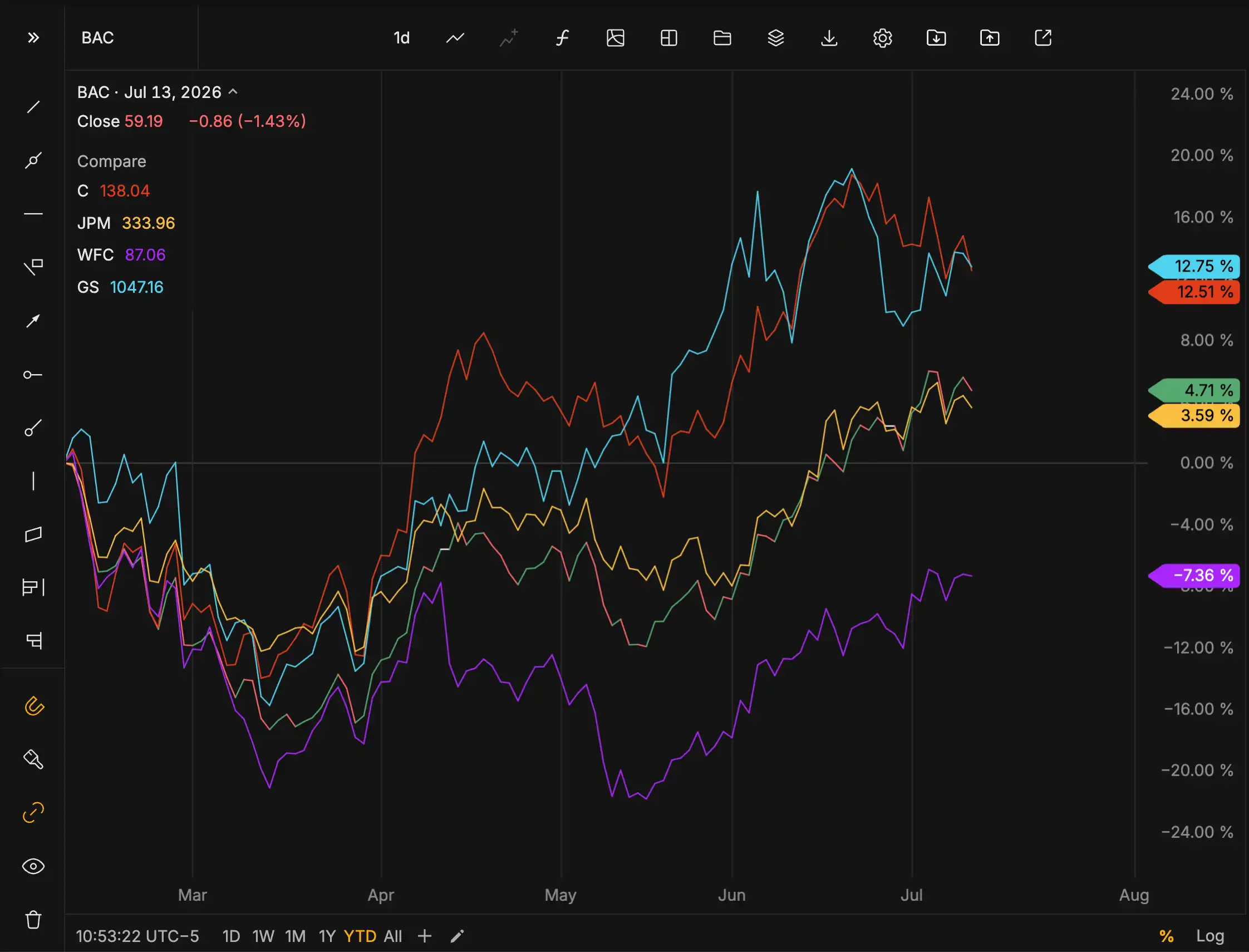
Big Bank Earnings Preview: What Analysts Expect
Consensus estimates point to broad, healthy growth across the group, though the magnitude varies quite a bit bank to bank:
JPMorgan (JPM): EPS near $5.44 to $5.61, roughly 7% to 11% year-over-year growth, powered by strength in markets and investment banking.
Bank of America (BAC): EPS around $1.12 on revenue near $30.7 billion, translating to EPS growth in the mid-20% to 27% range, with estimates revised higher over the past month.
Citigroup (C): EPS near $2.74 on revenue of roughly $23.7 billion, the fastest earnings growth of the group at close to 39% to 40% year-over-year as CEO Jane Fraser's restructuring continues to show up in the numbers.
Wells Fargo (WFC): EPS around $1.72 on revenue near $21.9 billion, with growth more modest at roughly 7% to 12%, reflecting some margin pressure even as the bank pushes into expansion mode.
Goldman Sachs (GS): EPS estimated near $14.47 to $16.30-plus, with growth above 30%, fueled by a surge in investment banking fees and trading activity tied to a busier deal calendar, including high-profile capital markets work around this year's marquee IPOs.
Across the sector, investment banking revenue could climb roughly 26% year-over-year and trading revenue around 14%, with Goldman Sachs and Wells Fargo both drawing attention for the size of their expected beats.
Net Interest Margin Is the Number That Actually Matters
Headline EPS beats are close to a foregone conclusion for this group; all five banks have strung together multiple quarters of topping estimates and tend to guide conservatively. The more important number buried in the release is net interest margin (NIM), the spread between what a bank earns on loans and investments versus what it pays out on deposits.
With the Fed holding rates steady and the yield curve relatively stable, consensus expects NIM to hold in a tight band around 2.7% to 2.9%. Any sign of additional compression would hit the most predictable, highest-quality part of bank earnings, and management commentary on where NIM is trending into the back half of the year is likely to matter more to the stock reaction than the EPS print itself.
Consumer Health and Credit Quality in Focus
Beyond the trading desks and deal fees, investors will be watching for signals on the health of the American consumer. Unemployment has stayed low, which has kept borrowers largely current on mortgages, auto loans, and credit cards, and that has limited losses for the group so far this year. JPMorgan and Bank of America carry the most direct consumer exposure and are typically viewed as the cleanest read on borrower behavior across the economy.
Commercial real estate exposure and private credit competition remain the areas analysts are most likely to press on during earnings calls. JPMorgan CEO Jamie Dimon has previously cautioned that credit problems tend to surface one at a time before spreading, and that kind of commentary will be parsed closely for any early warning signs.
Investment Banking and Trading Set Up for a Strong Quarter
The capital markets backdrop has clearly improved after a couple of sluggish years. M&A and IPO activity have picked up meaningfully in 2026, and this year's high-profile public offerings have generated substantial advisory and debt-underwriting fees for the banks involved. Goldman Sachs is positioned as the biggest beneficiary given its heavy weighting toward investment banking and trading, with fee growth estimates near 30% or higher. JPMorgan also benefits through its markets division, while Citigroup and Bank of America are more levered to core lending and consumer banking trends.
Citigroup's Turnaround Story Takes Center Stage
Of the five, Citigroup may be drawing the most attention for reasons that go beyond the number itself. After years as the group's clear laggard, Citi delivered its best quarterly revenue in a decade last quarter, with return on tangible common equity clearing its own long-term target ahead of schedule. CEO Jane Fraser's multi-year restructuring, which includes exiting lower-return international consumer markets and leaning harder into wealth management and institutional clients, is starting to show up in the results. Citi also still trades at the deepest valuation discount to its peers, meaning continued improvement in profitability metrics has more room to translate into share price upside than it would for a bank already priced for perfection.
Bullish Case for Big Bank Earnings
The bull case is built on a combination of resilient consumer credit, a reopened capital markets window, and Fed policy that has stabilized rather than deteriorated. Investment banking and trading revenue are both expected to post double-digit growth, with Goldman Sachs and JPMorgan best positioned to capture that upside. Net interest margin has held in a stable range rather than eroding further, and low unemployment has kept credit losses contained across consumer and commercial books alike. Citigroup's turnaround adds a re-rating story on top of sector-wide earnings growth, and if all five banks confirm flat-to-improving NIM alongside a healthy back-half deal pipeline, strategists see room for the sector to rally and drag the broader KBW Bank Index higher alongside it. Regional banks would likely catch a positive read-through as well.
Bearish Case for Big Bank Earnings
The bear case centers on how much good news is already priced in after a strong run into the print, combined with a genuinely uncertain rate path. Inflation has ticked back up toward multi-year highs heading into the next Fed meeting, and any hawkish shift in tone could pressure the rate-sensitive parts of bank earnings even if the current quarter looks clean. Deposit competition has also intensified as some institutions pay up to retain savers, which could squeeze margins if it continues. A weaker-than-expected June jobs report has added some uncertainty around consumer resilience, and any uptick in credit card or commercial real estate delinquencies would be read as an early crack in an otherwise healthy picture. Because expectations are already high and options markets are pricing in unusually large one-day moves, even a modest miss on guidance, particularly around NIM trajectory or provisions for credit losses, could trigger an outsized selloff across the group.
Mike Butler, tastylive director of market intelligence, has been trading the markets for a decade. He appears on Options Trading Concepts Live, Monday-Friday. @tradermikeyb
For live daily programming, market news and commentary, visit tastylive or the YouTube channels tastylive (for options traders), and tastyliveTrending for stocks, futures, forex & macro.
Trade with a better broker, open a tastytrade account today. tastylive, Inc. and tastytrade, Inc. are separate but affiliated companies.
Options involve risk and are not suitable for all investors. Please read Characteristics and Risks of Standardized Options before deciding to invest in options.
tastylive content is created, produced, and provided solely by tastylive, Inc. (“tastylive”) and is for informational and educational purposes only. It is not, nor is it intended to be, trading or investment advice or a recommendation that any security, futures contract, digital asset, other product, transaction, or investment strategy is suitable for any person. Trading securities, futures products, and digital assets involve risk and may result in a loss greater than the original amount invested. tastylive, through its content, financial programming or otherwise, does not provide investment or financial advice or make investment recommendations. Investment information provided may not be appropriate for all investors and is provided without respect to individual investor financial sophistication, financial situation, investing time horizon or risk tolerance. tastylive is not in the business of transacting securities trades, nor does it direct client commodity accounts or give commodity trading advice tailored to any particular client’s situation or investment objectives. Supporting documentation for any claims (including claims made on behalf of options programs), comparisons, statistics, or other technical data, if applicable, will be supplied upon request. tastylive is not a licensed financial adviser, registered investment adviser, or a registered broker-dealer. Options, futures, and futures options are not suitable for all investors. Prior to trading securities, options, futures, or futures options, please read the applicable risk disclosures, including, but not limited to, the Characteristics and Risks of Standardized Options Disclosure and the Futures and Exchange-Traded Options Risk Disclosure found on tastytrade.com/disclosures.
tastytrade, Inc. ("tastytrade”) is a registered broker-dealer and member of FINRA, NFA, and SIPC. tastytrade was previously known as tastyworks, Inc. (“tastyworks”). tastytrade offers self-directed brokerage accounts to its customers. tastytrade does not give financial or trading advice, nor does it make investment recommendations. You alone are responsible for making your investment and trading decisions and for evaluating the merits and risks associated with the use of tastytrade’s systems, services or products. tastytrade is a wholly-owned subsidiary of tastylive, Inc.
tastytrade has entered into a Marketing Agreement with tastylive (“Marketing Agent”) whereby tastytrade pays compensation to Marketing Agent to recommend tastytrade’s brokerage services. The existence of this Marketing Agreement should not be deemed as an endorsement or recommendation of Marketing Agent by tastytrade. tastytrade and Marketing Agent are separate entities with their own products and services. tastylive is the parent company of tastytrade.
tastyfx, LLC (“tastyfx”) is a Commodity Futures Trading Commission (“CFTC”) registered Retail Foreign Exchange Dealer (RFED) and Introducing Broker (IB) and Forex Dealer Member (FDM) of the National Futures Association (“NFA”) (NFA ID 0509630). Leveraged trading in foreign currency or off-exchange products on margin carries significant risk and may not be suitable for all investors. We advise you to carefully consider whether trading is appropriate for you based on your personal circumstances as you may lose more than you invest.
tastycrypto is provided solely by tasty Software Solutions, LLC. tasty Software Solutions, LLC is a separate but affiliate company of tastylive, Inc. Neither tastylive nor any of its affiliates are responsible for the products or services provided by tasty Software Solutions, LLC. Cryptocurrency trading is not suitable for all investors due to the number of risks involved. The value of any cryptocurrency, including digital assets pegged to fiat currency, commodities, or any other asset, may go to zero.
© copyright 2013 - 2026 tastylive, Inc. All Rights Reserved. Applicable portions of the Terms of Use on tastylive.com apply. Reproduction, adaptation, distribution, public display, exhibition for profit, or storage in any electronic storage media in whole or in part is prohibited under penalty of law, provided that you may download tastylive’s podcasts as necessary to view for personal use. tastylive was previously known as tastytrade, Inc. tastylive is a trademark/servicemark owned by tastylive, Inc.
Your privacy choices