How Are Bonds Rising Amid Surging Inflation and High Oil Prices?

How Are Bonds Rising Amid Surging Inflation and High Oil Prices?
By:Ilya Spivak
More hot inflation data and rising oil prices might have stoked rate hike bets. Bonds rallied across the curve instead. Is the US economy starting to crack?
- US producer prices jumped 1.3% on the month, the biggest rise since March 2022
- Treasury bonds rallied across maturities and rate hike bets barely moved as crude oil tested mid-September highs
- Retail sales and the Fed’s Beige Book point to consumers retrenching as energy costs bite
Two days of hot US inflation data and rising oil prices might have been expected to stoke bets on Federal Reserve rate hikes. Markets went the other way. Treasury bonds staged a scorching rally, extending a run that began last week after a report that OpenAI’s revenue is tracking slower than expected. Long-term bonds are now testing the bounds of a downtrend in place since late June. The rally also reached the front end of the yield curve, the part most sensitive to policy expectations, where yields also fell.
Crude oil, meanwhile, pushed toward its mid-September highs, threatening a breakout. In the war trade that has shaped markets since the US-Iran conflict began in late February, that would have meant higher inflation expectations, bets on a more hawkish Fed, and rising yields. Instead, rates-sensitive markets followed the bond markets’ contrarian lead. Gold reversed the losses it suffered after yesterday’s CPI report and silver steadied after a bruising selloff. In an almost mirror-image move, the US dollar erased CPI-inspired gains. Stocks looked uneasy. The S&P 500 paused after its inflation-driven drop, and the Nasdaq 100 clawed back from overnight losses to end roughly flat.
Wholesale inflation is hotter than consumer prices
Producer price index (PPI) data turned out to be far hotter than the CPI results. Wholesale prices jumped 1.3% on the month, the biggest rise since March 2022, while core prices rose 0.7%. Annual headline PPI inflation reached 6.3%, well above the 5.3% expected and the highest since December 2022. Core PPI hit 5%, beating the 4.4% forecast to reach its highest since January 2023.
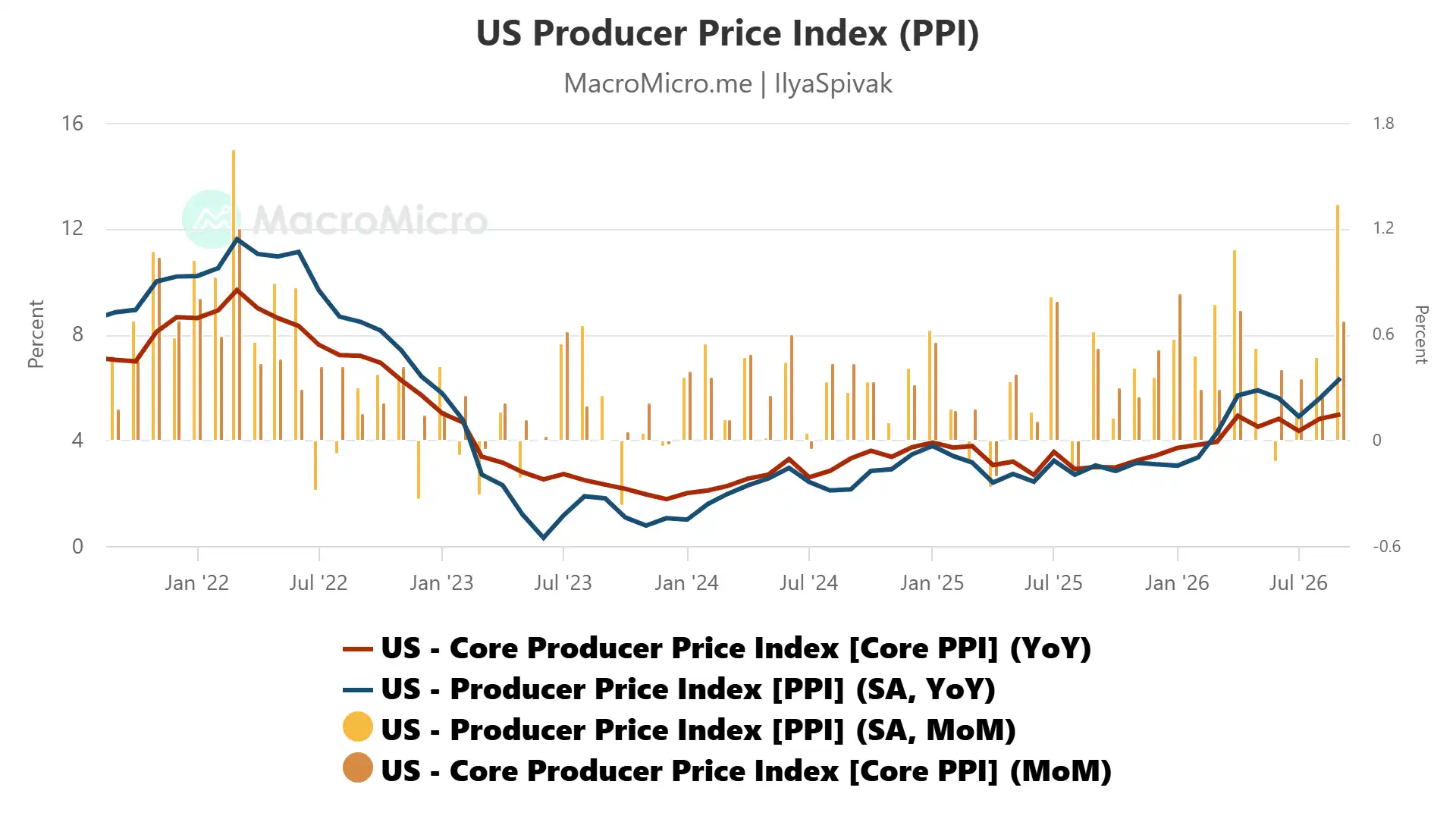
Energy did most of the damage, with wholesale costs up almost 11% on the month. Clear signs of spill-over turned up in prices for transportation and warehousing, where fuel is a direct input. Core goods prices barely budged, and core services moved only modestly.
Rate hike bets barely changed in the data’s wake. Fed funds futures put the odds of no change in October at about 70%, only modestly below the roughly 78% priced before the CPI release. A 25-basis-point (bps) hike remains fully priced for December. Markets still see two more hikes to follow in 2027, one by March and the other by June. Had the war trade still worked as it once did, the data might have pushed that path higher.
Is the US consumer starting to crack?
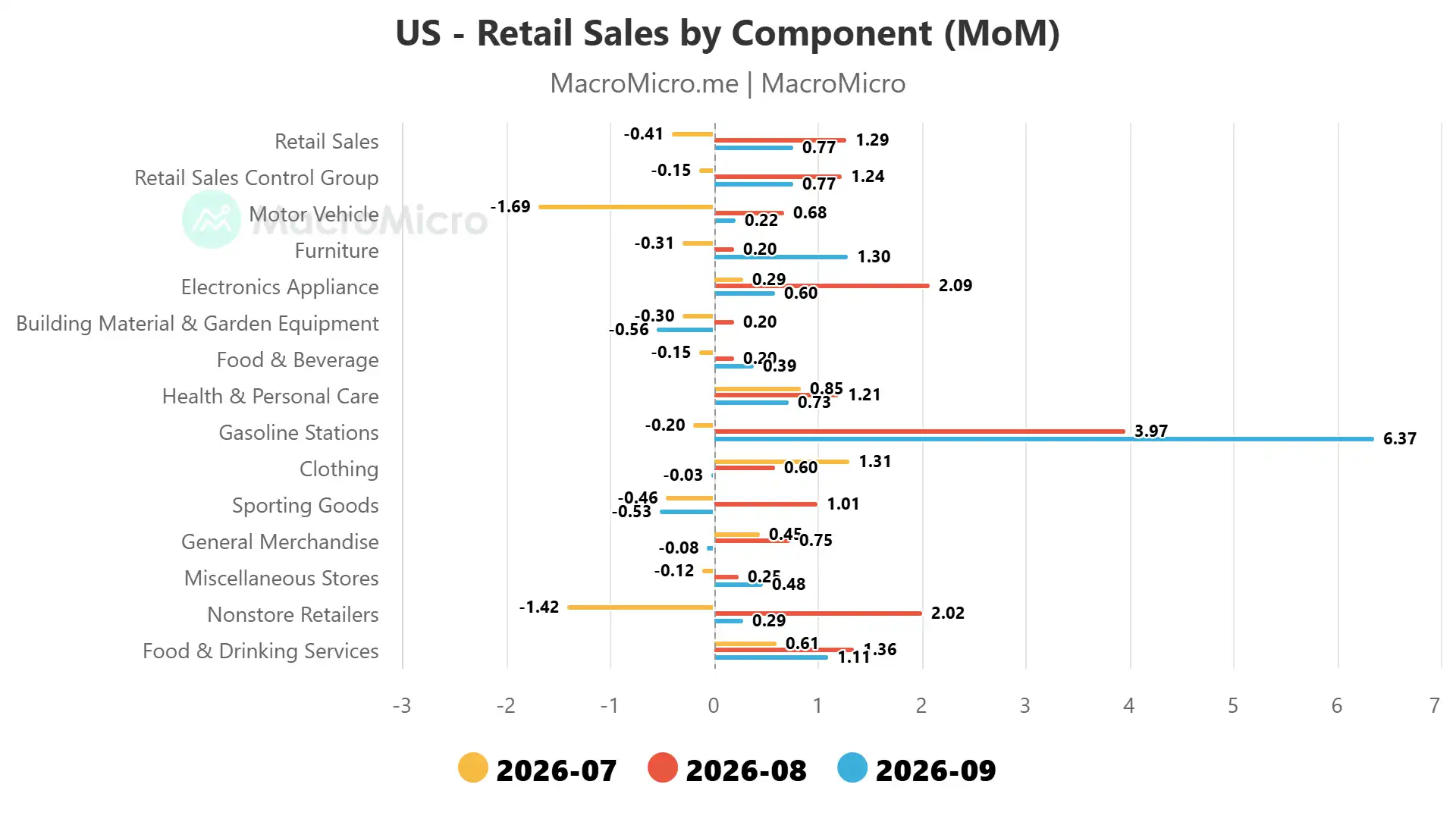
The retail sales report offers a clue. Receipts rose 0.8% in September, well above the 0.3% expected, after a 1.3% jump the prior month. The data are not adjusted for inflation, however, and much of the gain came from gasoline stations, where higher prices inflated spending. Elsewhere, outlays seem to be retreating. Sales growth at non-store retailers, mostly online, slowed to 0.3% from 2%. Spending on motor vehicles and on electronics and appliances slowed sharply, and general merchandise sales turned negative. A bigger share of household income going to energy appears to be crowding out other purchases.
The Fed’s Beige Book survey of regional economic conditions told a similar story. Activity was little changed overall, but growth remains narrow. Manufacturing is the main engine, driven by data centers, defense, and energy-related demand, while consumer-facing sectors are under increasing strain. Most notably, consumer stress has broadened beyond lower-income households to middle-income ones, and the boost from the World Cup seen in the second quarter has faded.
Sentiment surveys concur. The Conference Board’s consumer confidence index recently fell to its lowest since 2014, and the University of Michigan’s gauge notched its second-lowest reading on record.
That may explain the bond market’s reaction. Breakeven inflation rates priced into Treasuries have stopped tracking oil higher, suggesting markets see demand destruction from a slowing economy outweighing the cost push from pricier energy. The Atlanta Fed’s GDPNow model is at 3.6% for the third quarter, down from 5-6% when tracking began in late July. The official estimate arrives October 29.
If the consumer keeps retrenching, the bond rally may have further to run as 2027 rate hike bets look increasingly overdone. That could keep gold supported while the US dollar retreats against its major counterparts. Stocks may struggle, however, as a weakening economy weighs on earnings outside the AI buildout.
Ilya Spivak, tastylive Head of Global Macro, has over 15 years of experience in trading strategy. He specializes in identifying thematic moves in currencies, commodities, interest rates and equities. He hosts Macro Money and co-hosts Overtime, Monday-Thursday. @Ilyaspivak
For live daily programming, market news and commentary, visit tastylive.com or @tastyliveshow on YouTube
Trade with a better broker, open a tastytrade account today. tastylive, Inc. and tastytrade, Inc. are separate but affiliated companies.
Options involve risk and are not suitable for all investors. Please read Characteristics and Risks of Standardized Options before deciding to invest in options.
tastylive content is created, produced, and provided solely by tastylive, Inc. (“tastylive”) and is for informational and educational purposes only. It is not, nor is it intended to be, trading or investment advice or a recommendation that any security, futures contract, digital asset, other product, transaction, or investment strategy is suitable for any person. Trading securities, futures products, and digital assets involve risk and may result in a loss greater than the original amount invested. tastylive, through its content, financial programming or otherwise, does not provide investment or financial advice or make investment recommendations. Investment information provided may not be appropriate for all investors and is provided without respect to individual investor financial sophistication, financial situation, investing time horizon or risk tolerance. tastylive is not in the business of transacting securities trades, nor does it direct client commodity accounts or give commodity trading advice tailored to any particular client’s situation or investment objectives. Supporting documentation for any claims (including claims made on behalf of options programs), comparisons, statistics, or other technical data, if applicable, will be supplied upon request. tastylive is not a licensed financial adviser, registered investment adviser, or a registered broker-dealer. Options, futures, and futures options are not suitable for all investors. Prior to trading securities, options, futures, or futures options, please read the applicable risk disclosures, including, but not limited to, the Characteristics and Risks of Standardized Options Disclosure and the Futures and Exchange-Traded Options Risk Disclosure found on tastytrade.com/disclosures.
tastytrade, Inc. ("tastytrade”) is a registered broker-dealer and member of FINRA, NFA, and SIPC. tastytrade was previously known as tastyworks, Inc. (“tastyworks”). tastytrade offers self-directed brokerage accounts to its customers. tastytrade does not give financial or trading advice, nor does it make investment recommendations. You alone are responsible for making your investment and trading decisions and for evaluating the merits and risks associated with the use of tastytrade’s systems, services or products. tastytrade is a wholly-owned subsidiary of tastylive, Inc.
tastytrade has entered into a Marketing Agreement with tastylive (“Marketing Agent”) whereby tastytrade pays compensation to Marketing Agent to recommend tastytrade’s brokerage services. The existence of this Marketing Agreement should not be deemed as an endorsement or recommendation of Marketing Agent by tastytrade. tastytrade and Marketing Agent are separate entities with their own products and services. tastylive is the parent company of tastytrade.
tastyfx, LLC (“tastyfx”) is a Commodity Futures Trading Commission (“CFTC”) registered Retail Foreign Exchange Dealer (RFED) and Introducing Broker (IB) and Forex Dealer Member (FDM) of the National Futures Association (“NFA”) (NFA ID 0509630). Leveraged trading in foreign currency or off-exchange products on margin carries significant risk and may not be suitable for all investors. We advise you to carefully consider whether trading is appropriate for you based on your personal circumstances as you may lose more than you invest.
tastycrypto is provided solely by tasty Software Solutions, LLC. tasty Software Solutions, LLC is a separate but affiliate company of tastylive, Inc. Neither tastylive nor any of its affiliates are responsible for the products or services provided by tasty Software Solutions, LLC. Cryptocurrency trading is not suitable for all investors due to the number of risks involved. The value of any cryptocurrency, including digital assets pegged to fiat currency, commodities, or any other asset, may go to zero.
© copyright 2013 - 2026 tastylive, Inc. All Rights Reserved. Applicable portions of the Terms of Use on tastylive.com apply. Reproduction, adaptation, distribution, public display, exhibition for profit, or storage in any electronic storage media in whole or in part is prohibited under penalty of law, provided that you may download tastylive’s podcasts as necessary to view for personal use. tastylive was previously known as tastytrade, Inc. tastylive is a trademark/servicemark owned by tastylive, Inc.
Your privacy choices