Markets Shrugged Off the Best Data Since 2022. That is a Tell.

Markets Shrugged Off the Best Data Since 2022. That is a Tell.
By:Ilya Spivak
The markets ignored white-hot US economic activity data after readily repricing amid three weeks of soft news-flow. Will Jackson Hole confirm their fears?
- Friday’s US PMI data showed the fastest US economic activity growth since 2022, led by the services sector, and markets scarcely reacted
- Headline odds of a rate hike by December look emphatic at 92%, yet every individual meeting is close to a coin toss
- Kevin Warsh gives his first Jackson Hole address as chair, and vagueness may be the most dovish thing he can offer
Markets opened the week quietly. The bellwether S&P 500 idled after a pullback to chart support just above 7600. The tech-heavy Nasdaq 100 looked soggier, slipping to its lowest close in three weeks. Crude oil eased back from a one-month high after Treasury Secretary Scott Bessent unveiled a sanctions campaign against Iran while long-dated Treasury bonds marked time in the narrow range containing them throughout August. Gold lazily drifted up to another three-month high, while US dollar sat anchored against an average of its top currency counterparts.
This broadly muted price action seemed to echo the almost eerie quiet on display late last week, when markets seemed to sleep through explosive US economic data. Friday brought the S&P Global purchasing managers index (PMI) survey of US business activity. It showed the fastest expansion since 2022, powered by a revival in services, which is precisely the healthy composition that markets might have been expected to cheer. Traders responded with a shrug, pausing a dovish repricing in Fed policy expectations since the beginning of the month, and little else.
Good news is noise, bad news is signal
This points to an unmistakable asymmetry. Three weeks of disappointing data releases this month have unmistakably moved rate expectations, the dollar, and precious metals. The single strongest reading in nearly four years moved almost nothing. A market that ignores evidence against its thesis while acting on every scrap that supports it seems to have already reached a verdict, and that appears to bode ill for US consumers.
The case has been building for weeks. Retail sales data disappointed, consumer confidence sagged, and both retail (CPI) and wholesale (PPI) inflation showed demand-side pressure fading independently of the widely expected washing out of the Iran war’s oil shock from the figures. Households appear to be pulling in their horns, and since consumption accounts for roughly 68% of output, a real retrenchment ought to easily overpower the uplift from the feverish buildout of artificial intelligence (AI). Against that, one strong month of PMI data reads as an outlier rather than a refutation.
Why 92% odds of a rate hike are misleading
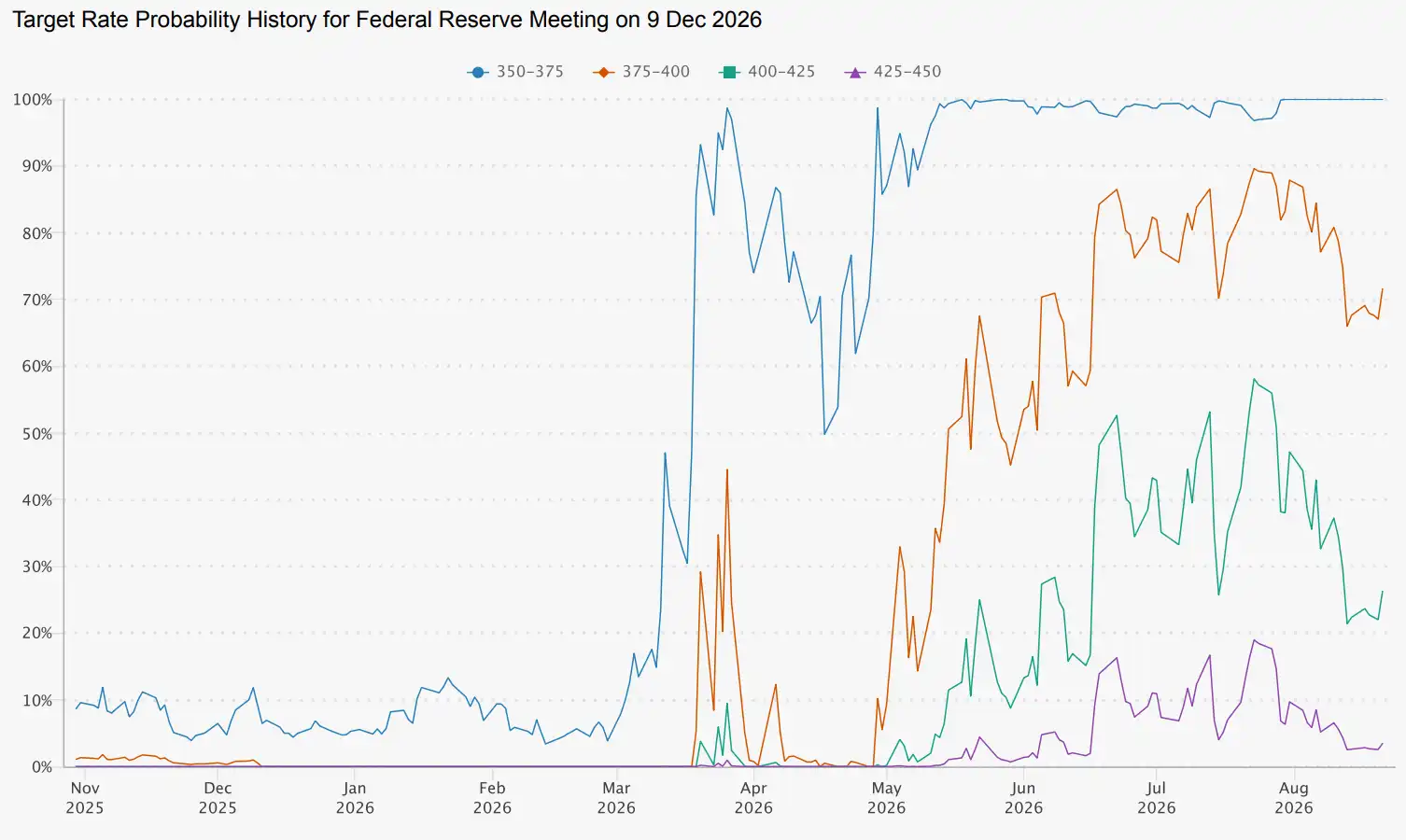
Nowhere is the lack of conviction clearer than in rate pricing. Futures imply a 92% chance of at least one hike by December, a number that sounds decisive until it is taken apart. That figure is cumulative, stacking the odds of a move at each meeting between now and year-end. Unstack it and September sits near an even split leaning toward a hold, October is a coin toss, and December carries standalone odds of roughly 45%. There is no meeting on the calendar through the end of next year where traders hold better than even conviction in any single outcome.
The drift has been steady. Probabilities of one, two and three hikes by December have all faded since the start of August, and they faded in lockstep with gold’s rally and the dollar’s slide. Worth noting is that those two moves began weeks before last week’s Treasury bond buyback intervention, so whatever they are pricing, it is not the latest yield suppression effort from Scott Bessent.
The data underneath keeps disappointing
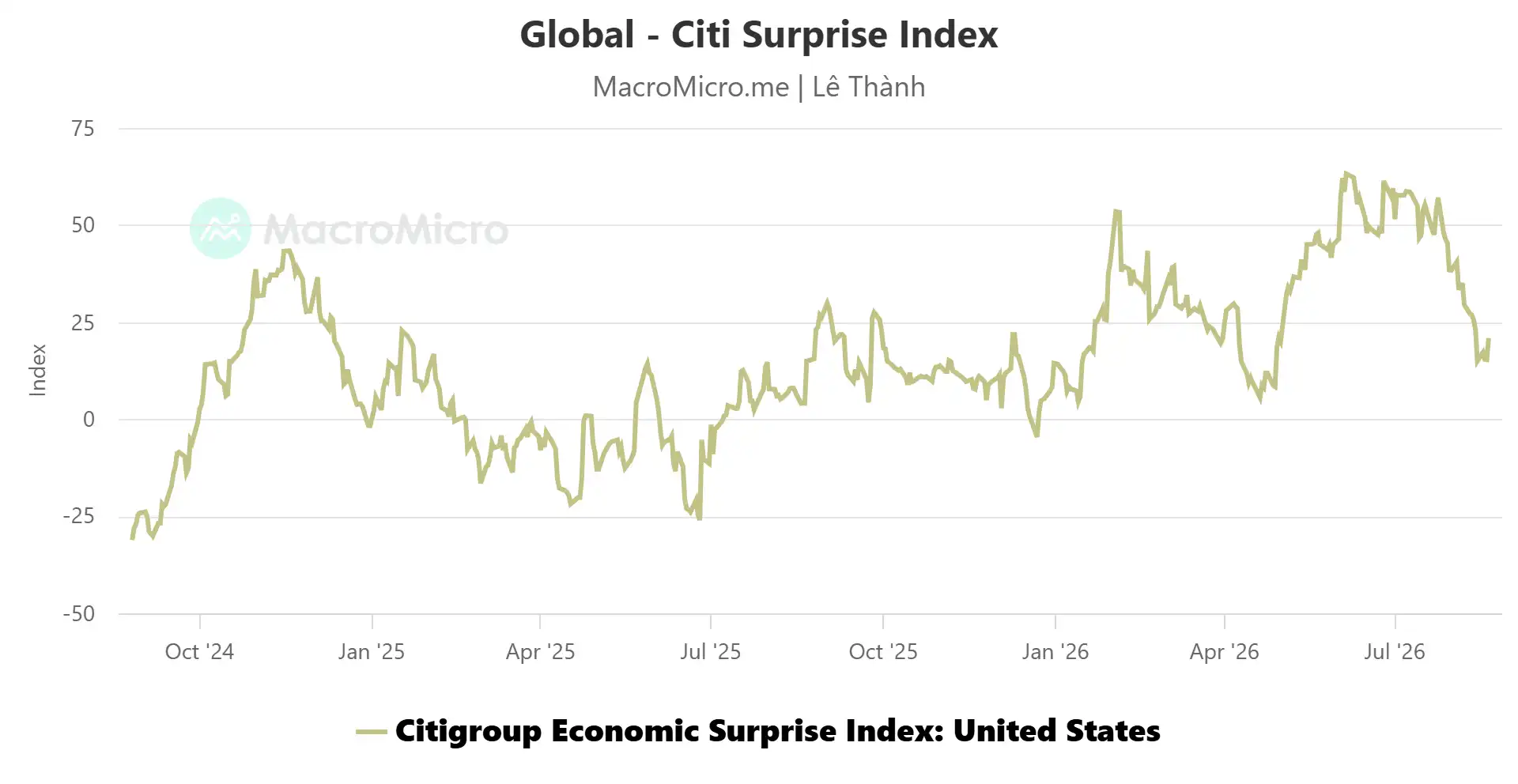
The Citigroup economic surprise index, which measures data against forecasts, has turned steeply lower, meaning analysts keep setting the bar higher than the economy can clear. The Atlanta Fed’s GDPNow model tells the same story: third-quarter figures are not due until October, so the level matters less than the trajectory, and that has pointed downward as each new release lands since the month began.
The bond market has drawn its own conclusion. Breakeven inflation rates tracked crude oil closely through the first half of the year, rising when the US-Iran war erupted and falling as traders flirted with the idea of the conflict ending. Crude has since rebounded toward its wartime highs, and breakevens have refused to follow, stuck near where they began the year. The markets seem to be saying that – fraught geopolitics notwithstanding – a disinflationary force looms on the horizon, and an economic downturn may well be it.
What Warsh can say at Jackson Hole
The catalyst that seems to matter most from here comes Friday, when Kevin Warsh delivers his first keynote address as Fed chair at the central bank’s annual Jackson Hole symposium. The outing is traditionally where the chair hands the markets a lens through which to read policy, as awkward as that sounds for a central bank leader that has made his distaste for forward guidance a defining principle.
What traders may end up with is another exercise in strategic vagueness, which they may well interpret to mean that the Fed feels no urgency to commit one way or another. Keeping things deliberately unclear buys the committee time, which markets already questioning officials’ appetite for rate hikes may read as permission to keep pushing the dollar lower and the metals higher. That might leave stocks faced with the uncomfortable possibility that the policy outlook is turning more dovish because the economy is buckling. Such a realization threatens to send them lower.
Ilya Spivak, tastylive Head of Global Macro, has over 15 years of experience in trading strategy. He specializes in identifying thematic moves in currencies, commodities, interest rates and equities. He hosts Macro Money and co-hosts Overtime, Monday-Thursday. @Ilyaspivak
For live daily programming, market news and commentary, visit tastylive.com or @tastyliveshow on YouTube
Trade with a better broker, open a tastytrade account today. tastylive, Inc. and tastytrade, Inc. are separate but affiliated companies.
Options involve risk and are not suitable for all investors. Please read Characteristics and Risks of Standardized Options before deciding to invest in options.
tastylive content is created, produced, and provided solely by tastylive, Inc. (“tastylive”) and is for informational and educational purposes only. It is not, nor is it intended to be, trading or investment advice or a recommendation that any security, futures contract, digital asset, other product, transaction, or investment strategy is suitable for any person. Trading securities, futures products, and digital assets involve risk and may result in a loss greater than the original amount invested. tastylive, through its content, financial programming or otherwise, does not provide investment or financial advice or make investment recommendations. Investment information provided may not be appropriate for all investors and is provided without respect to individual investor financial sophistication, financial situation, investing time horizon or risk tolerance. tastylive is not in the business of transacting securities trades, nor does it direct client commodity accounts or give commodity trading advice tailored to any particular client’s situation or investment objectives. Supporting documentation for any claims (including claims made on behalf of options programs), comparisons, statistics, or other technical data, if applicable, will be supplied upon request. tastylive is not a licensed financial adviser, registered investment adviser, or a registered broker-dealer. Options, futures, and futures options are not suitable for all investors. Prior to trading securities, options, futures, or futures options, please read the applicable risk disclosures, including, but not limited to, the Characteristics and Risks of Standardized Options Disclosure and the Futures and Exchange-Traded Options Risk Disclosure found on tastytrade.com/disclosures.
tastytrade, Inc. ("tastytrade”) is a registered broker-dealer and member of FINRA, NFA, and SIPC. tastytrade was previously known as tastyworks, Inc. (“tastyworks”). tastytrade offers self-directed brokerage accounts to its customers. tastytrade does not give financial or trading advice, nor does it make investment recommendations. You alone are responsible for making your investment and trading decisions and for evaluating the merits and risks associated with the use of tastytrade’s systems, services or products. tastytrade is a wholly-owned subsidiary of tastylive, Inc.
tastytrade has entered into a Marketing Agreement with tastylive (“Marketing Agent”) whereby tastytrade pays compensation to Marketing Agent to recommend tastytrade’s brokerage services. The existence of this Marketing Agreement should not be deemed as an endorsement or recommendation of Marketing Agent by tastytrade. tastytrade and Marketing Agent are separate entities with their own products and services. tastylive is the parent company of tastytrade.
tastyfx, LLC (“tastyfx”) is a Commodity Futures Trading Commission (“CFTC”) registered Retail Foreign Exchange Dealer (RFED) and Introducing Broker (IB) and Forex Dealer Member (FDM) of the National Futures Association (“NFA”) (NFA ID 0509630). Leveraged trading in foreign currency or off-exchange products on margin carries significant risk and may not be suitable for all investors. We advise you to carefully consider whether trading is appropriate for you based on your personal circumstances as you may lose more than you invest.
tastycrypto is provided solely by tasty Software Solutions, LLC. tasty Software Solutions, LLC is a separate but affiliate company of tastylive, Inc. Neither tastylive nor any of its affiliates are responsible for the products or services provided by tasty Software Solutions, LLC. Cryptocurrency trading is not suitable for all investors due to the number of risks involved. The value of any cryptocurrency, including digital assets pegged to fiat currency, commodities, or any other asset, may go to zero.
© copyright 2013 - 2026 tastylive, Inc. All Rights Reserved. Applicable portions of the Terms of Use on tastylive.com apply. Reproduction, adaptation, distribution, public display, exhibition for profit, or storage in any electronic storage media in whole or in part is prohibited under penalty of law, provided that you may download tastylive’s podcasts as necessary to view for personal use. tastylive was previously known as tastytrade, Inc. tastylive is a trademark/servicemark owned by tastylive, Inc.
Your privacy choices