Microsoft Earnings Preview: Can Azure Justify a $220 Billion Capex Bill?

Microsoft Earnings Preview: Can Azure Justify a $220 Billion Capex Bill?
By:Mike Butler
- Microsoft (NASDAQ: MSFT) reports fiscal fourth-quarter 2026 earnings on July 29, its final quarter of the fiscal year, which means management must also guide for fiscal 2027, the number the whole AI trade is waiting on.
- Analysts are forecasting EPS of roughly $4.21 to $4.24 on revenue near $87.7 billion, representing year-over-year growth of about 15% and 15%, respectively, extending a streak of four straight quarterly beats.
- Azure grew 40% last quarter (39% in constant currency), and whether that number holds above 35% or accelerates further will matter more to the stock than the headline EPS print.
- MSFT trades roughly 29% below its 52-week high of $555.45, at about 20.6 times forward earnings, among the cheapest multiples the stock has carried in years despite still posting double-digit revenue growth.
- The central tension heading into Wednesday is capital expenditures. Microsoft already guided to $190 billion for calendar 2026, up 61% from 2025, and analysts expect FY2027 guidance to land in the 20% to 30% growth range, or roughly $220 billion.
Microsoft Earnings Preview - July 2026
Microsoft has had a rough stretch by its own standards. Shares sit at $389.51 as of July 27, down about 25.7% over the past year and well off the 52-week high of $555.45 set last summer. That drawdown has happened even as the underlying business keeps growing at a clip most large-cap companies would envy. Last quarter, Microsoft beat on both the top and bottom lines, with revenue of $82.9 billion (up 18% year over year) and adjusted EPS of $4.27 versus the $4.06 Street estimate. Azure and other cloud services grew 40% in constant currency, and Copilot paid seats surpassed 20 million, up more than 250% year over year. None of that stopped the stock from sliding, because investors have been fixated on one line item: capex.
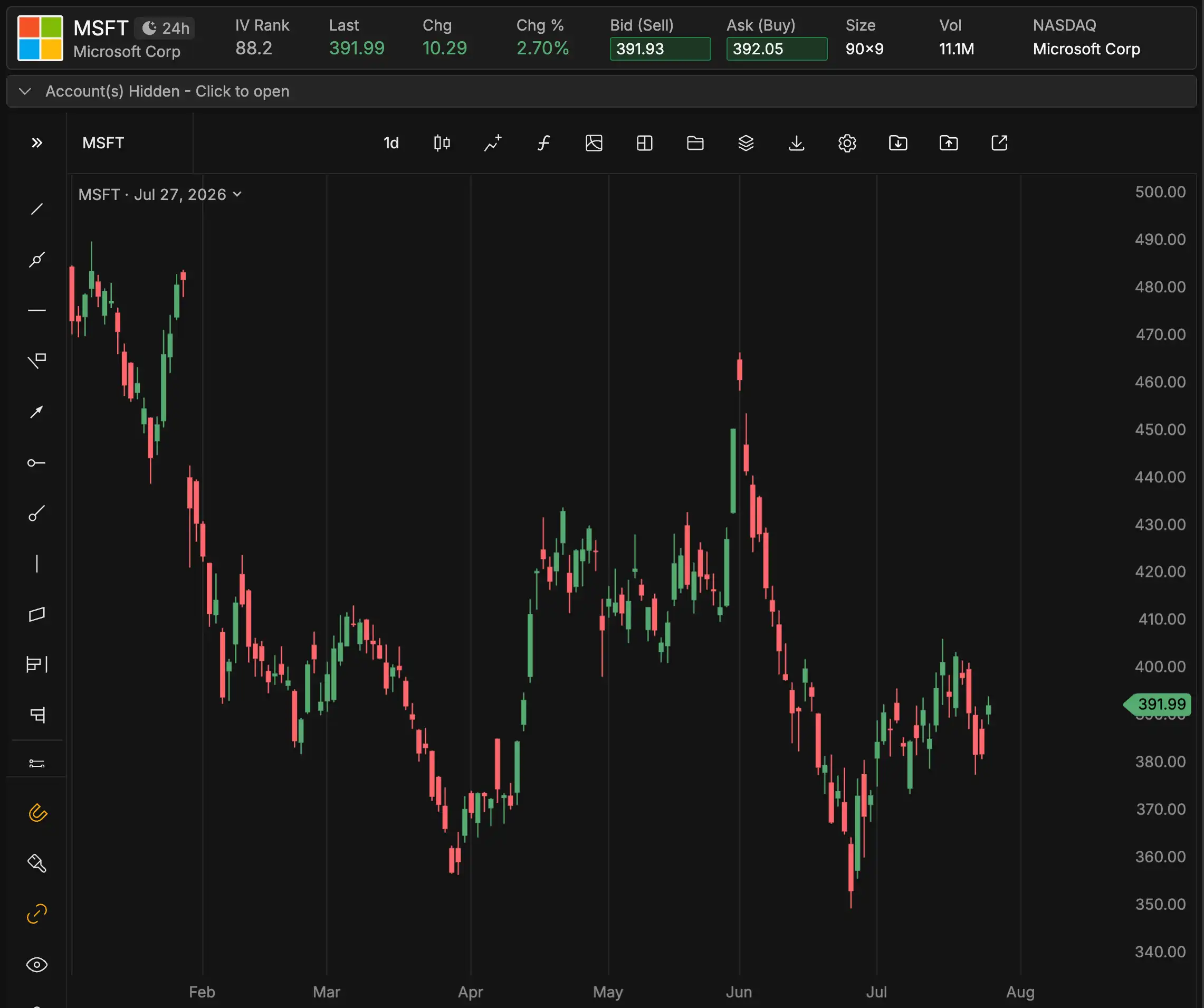
Wednesday's report closes out fiscal 2026, so Microsoft has to say something concrete about fiscal 2027 spending. Consensus sits at revenue of roughly $87.7 billion (up 14.7% year over year) and EPS of about $4.22, up 15.6%. Those numbers are almost secondary. The real question is whether CFO Amy Hood's capex guidance comes in around $220 billion, which would represent 20% to 30% growth and would read as disciplined relative to Azure's own growth rate, or whether it runs hotter and reinforces fears that the spending machine has no ceiling.
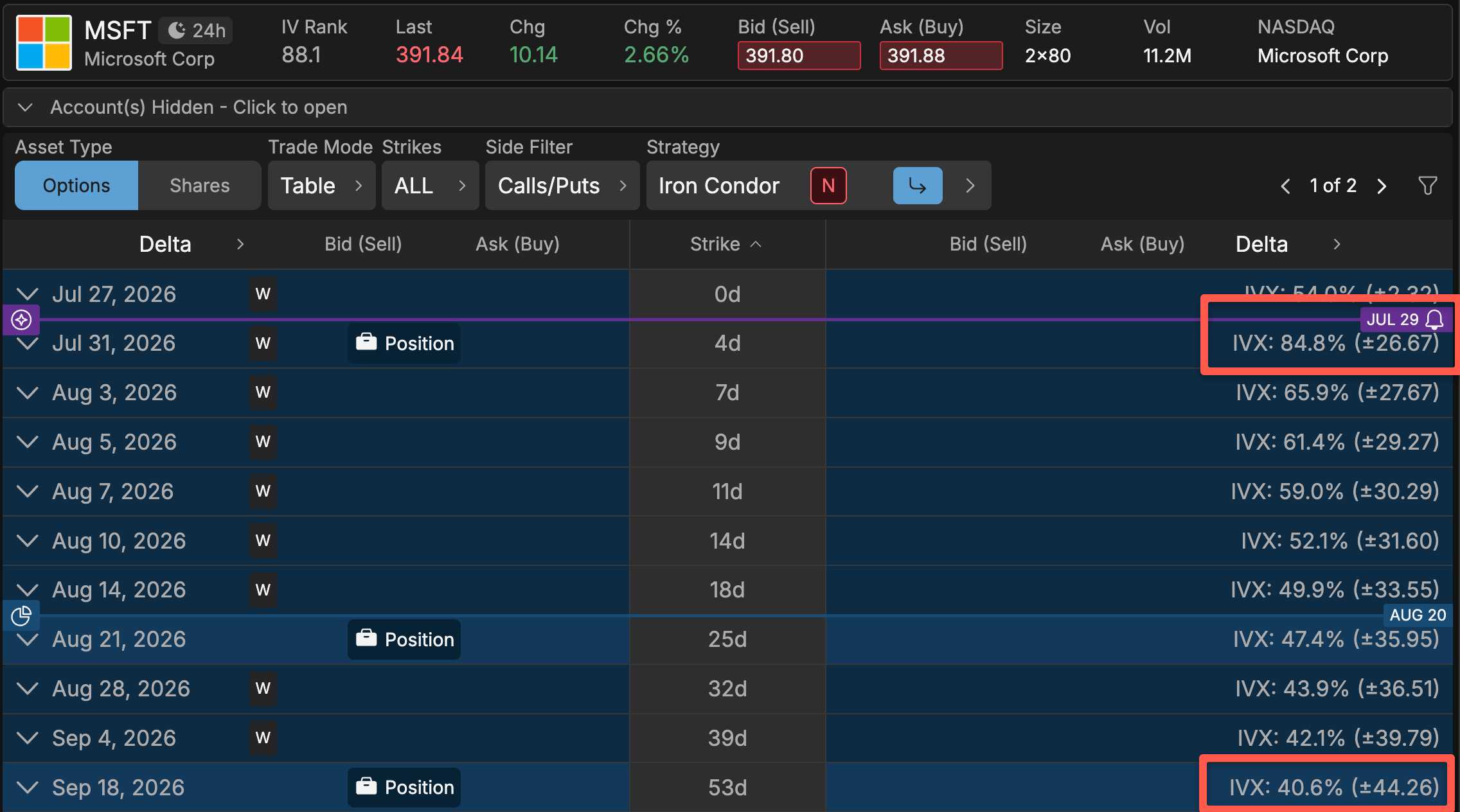
MSFT implied volatility is somewhat elevated ahead of the announcement, with a notional value implied move of 6.5% for this week. Looking further to September 2026, we can see just how much of this implied volatility is baked into a longer term cycle. September's implied move is only +-$44.26, and this week's expected move accounts for 60% of that implied range. I expect all of these implied volatility readings to crush down closer to 35% as that's what we're seeing in the very long term cycles that have many earnings announcements within them.
Azure Growth Is the Headline Number That Matters Most
Azure's growth rate is the single most-watched metric in this report. Microsoft guided last quarter to 39% to 40% Azure growth at constant currency for fiscal Q4, above the 37% consensus at the time. If Azure holds at or above that 39% to 40% range, or reaccelerates further, it reinforces the bull case that AI workloads are translating directly into cloud consumption. If growth slips meaningfully below 35%, it would echo the capex-to-revenue concerns that have already dogged Alphabet this earnings season. Microsoft's commercial bookings and remaining performance obligations, essentially contracted future revenue not yet recognized, will also get scrutiny as a forward-looking signal on whether AI demand is durable or front-loaded.
The $220 Billion Capex Question Heading Into Fiscal 2027
Microsoft's gross margin fell to 67.6% last quarter, its narrowest since 2022, as depreciation from the company's data center buildout mounted. Capital expenditures and finance leases hit $31.9 billion in fiscal Q3, up 49% year over year, and full calendar 2026 capex guidance stands at $190 billion, a 61% jump from 2025. Analysts widely expect Microsoft to guide FY2027 capex growth in the 20% to 30% range on this call, translating to roughly $220 billion. That figure matters because it needs to stay below Azure's own growth rate. If Microsoft's cloud engine can no longer fund its own buildout at a rate faster than spending grows, the market is likely to punish the stock the way it punished other hyperscalers on this same worry. A number that comes in meaningfully hotter than $220 billion, paired with any softening in Azure growth, would be the clearest bear signal available on Wednesday.
Bullish Case for Microsoft Earnings
Bulls point to valuation first. At roughly 20.6 times forward earnings, MSFT trades near its cheapest multiple in years for a company still growing revenue in the high teens. Analyst price targets remain well above the current share price, with an average target near $552 from a group of more than 50 analysts, the majority of whom rate the stock a strong buy, implying substantial upside from current levels. Azure's 39% to 40% growth rate is still one of the fastest in the hyperscaler group, and Copilot's rapid seat growth suggests Microsoft's AI products are finding paying enterprise customers, not just experimental pilots. If capex guidance for FY2027 comes in at or below the 20% to 30% range analysts expect, while Azure growth holds steady or accelerates, bulls argue the stock could see the kind of relief rally that comes from removing the market's single biggest overhang.
Bearish Case for Microsoft Earnings
Bears aren't arguing that Microsoft's cloud business is weak. They're questioning whether spending discipline exists at all. Gross margin has already compressed to its lowest level since 2022, and capex has been running ahead of consensus for multiple quarters straight, including a $31.9 billion figure last quarter against a Street estimate of $34.9 billion that still marked a 49% year-over-year jump. If FY2027 guidance comes in above $220 billion, especially if it's paired with Azure growth decelerating below 35%, the stock could revisit the kind of selloff that hit Alphabet's shares after its own capex disclosure earlier this earnings season. With MSFT already down nearly 30% from its highs, the market has priced in some caution, but a genuinely disappointing capex number, on top of an in-line quarter, is the scenario bears are watching for most closely.
Mike Butler, tastylive director of market intelligence, has been trading the markets for a decade. He appears on the tastylive morning show Monday - Friday. @tradermikeyb
For live daily programming, market news and commentary, visit tastylive or the YouTube channel tastylive (for options traders).
Trade with a better broker, open a tastytrade account today. tastylive, Inc. and tastytrade, Inc. are separate but affiliated companies.
Options involve risk and are not suitable for all investors. Please read Characteristics and Risks of Standardized Options before deciding to invest in options.
tastylive content is created, produced, and provided solely by tastylive, Inc. (“tastylive”) and is for informational and educational purposes only. It is not, nor is it intended to be, trading or investment advice or a recommendation that any security, futures contract, digital asset, other product, transaction, or investment strategy is suitable for any person. Trading securities, futures products, and digital assets involve risk and may result in a loss greater than the original amount invested. tastylive, through its content, financial programming or otherwise, does not provide investment or financial advice or make investment recommendations. Investment information provided may not be appropriate for all investors and is provided without respect to individual investor financial sophistication, financial situation, investing time horizon or risk tolerance. tastylive is not in the business of transacting securities trades, nor does it direct client commodity accounts or give commodity trading advice tailored to any particular client’s situation or investment objectives. Supporting documentation for any claims (including claims made on behalf of options programs), comparisons, statistics, or other technical data, if applicable, will be supplied upon request. tastylive is not a licensed financial adviser, registered investment adviser, or a registered broker-dealer. Options, futures, and futures options are not suitable for all investors. Prior to trading securities, options, futures, or futures options, please read the applicable risk disclosures, including, but not limited to, the Characteristics and Risks of Standardized Options Disclosure and the Futures and Exchange-Traded Options Risk Disclosure found on tastytrade.com/disclosures.
tastytrade, Inc. ("tastytrade”) is a registered broker-dealer and member of FINRA, NFA, and SIPC. tastytrade was previously known as tastyworks, Inc. (“tastyworks”). tastytrade offers self-directed brokerage accounts to its customers. tastytrade does not give financial or trading advice, nor does it make investment recommendations. You alone are responsible for making your investment and trading decisions and for evaluating the merits and risks associated with the use of tastytrade’s systems, services or products. tastytrade is a wholly-owned subsidiary of tastylive, Inc.
tastytrade has entered into a Marketing Agreement with tastylive (“Marketing Agent”) whereby tastytrade pays compensation to Marketing Agent to recommend tastytrade’s brokerage services. The existence of this Marketing Agreement should not be deemed as an endorsement or recommendation of Marketing Agent by tastytrade. tastytrade and Marketing Agent are separate entities with their own products and services. tastylive is the parent company of tastytrade.
tastyfx, LLC (“tastyfx”) is a Commodity Futures Trading Commission (“CFTC”) registered Retail Foreign Exchange Dealer (RFED) and Introducing Broker (IB) and Forex Dealer Member (FDM) of the National Futures Association (“NFA”) (NFA ID 0509630). Leveraged trading in foreign currency or off-exchange products on margin carries significant risk and may not be suitable for all investors. We advise you to carefully consider whether trading is appropriate for you based on your personal circumstances as you may lose more than you invest.
tastycrypto is provided solely by tasty Software Solutions, LLC. tasty Software Solutions, LLC is a separate but affiliate company of tastylive, Inc. Neither tastylive nor any of its affiliates are responsible for the products or services provided by tasty Software Solutions, LLC. Cryptocurrency trading is not suitable for all investors due to the number of risks involved. The value of any cryptocurrency, including digital assets pegged to fiat currency, commodities, or any other asset, may go to zero.
© copyright 2013 - 2026 tastylive, Inc. All Rights Reserved. Applicable portions of the Terms of Use on tastylive.com apply. Reproduction, adaptation, distribution, public display, exhibition for profit, or storage in any electronic storage media in whole or in part is prohibited under penalty of law, provided that you may download tastylive’s podcasts as necessary to view for personal use. tastylive was previously known as tastytrade, Inc. tastylive is a trademark/servicemark owned by tastylive, Inc.
Your privacy choices