MSFT Earnings Preview: Azure and AI Capex in Focus

MSFT Earnings Preview: Azure and AI Capex in Focus
By:Mike Butler
Microsoft Earnings Preview: Can Azure Justify a Near $4 Trillion Valuation?
By: Mike Butler
- Microsoft stock has climbed about 36% since its last earnings report on July 29, pushing the market cap to roughly $3.96 trillion and putting MSFT within about 4% of its 52-week high of $553.72.
- Analysts expect fiscal Q1 EPS of $4.71, up about 14% from $4.13 a year ago, on revenue of roughly $90.6 billion, which sits inside Microsoft’s own guidance range of $89.85 billion to $90.95 billion.
- Azure is guided to grow 44% to 45% in constant currency after accelerating to 43% last quarter, and commercial remaining performance obligation (RPO) stood at a record $678 billion, up 84% year over year.
- Microsoft has guided capital expenditures above $50 billion for the quarter, and the central debate heading into the print is whether AI spending is converting into revenue fast enough to protect margins.
- Options are pricing in a move of roughly 5% in either direction, but MSFT moved 13.4% after its last report against an implied move of 6.7%.
Microsoft Earnings Preview - October 2026
Microsoft (NASDAQ: MSFT) reports fiscal first quarter 2027 results on Wednesday, October 28, after the close. The stock closed Monday at $532.60 with a 52-week range of $349.20 to $553.72. That low came in late June, and shares have rallied sharply since Microsoft’s July report, when Azure growth accelerated and the stock jumped more than 13% the next day. At roughly 29.7 times trailing earnings, MSFT trades below its five-year median multiple of about 33, but the move has left little room for disappointment
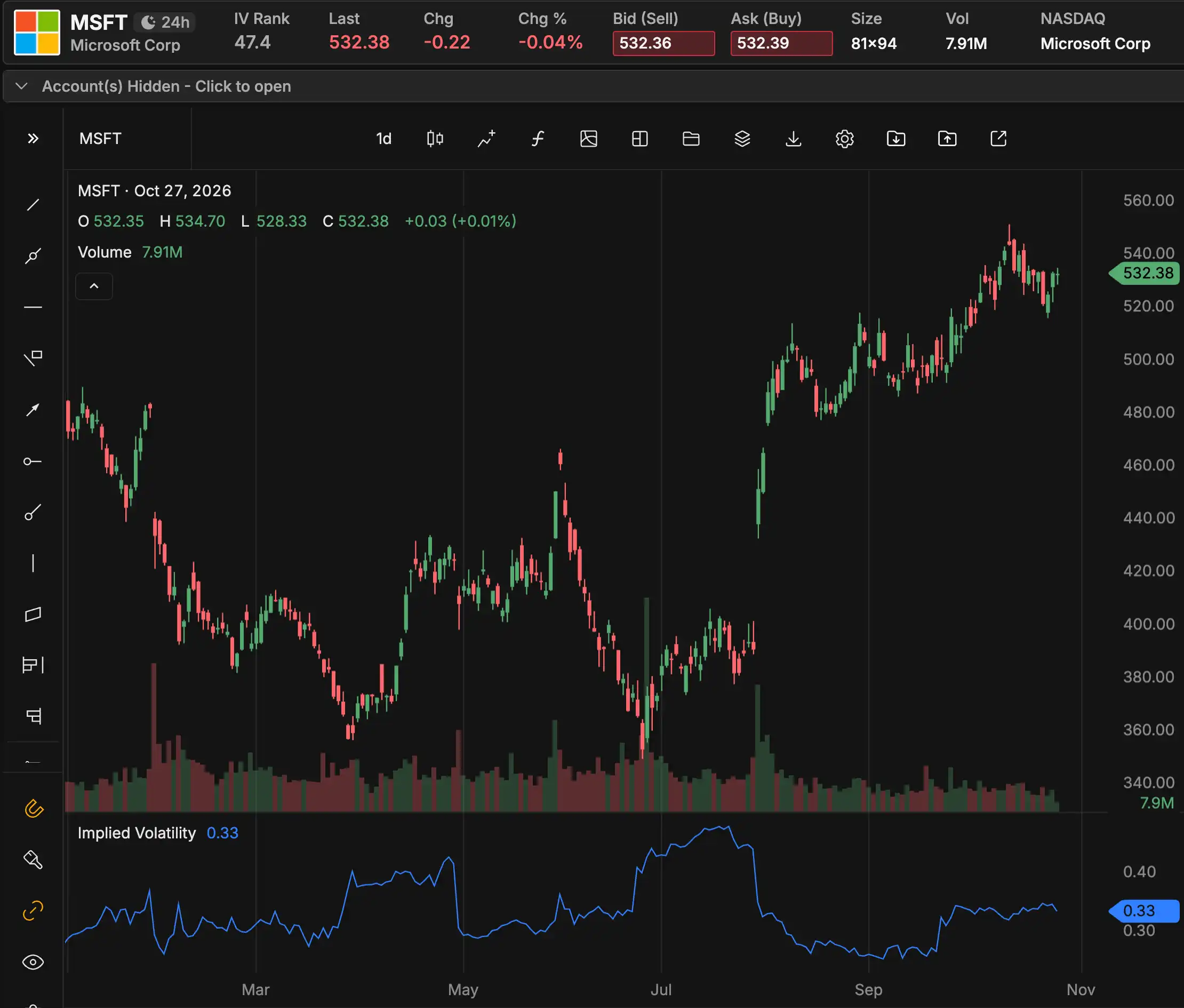
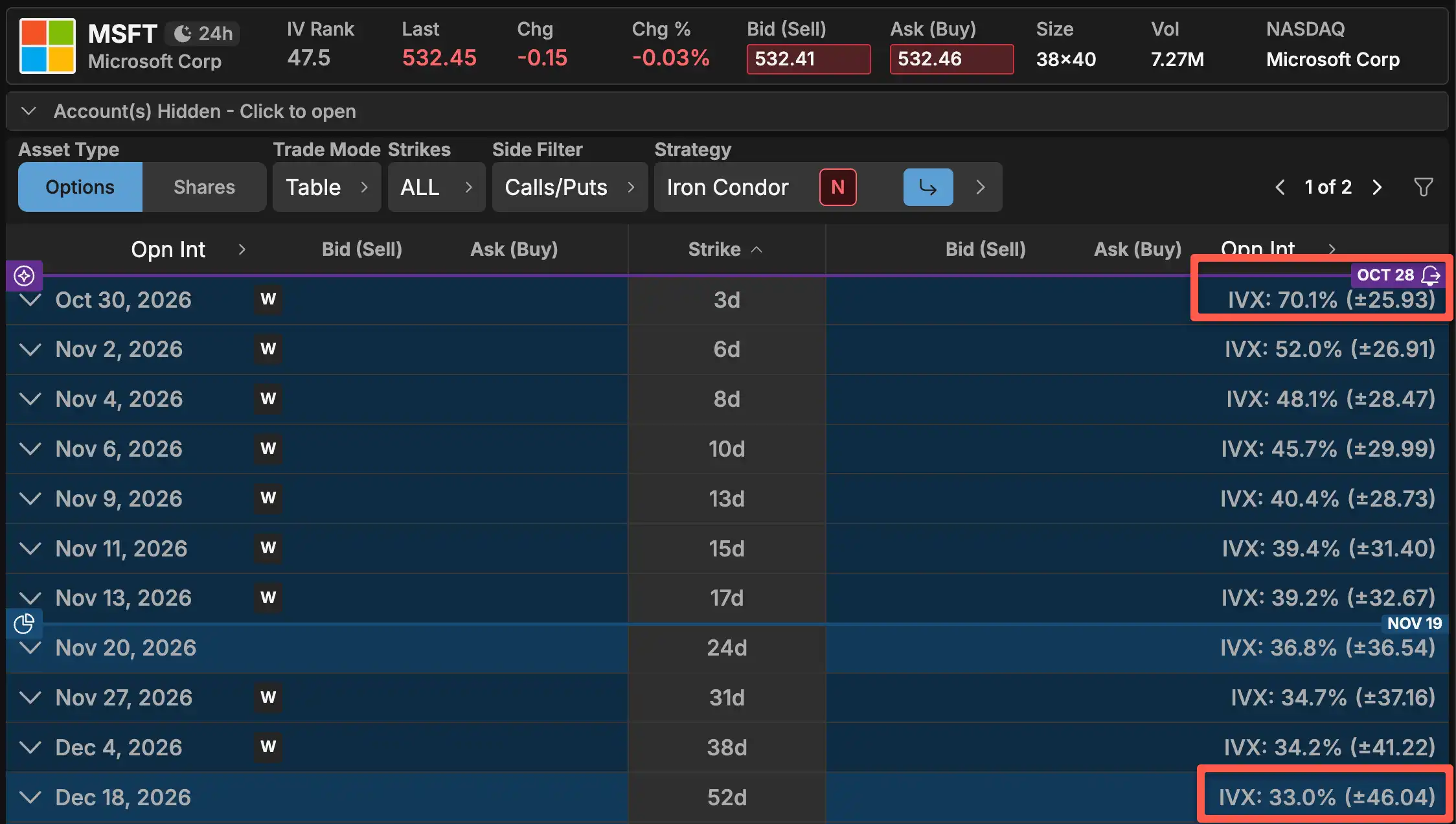
The implied volatility setup is moderate by earnings standards. The options market is pricing in a move of about $26, or roughly 5% of the notional value of the stock, which would put the expected range near $505 to $560 and would take MSFT through its 52-week high on the upside. History says to respect the tails. MSFT’s actual move exceeded the implied move in four of the last eight reports, including a 16% surge in April 2025 and a 13.4% jump last July. What's interesting is that the December 2026 cycle still has about 2x more implied volatility on a notional level, with a +-$46 implied range, so there is still some implied volatility priced in through the end of the year.
Microsoft Azure Growth and the $678 Billion Backlog
Azure remains the engine of the story. Microsoft’s cloud platform grew 43% in fiscal Q4 and crossed $100 billion in annual revenue for the first time, and management has guided to 44% to 45% growth this quarter. Intelligent Cloud revenue is guided to $40.95 billion to $41.25 billion, up 33% to 34%. One wrinkle to watch: Microsoft re-segmented its reporting in September, so Azure growth is now measured under an updated definition.
The backlog is the other headline number. Commercial RPO, the contracted revenue not yet recognized, hit $678 billion last quarter. Excluding OpenAI, it still grew 25%, which matters because concentration risk with OpenAI has been a persistent concern since early this year. Management has also said repeatedly that demand continues to exceed available capacity, so Azure growth is a function of how fast Microsoft can bring GPUs and data centers online.
Microsoft Capex: Is the AI Spending Paying Off?
Capital spending is where the bull and bear debates collide. Microsoft spent $41 billion on capex in fiscal Q4, roughly two thirds on short-lived assets like GPUs and CPUs, and has guided to more than $50 billion this quarter. Calendar 2026 capex is expected to land near $175 billion. Heavy depreciation has already pressured margins: gross margin slipped to 67.6% in fiscal Q3, the lowest since 2022, and cloud gross margin was 65% last quarter. Microsoft still guided operating margin roughly flat year over year, so any slippage there will draw attention.
The macro backdrop adds pressure. AI-linked stocks sold off on October 8 after a report that OpenAI’s revenue was lower than expected, and again on October 22, when MSFT fell 2.2%. Anthropic filed for its IPO on October 26, and Meta has outlined up to $95 billion in equity financing, keeping the question of how the AI buildout gets funded front and center.
Bullish Case for Microsoft Earnings
The bull case starts with momentum in estimates and demand. Analysts have nudged revenue estimates higher by about 1% over the past three months, with the biggest upward revisions concentrated in Intelligent Cloud, and Microsoft has a track record of beating on EPS, including a nearly 12% surprise last quarter ($4.74 versus $4.24). Microsoft 365 Copilot passed 30 million paid seats, up from 20 million one quarter earlier, with net seat additions more than doubling. Management is also adding usage-based billing for Copilot products, which could widen monetization. Sentiment on the Street is constructive: 43 of 49 analysts rate MSFT a Buy, the consensus price target is about $592, and Oppenheimer, Scotiabank, and Truist all lifted targets this week, with two of them going to $625. Bulls also point to Microsoft’s diversified AI exposure, including its roughly 27% stake in OpenAI and a relationship with Anthropic that includes both an investment and a large Azure commitment. A beat-and-raise on Azure with stable margins would give the stock a path through $553.72 into price discovery.
Bearish Case for Microsoft Earnings
Bears argue that MSFT is priced for a clean beat. The stock is up about 36% in three months, and the technical picture is less convincing than the headline: MSFT has stalled three times near $546, and momentum indicators have shown bearish divergence. The January report is the cautionary tale, when shares fell as much as 12% intraday after capex jumped 66% and Microsoft disclosed that roughly 45% of its RPO was tied to OpenAI. This time, more than $50 billion in quarterly capex, falling gross margins, and nervousness about AI financing could easily outweigh a strong Azure print. Weakness outside the cloud is another drag, with More Personal Computing revenue down 4% and Xbox content and services down 5% in the last report. If Azure comes in at the low end of guidance or management signals higher spending without a matching revenue lift, a stock sitting near its highs has a long way to fall.
Mike Butler, tastylive director of market intelligence, has been trading the markets for a decade. He appears on the tastylive morning show Monday - Friday. @tradermikeyb
For live daily programming, market news and commentary, visit tastylive or the YouTube channel tastylive (for options traders).
Trade with a better broker, open a tastytrade account today. tastylive, Inc. and tastytrade, Inc. are separate but affiliated companies.
Options involve risk and are not suitable for all investors. Please read Characteristics and Risks of Standardized Options before deciding to invest in options.
tastylive content is created, produced, and provided solely by tastylive, Inc. (“tastylive”) and is for informational and educational purposes only. It is not, nor is it intended to be, trading or investment advice or a recommendation that any security, futures contract, digital asset, other product, transaction, or investment strategy is suitable for any person. Trading securities, futures products, and digital assets involve risk and may result in a loss greater than the original amount invested. tastylive, through its content, financial programming or otherwise, does not provide investment or financial advice or make investment recommendations. Investment information provided may not be appropriate for all investors and is provided without respect to individual investor financial sophistication, financial situation, investing time horizon or risk tolerance. tastylive is not in the business of transacting securities trades, nor does it direct client commodity accounts or give commodity trading advice tailored to any particular client’s situation or investment objectives. Supporting documentation for any claims (including claims made on behalf of options programs), comparisons, statistics, or other technical data, if applicable, will be supplied upon request. tastylive is not a licensed financial adviser, registered investment adviser, or a registered broker-dealer. Options, futures, and futures options are not suitable for all investors. Prior to trading securities, options, futures, or futures options, please read the applicable risk disclosures, including, but not limited to, the Characteristics and Risks of Standardized Options Disclosure and the Futures and Exchange-Traded Options Risk Disclosure found on tastytrade.com/disclosures.
tastytrade, Inc. ("tastytrade”) is a registered broker-dealer and member of FINRA, NFA, and SIPC. tastytrade was previously known as tastyworks, Inc. (“tastyworks”). tastytrade offers self-directed brokerage accounts to its customers. tastytrade does not give financial or trading advice, nor does it make investment recommendations. You alone are responsible for making your investment and trading decisions and for evaluating the merits and risks associated with the use of tastytrade’s systems, services or products. tastytrade is a wholly-owned subsidiary of tastylive, Inc.
tastytrade has entered into a Marketing Agreement with tastylive (“Marketing Agent”) whereby tastytrade pays compensation to Marketing Agent to recommend tastytrade’s brokerage services. The existence of this Marketing Agreement should not be deemed as an endorsement or recommendation of Marketing Agent by tastytrade. tastytrade and Marketing Agent are separate entities with their own products and services. tastylive is the parent company of tastytrade.
tastyfx, LLC (“tastyfx”) is a Commodity Futures Trading Commission (“CFTC”) registered Retail Foreign Exchange Dealer (RFED) and Introducing Broker (IB) and Forex Dealer Member (FDM) of the National Futures Association (“NFA”) (NFA ID 0509630). Leveraged trading in foreign currency or off-exchange products on margin carries significant risk and may not be suitable for all investors. We advise you to carefully consider whether trading is appropriate for you based on your personal circumstances as you may lose more than you invest.
tastycrypto is provided solely by tasty Software Solutions, LLC. tasty Software Solutions, LLC is a separate but affiliate company of tastylive, Inc. Neither tastylive nor any of its affiliates are responsible for the products or services provided by tasty Software Solutions, LLC. Cryptocurrency trading is not suitable for all investors due to the number of risks involved. The value of any cryptocurrency, including digital assets pegged to fiat currency, commodities, or any other asset, may go to zero.
© copyright 2013 - 2026 tastylive, Inc. All Rights Reserved. Applicable portions of the Terms of Use on tastylive.com apply. Reproduction, adaptation, distribution, public display, exhibition for profit, or storage in any electronic storage media in whole or in part is prohibited under penalty of law, provided that you may download tastylive’s podcasts as necessary to view for personal use. tastylive was previously known as tastytrade, Inc. tastylive is a trademark/servicemark owned by tastylive, Inc.
Your privacy choices