NVIDIA Earnings Preview: Can Blackwell Justify a $5 Trillion Valuation?

NVIDIA Earnings Preview: Can Blackwell Justify a $5 Trillion Valuation?
By:Mike Butler
- NVIDIA reports Q2 fiscal 2027 earnings after the close on Wednesday, August 26, with the stock trading near $215, roughly 9% off its 52-week high of $236.54 set in May.
- Analysts expect revenue of $91.9 billion and EPS of $2.08, representing year-over-year growth of approximately 97%, comfortably above NVIDIA's own guidance of $91.0 billion plus or minus 2%.
- Options are pricing in a post-earnings move of roughly 5%, well above NVIDIA's average earnings-day move of 2.8% over the past four quarters, signaling that traders expect this print to matter more than usual.
- NVIDIA is building its guidance around essentially zero China data center compute revenue, meaning any resumption of meaningful H200 shipments could represent pure upside to Q3 guidance.
- The key debate heading into the report isn't whether NVIDIA beats Q2 numbers that are already known through its own guidance. It's whether Q3 guidance clears the bar Wall Street has set: $103 billion or higher.
NVIDIA Earnings Preview - August 2026
NVIDIA (NASDAQ: NVDA) heads into its fiscal second-quarter report as the final domino in "Magnificent Seven" earnings season, and also the one the market has been waiting on. Shares closed near $214.72 on Friday, down about 5% over the past week and roughly 9% below the all-time high hit in mid-May. Year to date, the stock is up modestly, a far quieter run than the AI trade delivered in 2024 and 2025. The pullback comes amid a broader semiconductor selloff and fresh reports that AI server prices are rising more than 15% due to surging memory costs, a dynamic that has investors reassessing margins across the entire AI supply chain just as NVIDIA prepares to report.
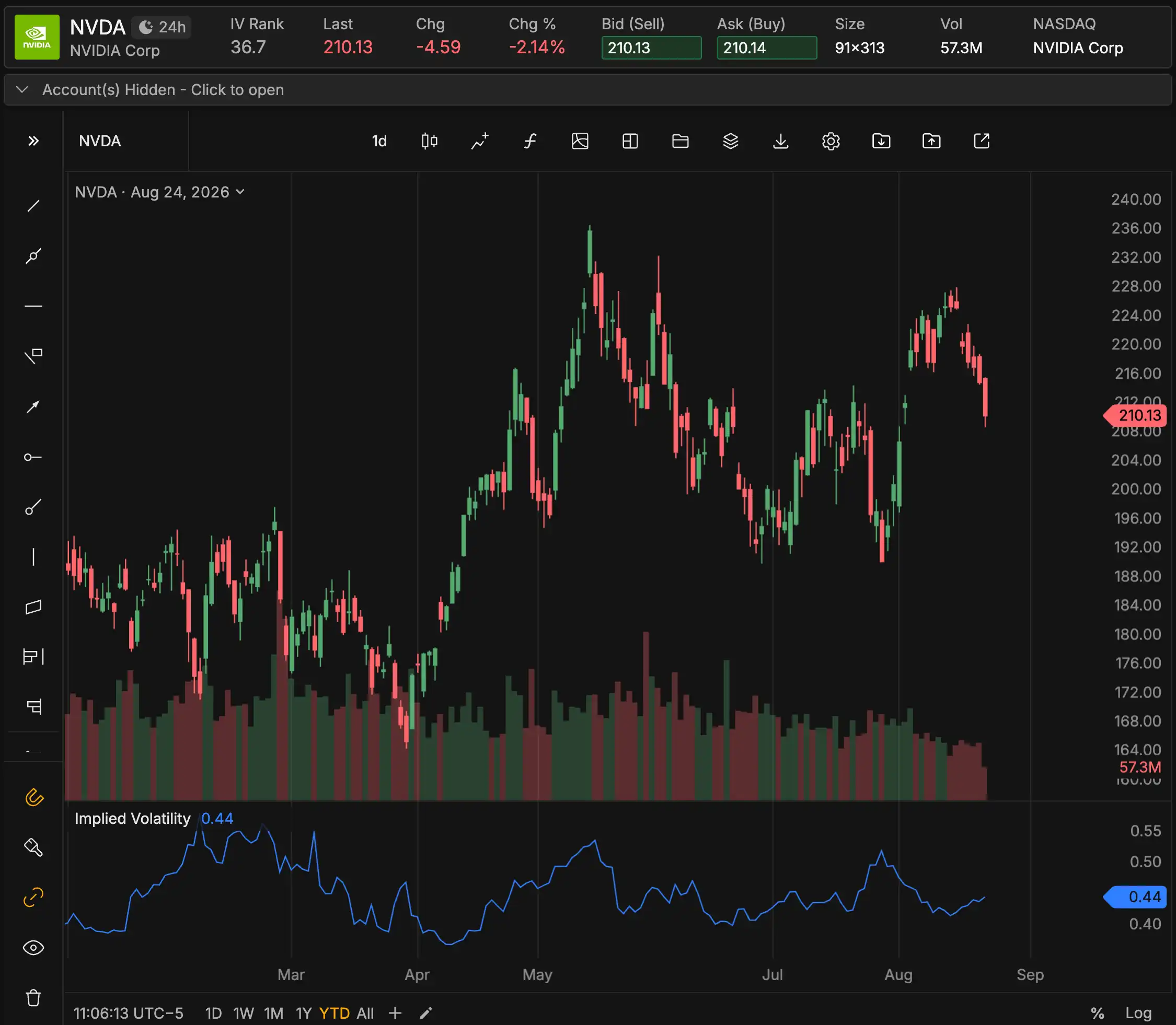
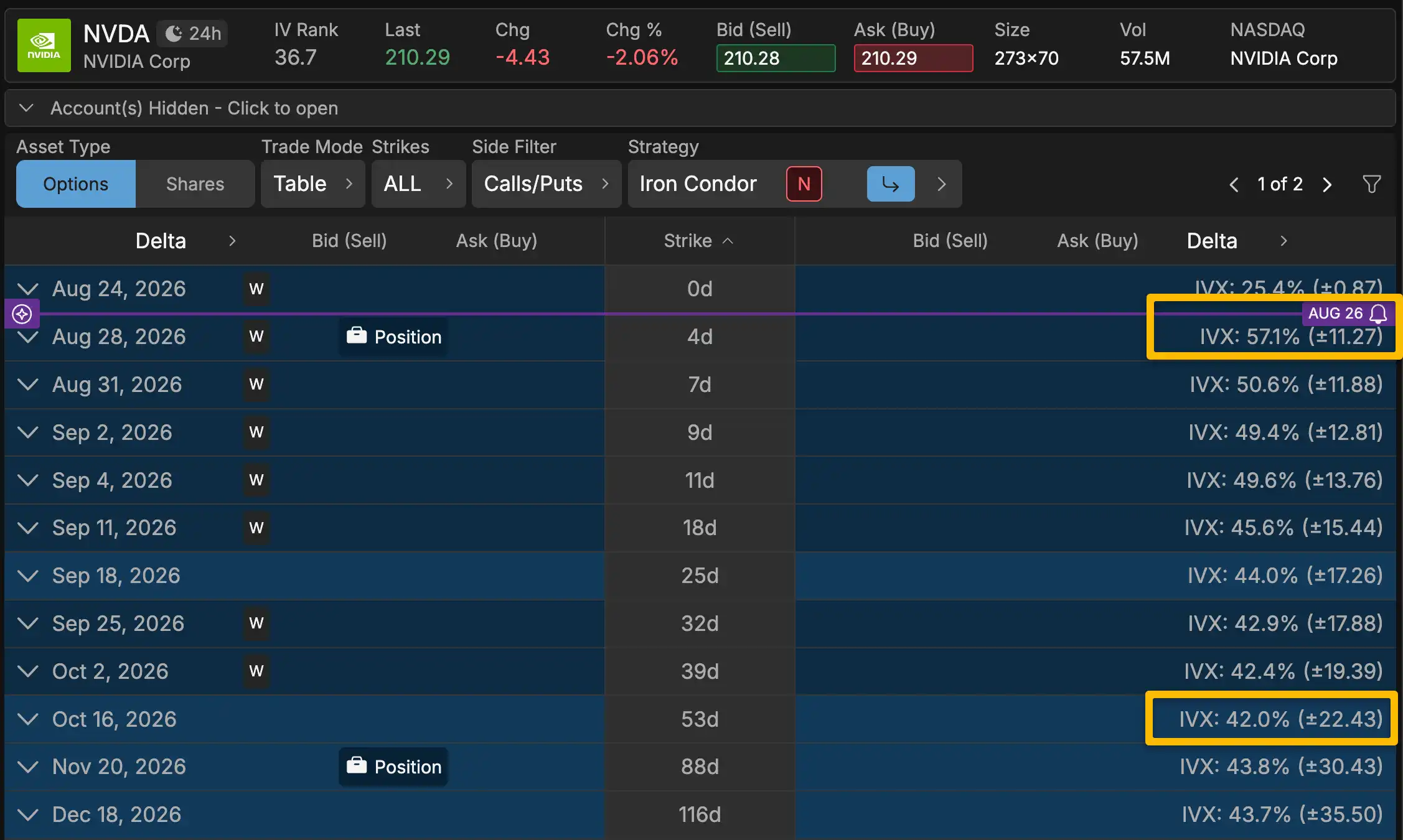
NVIDIA's options market is pricing in an implied move of roughly 5% for the week of earnings, equal to about $11 per share in either direction. That's more than double the stock's average post-earnings reaction of 2.8% over its last four reports, and it comes despite 30-day implied volatility of around 40%, only modestly above realized volatility near 38%. In plain terms: the options market expects this print to be a bigger deal than usual, even though the stock hasn't been especially volatile lately. With NVIDIA's market cap sitting above $5 trillion, a 5% swing represents about $2.5 billion in value moving in a single session, a figure that dwarfs the entire market capitalization of most S&P 500 companies. The weekly implied volatility also represents more than 50% of the implied range priced into the October cycle, which emphasizes the volatility of this earnings announcement.
What Wall Street Expects From NVIDIA's Q2 Print
NVIDIA already told investors most of what they need to know about Q2. Management guided to revenue of approximately $91.0 billion, plus or minus 2%, and consensus has settled just slightly above that at $91.9 billion, with EPS expected at $2.08. Both figures would represent roughly 97% growth from the $46.74 billion in revenue and $1.05 in adjusted EPS NVIDIA reported in the same quarter a year ago. The prior quarter, Q1 FY2027, set a strong baseline: revenue rose 20% sequentially and 85% year over year to $81.6 billion, with the Data Center segment reaching $75.2 billion, up 92% year over year, driven by the ramp of Blackwell Ultra products and continued demand for NVIDIA's InfiniBand and Spectrum-X networking gear.
Because the Q2 number is largely already known through guidance, the more important variable is Q3. Wall Street is looking for Q3 revenue guidance north of $103 billion, and some analysts have suggested that anything below $105 billion could disappoint a market that has priced in near-flawless execution. Gross margin trends matter just as much. NVIDIA has guided toward margins in the mid-70% range, and any commentary suggesting cost pressure from rising memory prices, given Micron and SK Hynix's HBM supply constraints, would be closely scrutinized on the call.
NVIDIA's China Wildcard: Zero Baked In, Upside If It Changes
One of the more unusual features of this quarter's setup is that NVIDIA has explicitly built its forward guidance around assuming no Data Center compute revenue from China at all. That's a significant shift from a year ago, when a $4.5 billion charge tied to H20 export licensing requirements knocked NVIDIA's non-GAAP gross margin down to 61% from what would have otherwise been north of 71%. China represented roughly $19.7 billion of NVIDIA's revenue in fiscal 2026, and while the government granted NVIDIA a license to ship H200 chips into China in February 2026, actual shipments have reportedly been minimal relative to the licenses approved. That means China is currently a non-factor in the numbers Wall Street is modeling, which cuts both ways: it removes a source of volatility from the base case, but it also means any real reopening of that market represents incremental upside that isn't yet reflected in estimates.
Bullish Case for NVIDIA Earnings
The bull case starts with the fact that demand visibility keeps extending rather than shrinking. The four largest hyperscalers, Microsoft, Alphabet, Amazon, and Meta, are projected to spend a combined $700 billion or more on capital expenditures in 2026, and NVIDIA's Data Center segment continues to post sequential growth even as it laps increasingly difficult year-over-year comparisons. Bulls point to the ramp of Blackwell Ultra and the road map toward the next-generation Vera Rubin platform as evidence that NVIDIA's product cycle, not just aggregate AI spending, is what's driving growth, with Rubin timing commentary on the call likely to be a key swing factor for sentiment. Analyst price targets remain well above the current tape, clustering between $275 and $325 with an average near $305 to $310, implying upside of roughly 35% to 40% from current levels. Cantor Fitzgerald has set one of the more aggressive targets at $350. With the stock trading roughly 9% off its highs heading into the print, bulls argue that a clean beat-and-raise quarter, combined with confident Q3 guidance above $103 billion, could be the catalyst that reignites the stock toward new highs.
Bearish Case for NVIDIA Earnings
Bears aren't arguing that NVIDIA's growth is slowing in absolute terms. They're arguing that the bar has been set so high that "great" numbers may not be good enough. NVIDIA has fallen after each of its past four earnings reports despite beating estimates in every one of them, a pattern that has options traders bracing for another selloff even if the headline numbers look strong. Rising Treasury yields have also compressed the present value the market is willing to assign to long-duration AI growth stories, and rising memory costs, with AI server prices up more than 15% due to surging HBM demand, could pressure NVIDIA's margins or its customers' willingness to keep spending at the current pace. Competitive pressure is also building on multiple fronts: AMD's MI-series accelerators are gaining traction with cloud providers looking to diversify supply, and hyperscalers including Google, Amazon, and Microsoft continue to invest in custom in-house AI silicon that could eventually reduce their reliance on NVIDIA GPUs. Finally, the China situation remains a wildcard in the other direction. NVIDIA's own 10-K has described the company as effectively foreclosed from China's data center computing market, and management has acknowledged that losing access to a market it estimates could grow to nearly $50 billion helps foreign competitors build ecosystems that challenge NVIDIA globally.
Mike Butler, tastylive director of market intelligence, has been trading the markets for a decade. He appears on the tastylive morning show Monday - Friday. @tradermikeyb
For live daily programming, market news and commentary, visit tastylive or the YouTube channel tastylive (for options traders).
Trade with a better broker, open a tastytrade account today. tastylive, Inc. and tastytrade, Inc. are separate but affiliated companies.
Options involve risk and are not suitable for all investors. Please read Characteristics and Risks of Standardized Options before deciding to invest in options.
tastylive content is created, produced, and provided solely by tastylive, Inc. (“tastylive”) and is for informational and educational purposes only. It is not, nor is it intended to be, trading or investment advice or a recommendation that any security, futures contract, digital asset, other product, transaction, or investment strategy is suitable for any person. Trading securities, futures products, and digital assets involve risk and may result in a loss greater than the original amount invested. tastylive, through its content, financial programming or otherwise, does not provide investment or financial advice or make investment recommendations. Investment information provided may not be appropriate for all investors and is provided without respect to individual investor financial sophistication, financial situation, investing time horizon or risk tolerance. tastylive is not in the business of transacting securities trades, nor does it direct client commodity accounts or give commodity trading advice tailored to any particular client’s situation or investment objectives. Supporting documentation for any claims (including claims made on behalf of options programs), comparisons, statistics, or other technical data, if applicable, will be supplied upon request. tastylive is not a licensed financial adviser, registered investment adviser, or a registered broker-dealer. Options, futures, and futures options are not suitable for all investors. Prior to trading securities, options, futures, or futures options, please read the applicable risk disclosures, including, but not limited to, the Characteristics and Risks of Standardized Options Disclosure and the Futures and Exchange-Traded Options Risk Disclosure found on tastytrade.com/disclosures.
tastytrade, Inc. ("tastytrade”) is a registered broker-dealer and member of FINRA, NFA, and SIPC. tastytrade was previously known as tastyworks, Inc. (“tastyworks”). tastytrade offers self-directed brokerage accounts to its customers. tastytrade does not give financial or trading advice, nor does it make investment recommendations. You alone are responsible for making your investment and trading decisions and for evaluating the merits and risks associated with the use of tastytrade’s systems, services or products. tastytrade is a wholly-owned subsidiary of tastylive, Inc.
tastytrade has entered into a Marketing Agreement with tastylive (“Marketing Agent”) whereby tastytrade pays compensation to Marketing Agent to recommend tastytrade’s brokerage services. The existence of this Marketing Agreement should not be deemed as an endorsement or recommendation of Marketing Agent by tastytrade. tastytrade and Marketing Agent are separate entities with their own products and services. tastylive is the parent company of tastytrade.
tastyfx, LLC (“tastyfx”) is a Commodity Futures Trading Commission (“CFTC”) registered Retail Foreign Exchange Dealer (RFED) and Introducing Broker (IB) and Forex Dealer Member (FDM) of the National Futures Association (“NFA”) (NFA ID 0509630). Leveraged trading in foreign currency or off-exchange products on margin carries significant risk and may not be suitable for all investors. We advise you to carefully consider whether trading is appropriate for you based on your personal circumstances as you may lose more than you invest.
tastycrypto is provided solely by tasty Software Solutions, LLC. tasty Software Solutions, LLC is a separate but affiliate company of tastylive, Inc. Neither tastylive nor any of its affiliates are responsible for the products or services provided by tasty Software Solutions, LLC. Cryptocurrency trading is not suitable for all investors due to the number of risks involved. The value of any cryptocurrency, including digital assets pegged to fiat currency, commodities, or any other asset, may go to zero.
© copyright 2013 - 2026 tastylive, Inc. All Rights Reserved. Applicable portions of the Terms of Use on tastylive.com apply. Reproduction, adaptation, distribution, public display, exhibition for profit, or storage in any electronic storage media in whole or in part is prohibited under penalty of law, provided that you may download tastylive’s podcasts as necessary to view for personal use. tastylive was previously known as tastytrade, Inc. tastylive is a trademark/servicemark owned by tastylive, Inc.
Your privacy choices