Oracle Earnings Preview: Q1 FY2027 Date, Estimates and Stock Outlook

Oracle Earnings Preview: Q1 FY2027 Date, Estimates and Stock Outlook
By:Mike Butler
Can OCI Growth Silence the Debt Doubters?
- Oracle (NYSE: ORCL) reports fiscal Q1 2027 results on Thursday, September 10, after the close, with a conference call at 4:00 p.m. Central Time.
- Analysts are forecasting non-GAAP EPS of $1.74 on revenue of roughly $19.13 billion, representing year-over-year growth of about 18% and 28% respectively, with management guiding Oracle Cloud Infrastructure revenue growth of 58% to 64%.
- Oracle's Remaining Performance Obligations hit $638 billion last quarter, up 363% year over year, but roughly half of that backlog reportedly traces back to a single customer, OpenAI, raising concentration questions heading into the print.
- Shares have fallen sharply from their September 2025 high of $345.72, trading near $159 heading into earnings, as investors weigh a $70 billion-plus capex plan and a $40 billion debt-and-equity financing package against the long-term AI infrastructure opportunity.
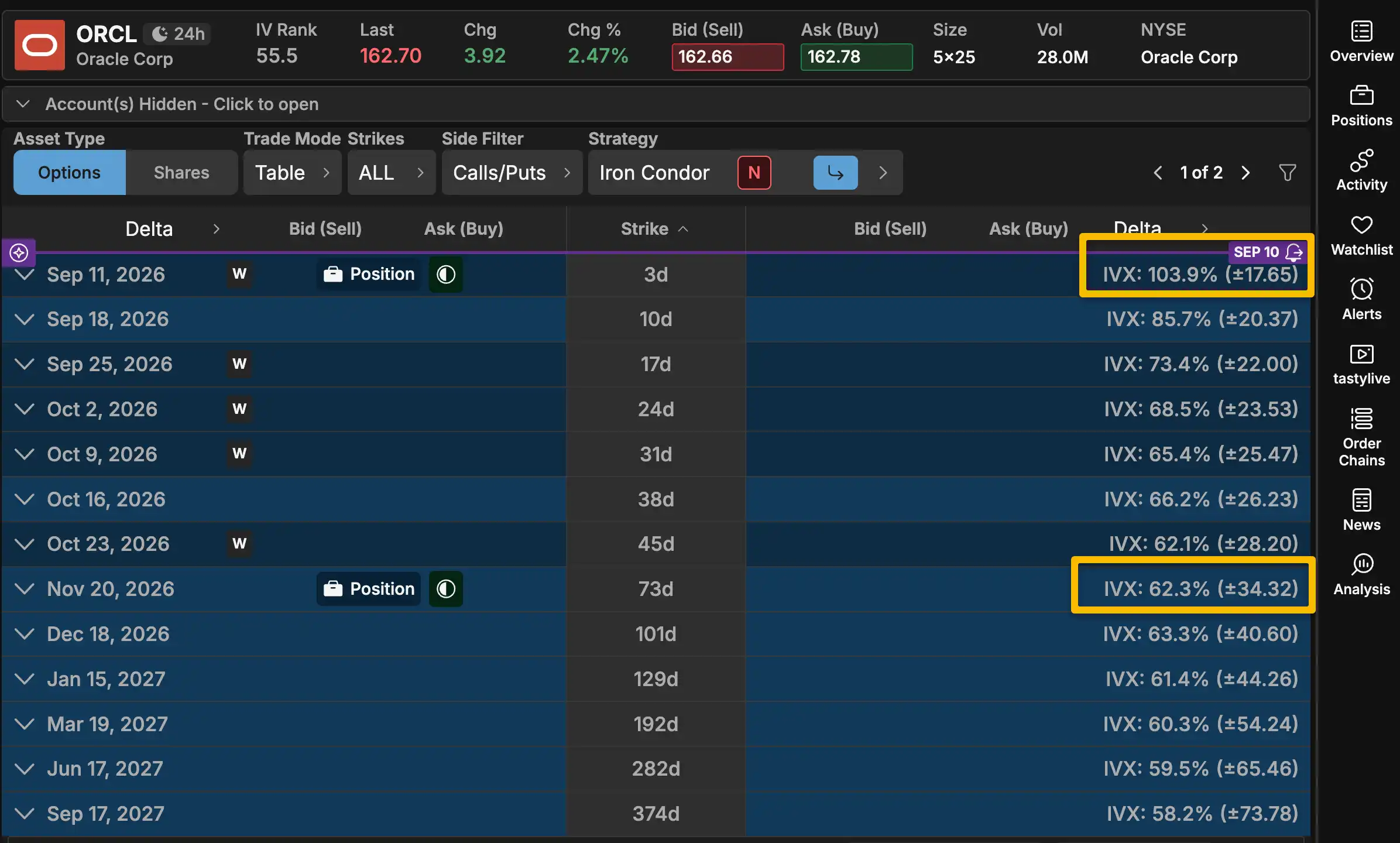
- Options markets are pricing an implied move of roughly 11% for Thursday's report, notably calmer than the stock's average post-earnings swing of 16.12% over the past four quarters, a gap worth watching given how violently ORCL has traded around recent prints.
Oracle Earnings Preview - September 2026
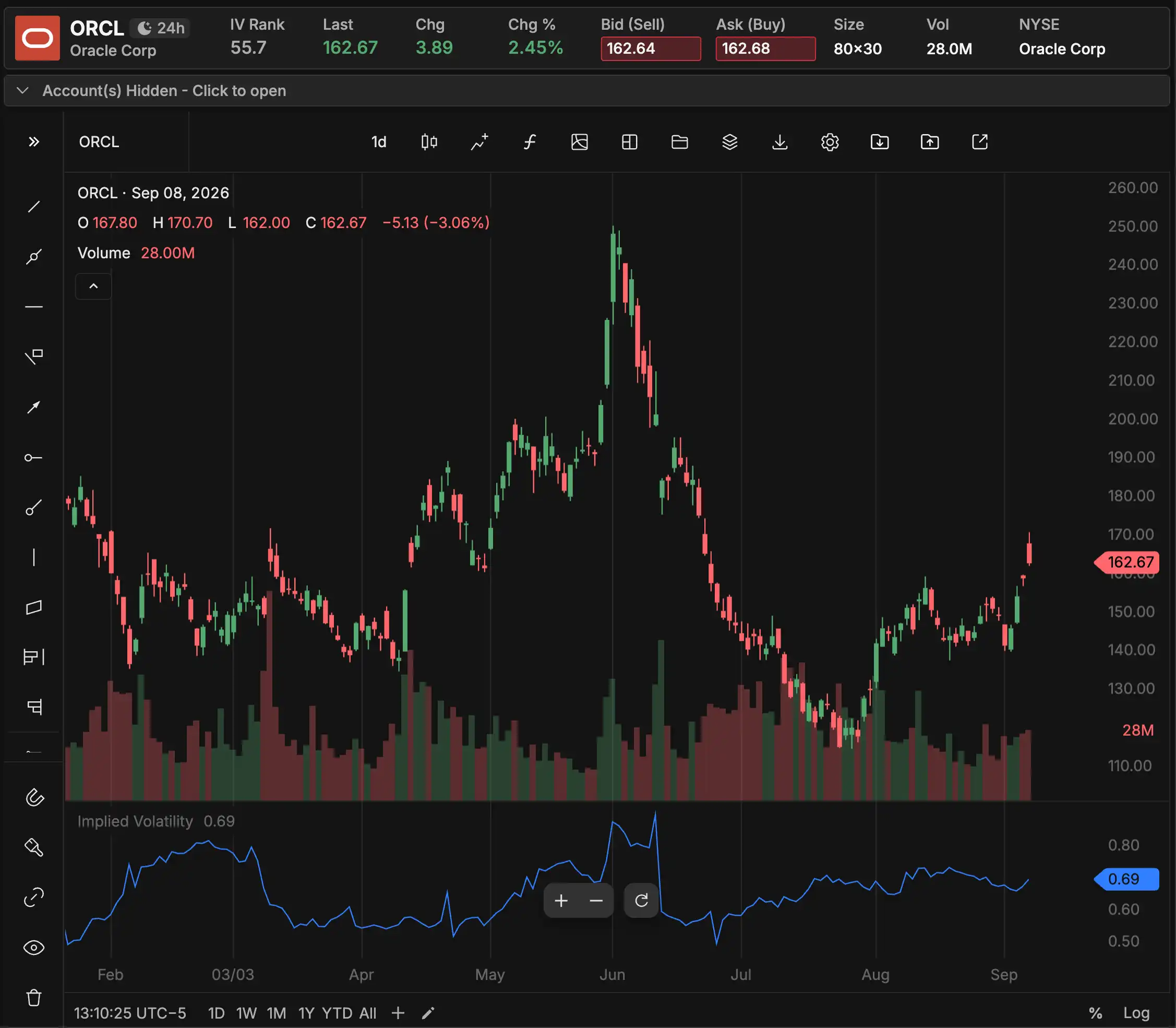
Oracle Corporation (NYSE: ORCL) heads into its fiscal Q1 2027 report as one of the more polarizing large caps in the market. The stock trades near $159 as of this writing, well off its 52-week high of $345.72 and up meaningfully from its 52-week low of $114.50, a round trip that has left both bulls and bears feeling validated at different points this year. Shares are down roughly 18% year to date even as the S&P 500 has climbed into double digits, a divergence that puts Oracle squarely in the "AI capex skeptics versus AI infrastructure believers" debate playing out across the sector.
Oracle's implied volatility landscape is elevated heading into Thursday's earnings announcement, though not as extreme as it has been for some of this year's AI infrastructure names. The options market is pricing an expected move of roughly 11% of the notional value of the stock, a meaningful swing for a company this size, but still a lower bar than Oracle has actually cleared lately. The company's last four post-earnings reactions have averaged a 16.12% swing in absolute terms, including an 8.52% decline in June that extended to nearly 13% intraday, driven largely by investor concern over the pace and cost of Oracle's data center buildout. Whether the options market is underpricing this print or whether Thursday finally delivers a calmer reaction is one of the more interesting setups of the week, especially with Adobe reporting fiscal Q3 results the same day.
Oracle's Cloud Infrastructure Boom: Why OCI Growth Is the Number That Matters
The core bull thesis on Oracle has always been straightforward: enterprises need somewhere to run AI workloads, and Oracle Cloud Infrastructure has become one of the fastest-growing venues to do it. OCI revenue surged 93% year over year in fiscal Q4 2026 to $5.8 billion, and management has guided for cloud infrastructure growth of 58% to 64% in the current quarter. Total fiscal 2026 revenue rose 17.4% to $67.4 billion, with revenue per employee climbing to roughly $478,000 from $354,000 a year earlier as Oracle has trimmed headcount from about 154,000 to 141,000 while leaning on AI-driven productivity gains. For fiscal 2027, Oracle has guided to $90 billion in total revenue and non-GAAP EPS of $8.05, a target that implies OCI continues to do most of the heavy lifting.
The $638 Billion Question: Oracle's Backlog and Its OpenAI Concentration Risk
No number gets more attention on an Oracle earnings call these days than Remaining Performance Obligations. RPO reached $638 billion last quarter, up 363% year over year and roughly eight times Oracle's current annualized revenue, representing contracted deals that have not yet hit the income statement. Management has told analysts it expects to convert about 12% of that backlog into revenue over the next 12 months and another 34% between 13 and 36 months. The problem, as bears see it, is concentration. Bank of America and other analysts estimate OpenAI alone accounts for roughly half of that $638 billion figure, and OpenAI remains unprofitable, reportedly posting a $20.9 billion operating loss in 2025 with further losses this year. With OpenAI's IPO reportedly pushed into 2027, questions about whether the backlog converts on schedule, and whether Oracle's data centers could sit underutilized if a major customer stumbles, will almost certainly come up on Thursday's call.
Oracle's Debt Load and Capex Bill: Why the Market Punished a Beat
Oracle's June quarter print was, on paper, a beat: record revenue of $19.2 billion and that eye-popping RPO figure. The stock still fell more than 8% on the news. The reason is spending. Oracle spent $55.7 billion on infrastructure in fiscal 2026 and has guided to as much as $70 billion to $95 billion in net capital expenditures for fiscal 2027, depending on which estimate you use, alongside an expected $25 billion in reimbursements from customers like OpenAI. Free cash flow ran negative $23.7 billion in fiscal 2026, and Oracle already carries close to $130 billion in long-term borrowings. To fund the buildout, the company has announced plans to raise roughly $40 billion through a mix of debt and equity, including a $20 billion at-the-market share issuance, on top of a $5 billion mandatory convertible preferred offering earlier this year. That combination, heavy capex, negative free cash flow, and dilution risk, is the reason a company with a 19.7 price-to-earnings ratio on fiscal 2026 earnings, a discount to both the S&P 500 and Nasdaq-100, has still traded like a much riskier growth stock.
Bullish Case for Oracle Earnings
The bull case rests on the idea that Oracle's backlog is real, contracted revenue rather than a speculative pipeline, and that OCI's 93% growth rate proves Oracle can win share from AWS, Azure and Google Cloud in AI workloads specifically. Analyst sentiment remains heavily positive, with roughly 36 buy ratings against a single sell and an average price target near $242, implying more than 50% upside from current levels. Guggenheim's $400 target is the most bullish on the Street, built on the view that Autonomous Database migrations and continued OCI share gains from AWS and Azure can sustain growth well beyond fiscal 2027. Bulls also point out that Oracle's fiscal 2026 revenue per employee jumped to $478,000 as headcount fell, suggesting the company can fund its AI buildout without sacrificing operating discipline, and that a calmer-than-usual implied move heading into Thursday could mean the worst of the debt fear is already priced in.
Bearish Case for Oracle Earnings
Bears are not arguing that AI demand is fake. They are arguing that Oracle's capital structure cannot support the spending required to capture it. S&P has projected fiscal 2027 capex as high as $90 billion to $95 billion and a free cash flow deficit widening to roughly $42 billion, prompting a more cautious credit view on the company's debt. With OpenAI representing an estimated half of the RPO backlog and posting billions of dollars in operating losses, bears see a single point of failure that could leave Oracle holding data center capacity it cannot easily repurpose, a risk the company itself flagged in its fiscal 2026 annual report. Add in a planned $40 billion debt-and-equity raise, a fresh round of job cuts reportedly being planned ahead of the fiscal second quarter, and insider selling from Vice Chairman Jeffrey Henley near the highs, and the bear case is less about whether Oracle's cloud business is growing and more about whether shareholders will be diluted, and creditors made nervous, before that growth fully shows up in free cash flow.
Options involve risk and are not suitable for all investors. Please read Characteristics and Risks of Standardized Options before deciding to invest in options.
tastylive content is created, produced, and provided solely by tastylive, Inc. (“tastylive”) and is for informational and educational purposes only. It is not, nor is it intended to be, trading or investment advice or a recommendation that any security, futures contract, digital asset, other product, transaction, or investment strategy is suitable for any person. Trading securities, futures products, and digital assets involve risk and may result in a loss greater than the original amount invested. tastylive, through its content, financial programming or otherwise, does not provide investment or financial advice or make investment recommendations. Investment information provided may not be appropriate for all investors and is provided without respect to individual investor financial sophistication, financial situation, investing time horizon or risk tolerance. tastylive is not in the business of transacting securities trades, nor does it direct client commodity accounts or give commodity trading advice tailored to any particular client’s situation or investment objectives. Supporting documentation for any claims (including claims made on behalf of options programs), comparisons, statistics, or other technical data, if applicable, will be supplied upon request. tastylive is not a licensed financial adviser, registered investment adviser, or a registered broker-dealer. Options, futures, and futures options are not suitable for all investors. Prior to trading securities, options, futures, or futures options, please read the applicable risk disclosures, including, but not limited to, the Characteristics and Risks of Standardized Options Disclosure and the Futures and Exchange-Traded Options Risk Disclosure found on tastytrade.com/disclosures.
tastytrade, Inc. ("tastytrade”) is a registered broker-dealer and member of FINRA, NFA, and SIPC. tastytrade was previously known as tastyworks, Inc. (“tastyworks”). tastytrade offers self-directed brokerage accounts to its customers. tastytrade does not give financial or trading advice, nor does it make investment recommendations. You alone are responsible for making your investment and trading decisions and for evaluating the merits and risks associated with the use of tastytrade’s systems, services or products. tastytrade is a wholly-owned subsidiary of tastylive, Inc.
tastytrade has entered into a Marketing Agreement with tastylive (“Marketing Agent”) whereby tastytrade pays compensation to Marketing Agent to recommend tastytrade’s brokerage services. The existence of this Marketing Agreement should not be deemed as an endorsement or recommendation of Marketing Agent by tastytrade. tastytrade and Marketing Agent are separate entities with their own products and services. tastylive is the parent company of tastytrade.
tastyfx, LLC (“tastyfx”) is a Commodity Futures Trading Commission (“CFTC”) registered Retail Foreign Exchange Dealer (RFED) and Introducing Broker (IB) and Forex Dealer Member (FDM) of the National Futures Association (“NFA”) (NFA ID 0509630). Leveraged trading in foreign currency or off-exchange products on margin carries significant risk and may not be suitable for all investors. We advise you to carefully consider whether trading is appropriate for you based on your personal circumstances as you may lose more than you invest.
tastycrypto is provided solely by tasty Software Solutions, LLC. tasty Software Solutions, LLC is a separate but affiliate company of tastylive, Inc. Neither tastylive nor any of its affiliates are responsible for the products or services provided by tasty Software Solutions, LLC. Cryptocurrency trading is not suitable for all investors due to the number of risks involved. The value of any cryptocurrency, including digital assets pegged to fiat currency, commodities, or any other asset, may go to zero.
© copyright 2013 - 2026 tastylive, Inc. All Rights Reserved. Applicable portions of the Terms of Use on tastylive.com apply. Reproduction, adaptation, distribution, public display, exhibition for profit, or storage in any electronic storage media in whole or in part is prohibited under penalty of law, provided that you may download tastylive’s podcasts as necessary to view for personal use. tastylive was previously known as tastytrade, Inc. tastylive is a trademark/servicemark owned by tastylive, Inc.
Your privacy choices