Retail Earnings Preview: Home Depot, Lowe's, Target, TJX and Walmart

Retail Earnings Preview: Home Depot, Lowe's, Target, TJX and Walmart
By:Mike Butler
- Five of the largest retailers in the country report earnings within a three-day stretch this week: Home Depot and Target on August 18-19, Lowe's and TJX on August 19, and Walmart on August 20, giving investors a near-complete read on the health of the U.S. consumer heading into the back half of 2026.
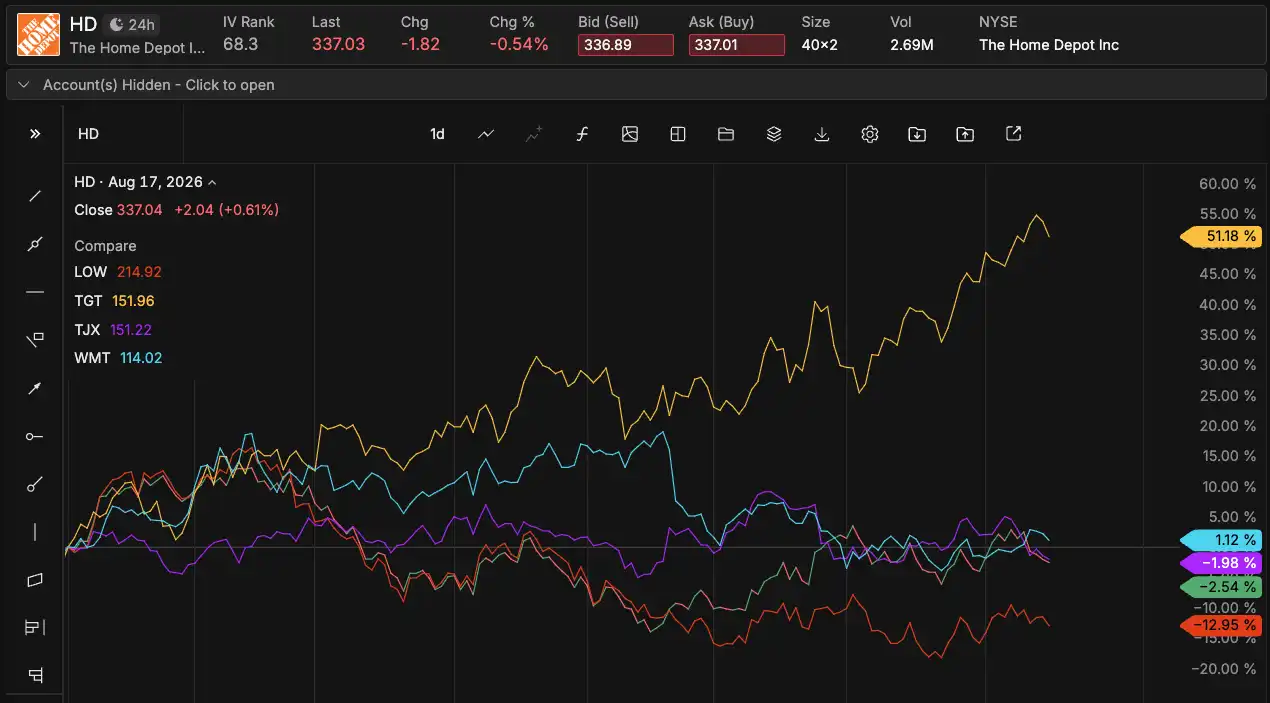
- Home Depot and Lowe's are expected to post only modest EPS growth of roughly 1% and mid-single digits, respectively, reflecting a housing market still stuck near multi-decade lows in existing-home turnover. Both stock prices are down YTD
- Target enters its print up around 55% year to date, with analysts looking for EPS of roughly $2.35 (up about 13% year over year), as investors watch for proof that the retailer's operational turnaround has staying power.
- TJX is projected to report EPS of about $1.19 on revenue near $15.1 billion, up roughly 5% year over year, as off-price retail continues to benefit from value-seeking shoppers across income levels.
- Walmart closes out the week on August 20 with EPS estimates of about $0.74 (up nearly 9% year over year) on revenue of $186.73 billion, as the company's grocery dominance and e-commerce growth remain the key swing factors for the stock.
Big Retail Earnings Week: What to Watch
This week is effectively a full physical on the American consumer. Home Depot (NYSE: HD) and Target (NYSE: TGT) both report before the bell on Tuesday, August 18 and August 19, respectively, Lowe's (NYSE: LOW) and TJX Companies (NYSE: TJX) follow on Wednesday, August 19, and Walmart (NYSE: WMT) closes the week out on Thursday, August 20. Together, these five companies represent well over $1.5 trillion in combined market value and touch nearly every category of consumer spending, from home improvement to apparel to groceries to general merchandise.
The overarching question heading into the reports is whether U.S. shoppers are still spending, and where. Home improvement has been the weak link for over a year, discretionary spending at Target has been improving but remains fragile, off-price retail keeps taking share as consumers trade down, and Walmart's low prices and grocery mix keep pulling in higher-income shoppers who might otherwise not set foot in a Supercenter. Expect all five management teams to address tariffs, private-label sourcing, and consumer trade-down behavior on their calls.
Home Depot (HD) Earnings Preview
Home Depot reports fiscal second-quarter results before the market opens on Tuesday, August 18. Analysts are looking for EPS of around $4.71 to $4.73, up only marginally from $4.68 in the year-ago period, on revenue near $47 billion, which would represent growth of roughly 4.9%. This is traditionally Home Depot's biggest quarter of the year, covering the spring and early summer selling season, and management has already guided full-year comparable sales to a flat-to-2% range. Q1 comps landed at a modest 0.6%, so the back half needs real acceleration to hit the midpoint of guidance. The stock is trading in the high $330s, roughly one-fifth below its 52-week high, with a Strong Buy consensus rating and an average price target near $384.
The bullish case for Home Depot rests on its scale, its Pro-customer business, and the SRS Distribution acquisition, which has expanded its footprint with professional contractors even while DIY renovation spending stays soft. Bulls also point to the possibility that lower interest rates later in 2026 finally start to unlock pent-up demand from homeowners who have been sitting on ultra-low mortgage rates and delaying big projects.
The bearish case centers on housing turnover sitting near 40-year lows, a consumer that has shown little appetite for big-ticket renovation spending, and a stock that already trades at a premium multiple relative to its own history. A comp print below the 0.6% pace set in Q1, especially if paired with soft guidance for the back half, would revive the debate over whether Home Depot's turnaround story is real or just a hope trade.
Lowe's (LOW) Earnings Preview
Lowe's reports its fiscal second-quarter results before the market opens on Wednesday, August 19, one day after its larger rival. Current consensus estimates call for EPS of roughly $4.23, building on a first quarter in which adjusted EPS came in at $3.03 (up 3.8% year over year) on comparable sales growth of 0.6%, driven by Pro, appliances, and online sales. Lowe's has beaten EPS estimates in each of its last eight quarters, giving it a stronger recent beat rate than Home Depot heading into this print.
The bullish case for Lowe's is built around sharper execution than its larger peer, expanding Pro-segment penetration, and a "Total Home" strategy that targets DIY, rental, and professional customers all at once. Bulls also note that Lowe's carries a lower forward P/E than Home Depot despite comparable or better projected earnings growth, which some analysts view as a valuation gap worth closing.
The bearish case is essentially the same macro overhang facing Home Depot: a housing market with limited transaction volume, cautious consumers, and a business that is highly sensitive to interest rates and existing-home sales activity. Any disappointment in Pro-segment growth, which has been Lowe's primary offset to DIY weakness, would remove one of the stock's few genuine bright spots.
Target (TGT) Earnings Preview
Target reports fiscal second-quarter results before the market opens on Wednesday, August 19. Wall Street is looking for EPS of about $2.35, up roughly 13% year over year, on revenue near $26.15 billion, an increase of about 3.4%. Target shares have rallied approximately 55% year to date heading into the print, one of the sharpest turnarounds among major retailers this year, though the average analyst price target now implies modest downside from current levels, a sign that much of the good news may already be priced in. At the same time, Target has the highest implied volatility for the week of all the stocks in this article, and it's not even close.
The bullish case for Target is that store operations, product assortment, and inventory discipline have all meaningfully improved, and that Q2 can show these gains translating into sustainable comparable-sales growth rather than a one-off bounce. A beat here, paired with a raised full-year outlook, could validate the stock's sharp rally and open the door to further multi-expansion.
The bearish case is largely a valuation argument: after a 55% run, expectations are elevated, and several analysts have already noted that Target's recovery appears mostly reflected in the share price. If comparable sales growth or gross margin comes in merely in-line rather than better than expected, the stock could see a classic sell-the-news reaction even on a technically "good" quarter.
TJX Companies (TJX) Earnings Preview
TJX, the parent of TJ Maxx, Marshalls, and HomeGoods, reports fiscal second-quarter results before the market opens on Wednesday, August 19. Consensus estimates call for EPS of approximately $1.19 on revenue of $15.1 billion, representing growth of about 5.1% year over year. Management guided for comparable sales growth of 2% to 3% heading into the quarter and noted that the period was off to a good start, aided by a broad customer base that spans income levels and a growing share of younger shoppers drawn to its "treasure hunt" model. TJX has beaten EPS estimates in each of its last several quarters, with an average surprise near 8.8%.
The bullish case for TJX is straightforward: off-price retail tends to do well in almost any consumer environment, since value-seeking behavior increases when budgets are tight and stays intact even when they loosen. Bulls point to consistent market-share gains from both full-price retailers and lower-end competitors, along with a resilient off-price business model that has weathered inflation, tariffs, and shifting consumer sentiment better than most.
The bearish case is mostly about valuation and expectations. TJX trades at a premium multiple near 30 times forward earnings, a rich price for a retailer, and shares sit closer to their 52-week high than their low heading into the print. With comp guidance already calling for solid 2% to 3% growth, the bar for a genuine upside surprise is higher than it looks at first glance.
Walmart (WMT) Earnings Preview
Walmart closes out the week, reporting fiscal second-quarter results before the market opens on Thursday, August 20. Analysts expect EPS of about $0.74, up nearly 9% from $0.68 in the year-ago quarter, on revenue of $186.73 billion. That estimate sits slightly above the midpoint of management's own guidance range of $0.72 to $0.74, and full-year EPS guidance for fiscal 2027 stands at $2.75 to $2.85. Walmart shares have traded closer to $116 heading into the report, a softer performance over the past three months that has left the stock's valuation and forward guidance under closer scrutiny than usual.
The bullish case for Walmart centers on its grocery dominance, its growing advertising and membership businesses, and continued market-share gains from higher-income households trading down without sacrificing convenience. E-commerce profitability has also been steadily improving, and any upside on that front would support the argument that Walmart's flywheel, low prices, scale, and a growing digital ecosystem, is still accelerating rather than maturing.
The bearish case is that after a strong multi-year run, Walmart's stock is no longer cheap, and a business this large has a smaller margin for error. A guidance range that only calls for high-single-digit EPS growth leaves little room for a soft quarter, and any signs of slowing grocery volume or tariff-driven margin pressure could weigh on shares given how much good news is already reflected in the valuation.
Bottom Line
Home improvement, discretionary, off-price, and grocery retail all get tested within a single 72-hour window this week. Home Depot and Lowe's will show whether the housing-driven slump has bottomed, Target will show whether its turnaround has legs beyond a stock-price rally, TJX will show whether off-price momentum can continue even as inflation cools, and Walmart will close the loop on where the broader U.S. consumer actually stands. Taken together, the five reports should give a clearer picture of consumer health heading into the holiday shopping season than any single print could on its own.
Mike Butler, tastylive director of market intelligence, has been trading the markets for a decade. He appears on the tastylive morning show Monday - Friday. @tradermikeyb
For live daily programming, market news and commentary, visit tastylive or the YouTube channel tastylive (for options traders).
Trade with a better broker, open a tastytrade account today. tastylive, Inc. and tastytrade, Inc. are separate but affiliated companies.
Options involve risk and are not suitable for all investors. Please read Characteristics and Risks of Standardized Options before deciding to invest in options.
tastylive content is created, produced, and provided solely by tastylive, Inc. (“tastylive”) and is for informational and educational purposes only. It is not, nor is it intended to be, trading or investment advice or a recommendation that any security, futures contract, digital asset, other product, transaction, or investment strategy is suitable for any person. Trading securities, futures products, and digital assets involve risk and may result in a loss greater than the original amount invested. tastylive, through its content, financial programming or otherwise, does not provide investment or financial advice or make investment recommendations. Investment information provided may not be appropriate for all investors and is provided without respect to individual investor financial sophistication, financial situation, investing time horizon or risk tolerance. tastylive is not in the business of transacting securities trades, nor does it direct client commodity accounts or give commodity trading advice tailored to any particular client’s situation or investment objectives. Supporting documentation for any claims (including claims made on behalf of options programs), comparisons, statistics, or other technical data, if applicable, will be supplied upon request. tastylive is not a licensed financial adviser, registered investment adviser, or a registered broker-dealer. Options, futures, and futures options are not suitable for all investors. Prior to trading securities, options, futures, or futures options, please read the applicable risk disclosures, including, but not limited to, the Characteristics and Risks of Standardized Options Disclosure and the Futures and Exchange-Traded Options Risk Disclosure found on tastytrade.com/disclosures.
tastytrade, Inc. ("tastytrade”) is a registered broker-dealer and member of FINRA, NFA, and SIPC. tastytrade was previously known as tastyworks, Inc. (“tastyworks”). tastytrade offers self-directed brokerage accounts to its customers. tastytrade does not give financial or trading advice, nor does it make investment recommendations. You alone are responsible for making your investment and trading decisions and for evaluating the merits and risks associated with the use of tastytrade’s systems, services or products. tastytrade is a wholly-owned subsidiary of tastylive, Inc.
tastytrade has entered into a Marketing Agreement with tastylive (“Marketing Agent”) whereby tastytrade pays compensation to Marketing Agent to recommend tastytrade’s brokerage services. The existence of this Marketing Agreement should not be deemed as an endorsement or recommendation of Marketing Agent by tastytrade. tastytrade and Marketing Agent are separate entities with their own products and services. tastylive is the parent company of tastytrade.
tastyfx, LLC (“tastyfx”) is a Commodity Futures Trading Commission (“CFTC”) registered Retail Foreign Exchange Dealer (RFED) and Introducing Broker (IB) and Forex Dealer Member (FDM) of the National Futures Association (“NFA”) (NFA ID 0509630). Leveraged trading in foreign currency or off-exchange products on margin carries significant risk and may not be suitable for all investors. We advise you to carefully consider whether trading is appropriate for you based on your personal circumstances as you may lose more than you invest.
tastycrypto is provided solely by tasty Software Solutions, LLC. tasty Software Solutions, LLC is a separate but affiliate company of tastylive, Inc. Neither tastylive nor any of its affiliates are responsible for the products or services provided by tasty Software Solutions, LLC. Cryptocurrency trading is not suitable for all investors due to the number of risks involved. The value of any cryptocurrency, including digital assets pegged to fiat currency, commodities, or any other asset, may go to zero.
© copyright 2013 - 2026 tastylive, Inc. All Rights Reserved. Applicable portions of the Terms of Use on tastylive.com apply. Reproduction, adaptation, distribution, public display, exhibition for profit, or storage in any electronic storage media in whole or in part is prohibited under penalty of law, provided that you may download tastylive’s podcasts as necessary to view for personal use. tastylive was previously known as tastytrade, Inc. tastylive is a trademark/servicemark owned by tastylive, Inc.
Your privacy choices