Tapestry’s 2025 Rally: From Retail Underdog to Luxury Leader — Can It Keep This Up?

Tapestry’s 2025 Rally: From Retail Underdog to Luxury Leader — Can It Keep This Up?
From mall favorite to TikTok titan — the brand is transforming luxury
- Tapestry has emerged as one of 2025’s most surprising retail winners.
- The company has surged 60%, thanks to a revitalized Coach brand, rising margins and a sharp Gen Z pivot.
- Strategic moves have included divestiture of Stuart Weitzman and a focus on direct-to-consumer growth.
- The business and extended its reach, turning accessible luxury into a winning formula.
- Now trading at a premium to its peers, Tapestry looks less like an underdog and has to stay ahead of investor expectations to maintain its premium valuation.
Tapestry (TPR), long seen as a dependable but uninspiring accessories brand, has upended expectations in 2025. It’s roared back into relevance with a revitalized Coach, a younger customer base and sharp execution in a sector where many peers remain stubbornly bland. Shares have surged more than 60% year-to-date, outpacing competitors and outperforming the broader consumer discretionary universe.
It’s not just a case of seasonal strength or macro-driven momentum. With expanding margins, aggressive buyback and a brand that’s clearly resonating, Tapestry is starting to look like more than just a cyclical winner. Today, we explore whether the rally is justified and where the stock might be headed.

How Tapestry is reshaping luxury
Tapestry holds an enviable position in high-end retailing, blending premium branding with broad-market accessibility. It delivers fashion that feels elevated yet remains scalable, affordable and built for mainstream appeal. While global luxury giants like LVMH Moët Hennessy and Kering wrestle with slowing demand and pricing fatigue, Tapestry has established itself at the crossroads of accessible luxury and cultural relevance. At the center of that strategy is Coach, a brand that continues to resonate with younger consumers, especially Gen Z and Millennials who are seeking status symbols without the luxury price tag.
The company, founded in 1941 and rebranded as Tapestry in 2017, owns three primary brands: Coach, Kate Spade and (until recently) Stuart Weitzman. Of the three, Coach is the growth engine, accounting for more than 75% of revenue and over 90% of operating profit. That concentration has become even more pronounced after the decision to sell Stuart Weitzman to Caleres for $105 million in cash. Once viewed as a strategic asset, the brand had turned into a drag on growth and margins. The sale helps Tapestry streamline its portfolio and sharpen the focus on what’s working.
And what’s working is Coach. The brand’s resurgence hasn’t relied on promotions or heavy discounting Instead, it’s been fueled by cleaner distribution, rising average unit retail (AUR) and a focused shift toward design-led innovation and influencer-driven marketing. In the most recent quarter alone, Tapestry added over 1.2 million new customers in North America, two-thirds of them from Gen Z or Millennial demographics. That shift isn’t just cosmetic. It reflects a deeper repositioning of Coach’s identity, moving away from its legacy mall image and toward something more digitally native, culturally attuned and built for the next generation.
Unlike the broader luxury sector — where steep price hikes are losing traction and aspirational demand is fading — Tapestry’s “accessible luxury” model is holding up remarkably well. With consumers growing more selective about discretionary spending, brands like Burberry (BURBY) and Kering (PPRUY) are feeling the pressure. But Coach’s mix of affordability, heritage and amodern brand refresh is resonating with shoppers who still want luxury — just not at luxury prices.
Tapestry’s global presence is also a strength. With more than 1,400 stores worldwide and a direct-to-consumer model that spans online and retail, the company has built a supply chain and sales infrastructure designed for flexibility. Roughly 60% of sales come from North America, with strong growth recently reported in Europe and Asia. Manufacturing is outsourced to third-party vendors in Vietnam, China, the Philippines and Spain, allowing for cost efficiency and margin preservation, even in a tariff-sensitive business.
It may not have the mystique of Hermès (HESAY) or the breadth of LVMH (LVMUY), but in 2025, Tapestry looks like something rarer: A brand-led business executing with discipline and winning market share.
Earnings that justify the momentum
Not long ago, the outlook for consumer discretionary stocks looked grim. Fear of recession was causing even high-end shoppers to pull back. The sector stalled. Even now, the Consumer Discretionary ETF (XLY), a broad benchmark for the sector, is flat on the year. But Tapestry has broken away from the pack. As of late July, the stock is up more than 60% — not on speculation, but on execution.
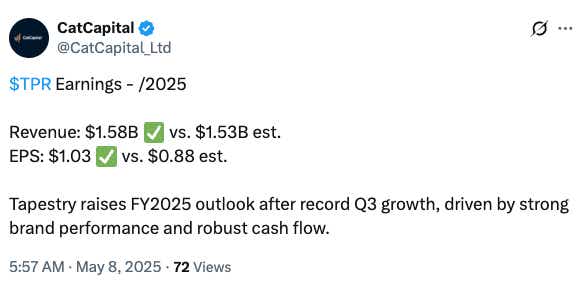
Last quarter, Tapestry delivered impressive results: Revenue rose 7% to $1.6 billion, and EPS (earnings per share) climbed 27% to $1.03. Gross margin reached 76%, its highest level in over 15 years. Driving that performance was Coach, which posted 15% growth in sales, powered by strong consumer demand, a refreshed product lineup and a pricing strategy that leaned into brand strength instead of discounting.
Even more impressive is how the company is changing its customer base. In North America alone, Tapestry added more than 1.2 million new customers, with two-thirds from Gen Z and Millennials. Digital sales rose by a mid-teens percentage and now makes up about 30% of total revenue. Direct-to-consumer sales overall climbed 9%, while European growth came in at a stunning 35%. This isn’t just seasonal momentum — it’s a demographic and geographic expansion that’s reshaping Tapestry’s long-term growth profile.
Operationally, the company continues to deliver. Non-GAAP operating margin expanded to 17.5%, up 140 basis points from the previous year, driven by rising average unit prices (AUR) and careful cost management. SG&A spending was in line with expectations, and leverage remains low. Moreover, Tapestry ended the quarter with $1.1 billion in cash, underscoring the balance sheet strength behind this momentum. The company also repaid $303 million in maturing bonds in April, another signal of financial discipline and long-term confidence.
While challenges remain — Kate Spade sales fell 12%, and the company is actively repositioning the brand — Tapestry is moving quickly to clean house. The sale of Stuart Weitzman, a consistent underperformer, is on track to close this summer and will help streamline operations and improve blended margins.
For fiscal 2025, management now expects $6.95 billion in revenue and $5.00 in EPS, both above previous guidance. That forecast accounts for tariffs, FX headwinds and macro caution. But it also reflects something deeper: A business that’s not just weathering the storm but expanding its reach while others retrench. In a sector full of excuses, Tapestry is offering results, and investors are paying attention.
.png?format=pjpg&auto=webp&quality=50&width=1600&disable=upscale)
Valuation has shifted from underrated to premium
Tapestry has delivered on nearly every operational front in 2025. But when it comes to valuation, the story is less straightforward. After a blistering run — up more than 60% year-to-date — the stock no longer trades like a retail recovery play. It trades like a premium asset.
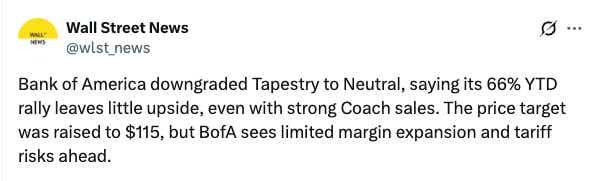
As of late July, stock in Tapestry sits around $107 per share, above the average analyst price target of $102. Its forward P/E is 24, and trailing P/E is 28, with the latter well ahead of the sector median of 20. The gulf is even wider on other metrics: 3.5x sales and 15x book, compared to industry norms closer to 1.0 and 2.0, respectively. Those aren’t valuations typically assigned to leather-goods retailers. They’re more often seen in high-growth platforms.
So, does Tapestry deserve this kind of multiple?
In some ways, yes. The company is growing earnings in the double digits, expanding margins and generating over $1 billion in free cash flow — all while capturing share in a shaky global market. Coach, in particular, has become a category leader, not just outperforming peers but redefining its brand identity in a way that’s resonating with Gen Z and Millennial shoppers. And with many aspirational consumers trading down from ultra-luxury, Tapestry is catching demand that might otherwise have gone elsewhere.
But valuation often hinges on what happens next, not what’s already happened. And here, the picture becomes more complicated. With the stock now above consensus expectations, the bar for future performance has moved higher. Even if Tapestry hits its $5 EPS target — and it likely will — it’s already trading rich in terms of forward earnings, leaving little margin for disappointment. Meanwhile, risks around tariffs, consumer spending fatigue and the still-unfolding reset at Kate Spade remain key unknowns.
Add to that a layer of macro uncertainty that includes slower growth of GDP in Q1 and continuing questions about the resilience of discretionary spending, and the setup becomes more fragile. Tapestry may be outperforming now, but it’s still operating in a sector that’s historically sensitive to economic pullbacks.
Investment takeaways
Tapestry isn’t riding a post-pandemic rebound or relying on deep discounting to drive growth. It’s executing a brand-led strategy that’s clearly resonating with younger consumers, expanding margins and a sharpened portfolio that fits today’s retail climate.
Coach is leading the charge and doing more than just growing. Margins are widening, free cash flow is strong and the company plans to return over $2 billion to shareholders this year. With the sale of Stuart Weitzman, Tapestry is now leaner, more focused and arguably more culturally relevant than it’s been in years.
But consumer discretionary stocks are inherently sensitive, not just to the economy but also to shifts in consumer mood and preference. And after a 60%+ rally in 2025, Tapestry is no longer priced as a turnaround. It’s priced as a winner, putting pressure on future results not just to impress but to exceed expectations. Unless earnings continue to outpace what’s anticipated — or a major catalyst emerges at its autumn investor day — the risk of disappointment or a broader market pullback could weigh heavily on shares.
That’s not a knock on the story. It’s more about timing. Tapestry is a high-quality name with strong fundamentals and brand momentum but at current levels feels more like a "sell” than a “buy.” Not because we doubt the trajectory but because the setup leaves little room for error.
For long-term bulls, a better entry point could emerge on near-term weakness. But for those already holding the stock or initiating new positions at current levels, it may be prudent to pair the trade with a stop order or a covered call. A stop can help limit downside if the rally falters, while a covered call can generate income while you wait, effectively reducing your cost basis if the stock trades sideways or experiences a modest pullback.
In short, Tapestry is outperforming while many peers are still recalibrating. It’s gaining share, expanding its reach and doing so with enviable financial strength. But after a run of this magnitude, the story shifts from recovery to justification. And that shift leaves more room for disappointment.
Options involve risk and are not suitable for all investors. Please read Characteristics and Risks of Standardized Options before deciding to invest in options.
tastylive content is created, produced, and provided solely by tastylive, Inc. (“tastylive”) and is for informational and educational purposes only. It is not, nor is it intended to be, trading or investment advice or a recommendation that any security, futures contract, digital asset, other product, transaction, or investment strategy is suitable for any person. Trading securities, futures products, and digital assets involve risk and may result in a loss greater than the original amount invested. tastylive, through its content, financial programming or otherwise, does not provide investment or financial advice or make investment recommendations. Investment information provided may not be appropriate for all investors and is provided without respect to individual investor financial sophistication, financial situation, investing time horizon or risk tolerance. tastylive is not in the business of transacting securities trades, nor does it direct client commodity accounts or give commodity trading advice tailored to any particular client’s situation or investment objectives. Supporting documentation for any claims (including claims made on behalf of options programs), comparisons, statistics, or other technical data, if applicable, will be supplied upon request. tastylive is not a licensed financial adviser, registered investment adviser, or a registered broker-dealer. Options, futures, and futures options are not suitable for all investors. Prior to trading securities, options, futures, or futures options, please read the applicable risk disclosures, including, but not limited to, the Characteristics and Risks of Standardized Options Disclosure and the Futures and Exchange-Traded Options Risk Disclosure found on tastytrade.com/disclosures.
tastytrade, Inc. ("tastytrade”) is a registered broker-dealer and member of FINRA, NFA, and SIPC. tastytrade was previously known as tastyworks, Inc. (“tastyworks”). tastytrade offers self-directed brokerage accounts to its customers. tastytrade does not give financial or trading advice, nor does it make investment recommendations. You alone are responsible for making your investment and trading decisions and for evaluating the merits and risks associated with the use of tastytrade’s systems, services or products. tastytrade is a wholly-owned subsidiary of tastylive, Inc.
tastytrade has entered into a Marketing Agreement with tastylive (“Marketing Agent”) whereby tastytrade pays compensation to Marketing Agent to recommend tastytrade’s brokerage services. The existence of this Marketing Agreement should not be deemed as an endorsement or recommendation of Marketing Agent by tastytrade. tastytrade and Marketing Agent are separate entities with their own products and services. tastylive is the parent company of tastytrade.
tastyfx, LLC (“tastyfx”) is a Commodity Futures Trading Commission (“CFTC”) registered Retail Foreign Exchange Dealer (RFED) and Introducing Broker (IB) and Forex Dealer Member (FDM) of the National Futures Association (“NFA”) (NFA ID 0509630). Leveraged trading in foreign currency or off-exchange products on margin carries significant risk and may not be suitable for all investors. We advise you to carefully consider whether trading is appropriate for you based on your personal circumstances as you may lose more than you invest.
tastycrypto is provided solely by tasty Software Solutions, LLC. tasty Software Solutions, LLC is a separate but affiliate company of tastylive, Inc. Neither tastylive nor any of its affiliates are responsible for the products or services provided by tasty Software Solutions, LLC. Cryptocurrency trading is not suitable for all investors due to the number of risks involved. The value of any cryptocurrency, including digital assets pegged to fiat currency, commodities, or any other asset, may go to zero.
© copyright 2013 - 2026 tastylive, Inc. All Rights Reserved. Applicable portions of the Terms of Use on tastylive.com apply. Reproduction, adaptation, distribution, public display, exhibition for profit, or storage in any electronic storage media in whole or in part is prohibited under penalty of law, provided that you may download tastylive’s podcasts as necessary to view for personal use. tastylive was previously known as tastytrade, Inc. tastylive is a trademark/servicemark owned by tastylive, Inc.
Your privacy choices