Markets Are Confused About the Fed, Just as Chair Warsh Wants It

Markets Are Confused About the Fed, Just as Chair Warsh Wants It
By:Ilya Spivak
Markets can’t tell where Fed interest rate policy is going, and that’s just the way Chair Kevin Warsh wants it. This bodes ill for stock markets.
- Consumer confidence fell when forecasters expected a rise, and new home sales collapsed 10.5% on the month
- Beyond September, no interest rate outcome carries better than even odds through the end of 2027 as traders struggle to pin down Fed policy
- Chair Kevin Warsh rejects forward guidance, which makes his first Jackson Hole address an unusual kind of event risk
Stock markets are drifting sideways after a shallow pullback last week. The bellwether S&P 500 is narrowly outperforming a somewhat soggier Nasdaq 100, where the hangover after a blistering AI-powered rally has been playing out since the start of June. Crude oil prices have eased amid reports that Iran has resumed talks with Oman to reopen the Strait of Hormuz, after the Treasury Department announced new secondary sections. Long-dated Treasury bonds climbed to the top of their monthly range. Gold continued to inch higher while the US dollar licked its wounds near three-month lows.
On the economic data front, a Conference Board gauge of US consumer confidence fell in August when forecasters had penciled in an increase, while new home sales suffered a monthly drop of 10.5% in July, marking the worst performance since January. The run of soft US economic data now stretches through most of the month, white-hot S&P Global PMI results notwithstanding.
Two different kinds of falling inflation
The Federal Reserve’s preferred price gauge, the personal consumption expenditures (PCE) index, is due next. The headline rate seen easing to 3.6% year-on-year in July from 3.7% previously, while and the core measure excluding food and energy prices holds at 3.3% for a second month. This hints that much of the expected disinflation reflects the oil shock from the US-Iran war washing out of the figures, which is unremarkable. The question is whether anything else is fading also.
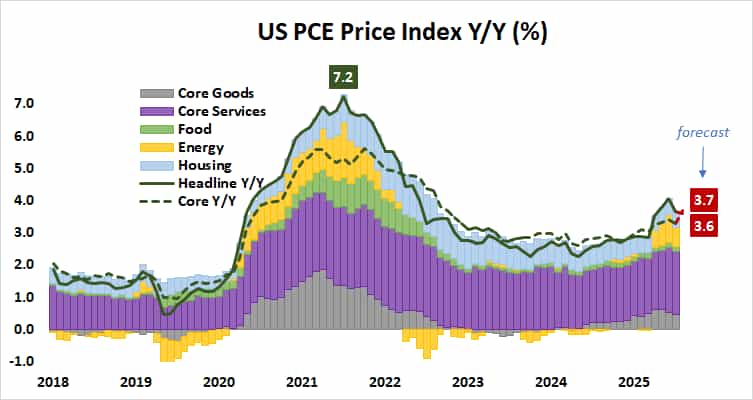
The evidence says yes. Analog consumer price index (CPI) inflation data undershot expectations, with roughly half of the decline in the headline reading coming from softening core services. Wholesale prices measured by the producer price index (PPI) told a similar story. As it happens, the three-month annualized pace of PCE inflation has been easing since the start of the year, and the six-month measure may have now crested too. Inflation cooling because crude oil is cheaper is one thing. Sagging demand-pull price growth in the core of the economy is far more ominous.
Even the rare good bit of recent economic news pointed to disinflation. That S&P Global PMI survey showed the fastest US activity growth in about four years, and led by services at that. This ought to be the composition that a healthy expansion should have. Nevertheless, a glance under the hood reveals that sub-indexes tracking prices fell across both services and manufacturing in August’s report, on inputs and outputs alike.
Gold and the dollar saw it first
Precious metals seemed to have read these tea leaves weeks ago. Through July, real interest rates climbed to their highest since early April 2025, when the Trump administration’s “Liberation Day” tariff rollout panicked markets. Non-yielding gold ought to have suffered in that environment. It held instead, a display of considerable resilience, and sprang higher once yields stopped climbing. The dollar mirrored the logic in reverse, refusing to rally on improving carry before selling off into month-end and falling ever since.
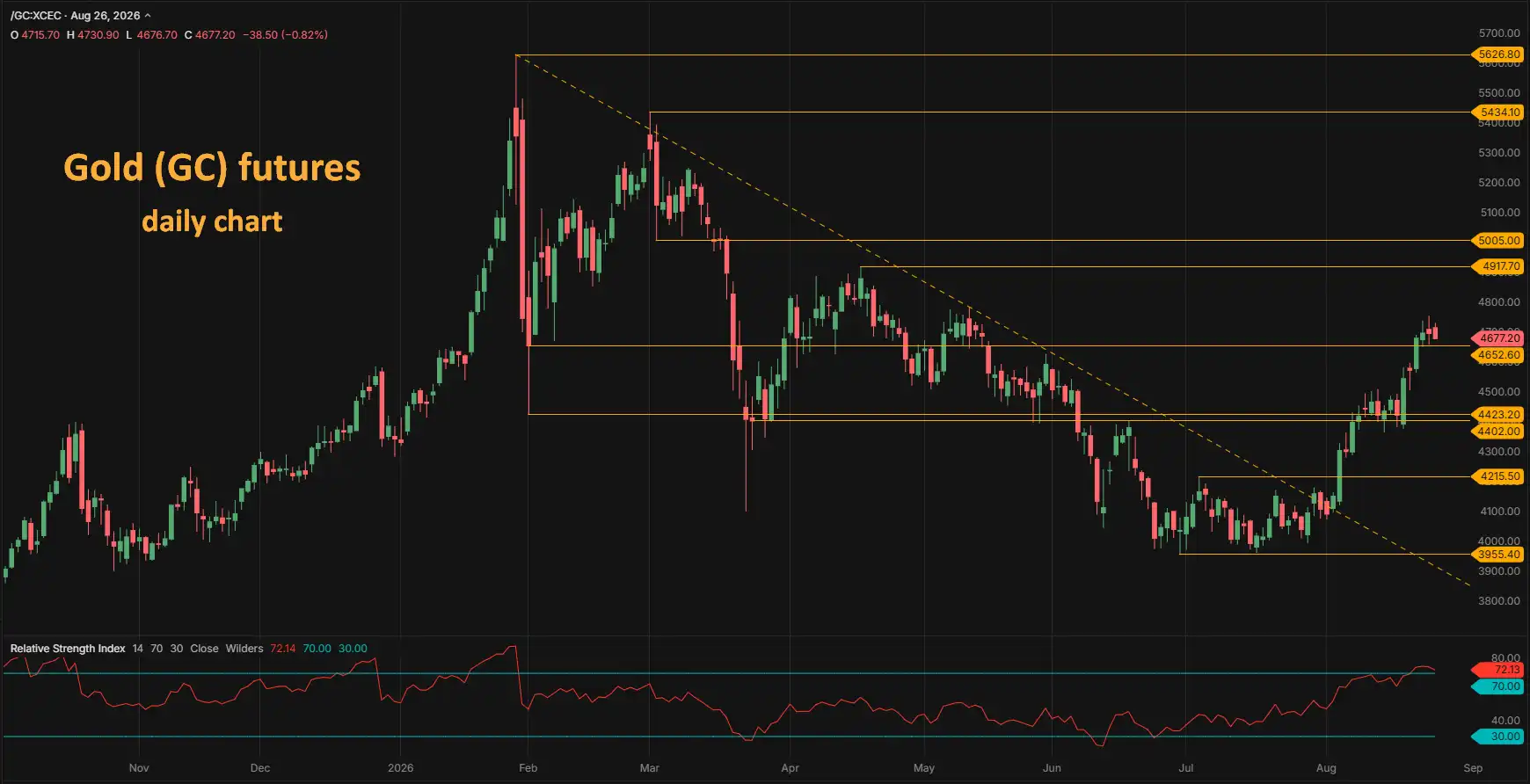
Bonds are only now joining them. That might be why Treasury Secretary Scott Bessent’s buyback expansion, a modest increase from $2 billion to $4 billion per operation that he openly called a signal rather than an attempt to force the market’s hand, has held up better than its size suggests. When long-term yields spiked to their highest since 2007 this month, the move could not even survive the session. Treasuries have since outperformed equivalent maturity swaps, narrowing the 30-year spread to the smallest since February. This hints that officials may have nudged markets in a direction that they were already leaning in.
Nobody knows where policy is going
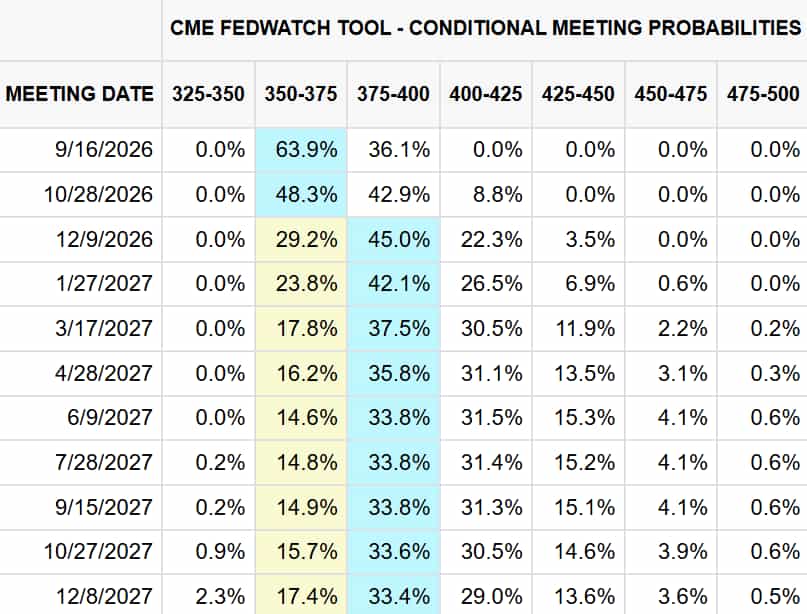
Against this backdrop, traders seem utterly confused about where central bank policy is heading. Fed Funds futures put the cumulative odds of a 25-basis-point (bps) rate hike by December at almost 96%. That seems like conviction, but looking at the odds of a given result tells a wholly other tale. Only September shows genuine agreement, with traders betting roughly 60/40 on a rate hold and writing off alternative scenarios. From October onward, no single outcome commands better than even odds. The further out one looks, the less traders agree and the more dispersed the possibilities.
What does seem clear however is that the chances of one, two and three hikes by December have diminished throughout August, in step with a steep drop in Citigroup’s US economic surprise index and the parallel slide in the Atlanta Fed’s GDPNow model, where the estimate of third-quarter growth dropped from about 6% to 4% in a mere three weeks. Disappointing news-flow appears to pulling the policy outlook in a more dovish direction.
A chair who prefers the fog
Kevin Warsh steps back into the fray on Friday, delivering his first Jackson Hole keynote speech as Fed Chair. The symposium has functioned for years as a kind of tuning exercise, where the US central bank chief teaches markets to read incoming data so their reaction function resembles that of policy officials themselves. Warsh has loudly rejected that approach. He seems to have elevated obfuscation to key function of the job, reversing the transparency doctrine the Fed has followed since the 2008 financial crisis and the Ben Bernanke years. He styles himself closer to an Alan Greenspan figure, tactically muddying the waters in a bid to force the markets to think independently and manage risks themselves.
A speech that settles nothing may therefore leave traders to fill the silence with the only material they have, which is three weeks of disappointing data. That points to further dovish repricing, which might give bonds some room to follow where gold and the dollar have been leading. Equities are an awkward case in this scenario. Lower rate expectations arriving because the economy is cooling seems hardly encouraging for earnings prospects and risk appetite more generally. If cyclical concerns take hold, a market already on be backfoot may find that what looked like a modest pullback was actually the formation of a major top.
Ilya Spivak, tastylive Head of Global Macro, has over 15 years of experience in trading strategy. He specializes in identifying thematic moves in currencies, commodities, interest rates and equities. He hosts Macro Money and co-hosts Overtime, Monday-Thursday. @Ilyaspivak
For live daily programming, market news and commentary, visit tastylive.com or @tastyliveshow on YouTube
Trade with a better broker, open a tastytrade account today. tastylive, Inc. and tastytrade, Inc. are separate but affiliated companies.
Options involve risk and are not suitable for all investors. Please read Characteristics and Risks of Standardized Options before deciding to invest in options.
tastylive content is created, produced, and provided solely by tastylive, Inc. (“tastylive”) and is for informational and educational purposes only. It is not, nor is it intended to be, trading or investment advice or a recommendation that any security, futures contract, digital asset, other product, transaction, or investment strategy is suitable for any person. Trading securities, futures products, and digital assets involve risk and may result in a loss greater than the original amount invested. tastylive, through its content, financial programming or otherwise, does not provide investment or financial advice or make investment recommendations. Investment information provided may not be appropriate for all investors and is provided without respect to individual investor financial sophistication, financial situation, investing time horizon or risk tolerance. tastylive is not in the business of transacting securities trades, nor does it direct client commodity accounts or give commodity trading advice tailored to any particular client’s situation or investment objectives. Supporting documentation for any claims (including claims made on behalf of options programs), comparisons, statistics, or other technical data, if applicable, will be supplied upon request. tastylive is not a licensed financial adviser, registered investment adviser, or a registered broker-dealer. Options, futures, and futures options are not suitable for all investors. Prior to trading securities, options, futures, or futures options, please read the applicable risk disclosures, including, but not limited to, the Characteristics and Risks of Standardized Options Disclosure and the Futures and Exchange-Traded Options Risk Disclosure found on tastytrade.com/disclosures.
tastytrade, Inc. ("tastytrade”) is a registered broker-dealer and member of FINRA, NFA, and SIPC. tastytrade was previously known as tastyworks, Inc. (“tastyworks”). tastytrade offers self-directed brokerage accounts to its customers. tastytrade does not give financial or trading advice, nor does it make investment recommendations. You alone are responsible for making your investment and trading decisions and for evaluating the merits and risks associated with the use of tastytrade’s systems, services or products. tastytrade is a wholly-owned subsidiary of tastylive, Inc.
tastytrade has entered into a Marketing Agreement with tastylive (“Marketing Agent”) whereby tastytrade pays compensation to Marketing Agent to recommend tastytrade’s brokerage services. The existence of this Marketing Agreement should not be deemed as an endorsement or recommendation of Marketing Agent by tastytrade. tastytrade and Marketing Agent are separate entities with their own products and services. tastylive is the parent company of tastytrade.
tastyfx, LLC (“tastyfx”) is a Commodity Futures Trading Commission (“CFTC”) registered Retail Foreign Exchange Dealer (RFED) and Introducing Broker (IB) and Forex Dealer Member (FDM) of the National Futures Association (“NFA”) (NFA ID 0509630). Leveraged trading in foreign currency or off-exchange products on margin carries significant risk and may not be suitable for all investors. We advise you to carefully consider whether trading is appropriate for you based on your personal circumstances as you may lose more than you invest.
tastycrypto is provided solely by tasty Software Solutions, LLC. tasty Software Solutions, LLC is a separate but affiliate company of tastylive, Inc. Neither tastylive nor any of its affiliates are responsible for the products or services provided by tasty Software Solutions, LLC. Cryptocurrency trading is not suitable for all investors due to the number of risks involved. The value of any cryptocurrency, including digital assets pegged to fiat currency, commodities, or any other asset, may go to zero.
© copyright 2013 - 2026 tastylive, Inc. All Rights Reserved. Applicable portions of the Terms of Use on tastylive.com apply. Reproduction, adaptation, distribution, public display, exhibition for profit, or storage in any electronic storage media in whole or in part is prohibited under penalty of law, provided that you may download tastylive’s podcasts as necessary to view for personal use. tastylive was previously known as tastytrade, Inc. tastylive is a trademark/servicemark owned by tastylive, Inc.
Your privacy choices