Stock Markets Won't Like What's Next as the Iran War Trade Breaks

Stock Markets Won't Like What's Next as the Iran War Trade Breaks
By:Ilya Spivak
The Iran war trade is breaking down and stock markets probably won’t like what’s coming next as economic growth fears cut through muddled price signals.
- Stocks drifted higher on some of the lightest volume of the year, with little conviction in either direction
- Priced-in inflation expectations refused to climb even as crude oil rallied, a telling break from the war-era pattern
- Global growth momentum is fading and US tracking estimates are slipping, with Friday’s business surveys the next test
The bellwether S&P 500 popped higher for no obvious reason on some of the thinnest volumes since the turn of the year. The move carried little conviction, with the index bouncing within the congestion it has been stuck in since mid-May without making real headway. The tech-heavy Nasdaq 100 looked much the same. On a session this quiet, the cross-asset picture turned into a muddle worth treating with caution.
A muddled tape with one clear tell
Crude oil pushed higher again, and by the war-era playbook that should have pressured everything else in predictable ways. Instead, the signals scrambled. Stocks rose alongside oil. Treasury bonds softened only slightly and held well above their mid-May lows. And gold, which ought to wilt when oil and yields climb together, rose anyway. None of it hangs together as a clean narrative, and with volumes this light, it would be a mistake to try to force one.
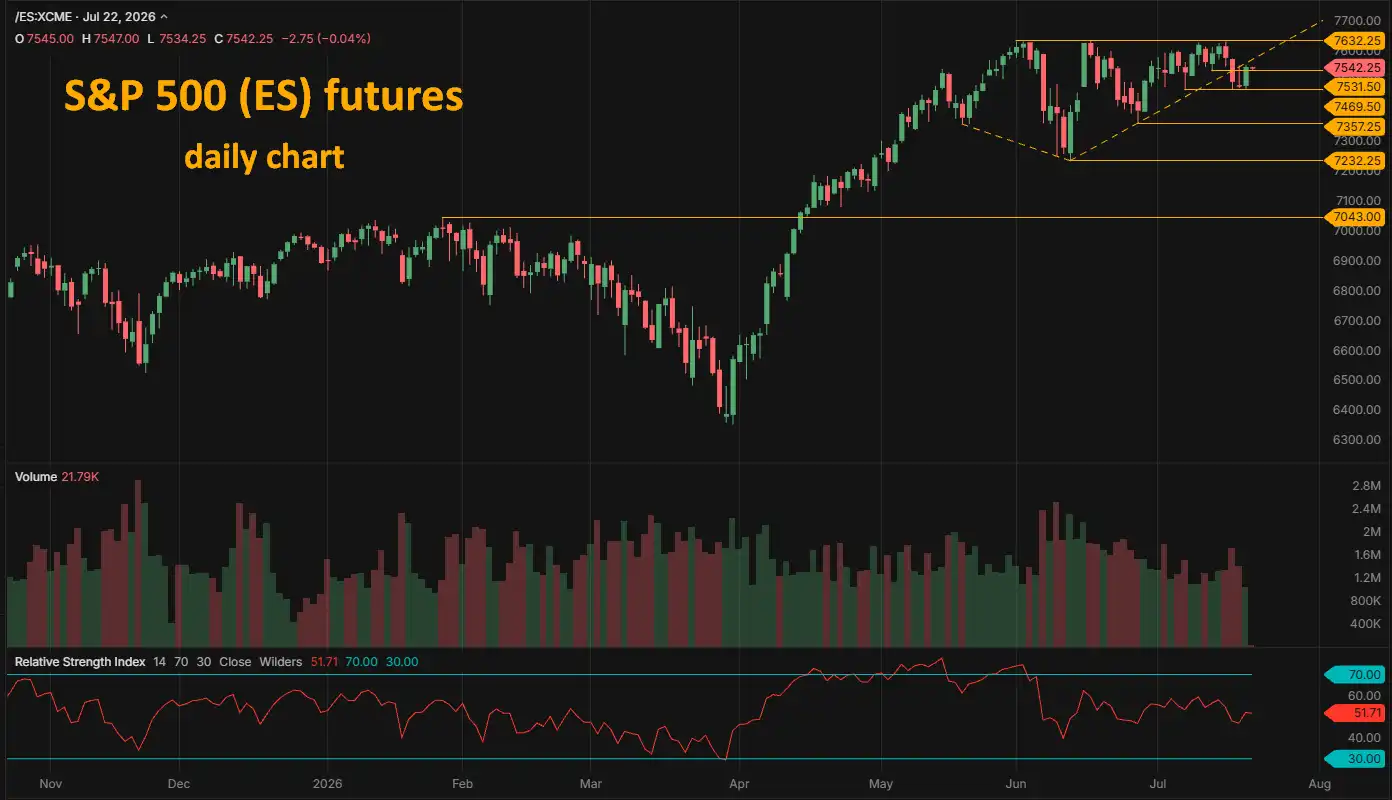
The signal that survived the noise
One thing did cut through, precisely because of what it declined to do. Breakeven inflation rates — the expectations for future inflation embedded in Treasury bond prices — did not rise even as crude rebounded. They have stopped falling and anchored, seeming to be refusing to read the latest oil bounce as inflationary.
This looks like a giveaway. During the war, every uptick in oil fed straight into higher inflation expectations, higher yields, and a firmer dollar. Now the market is looking at the same kind of oil rally and shrugging, perhaps because it senses a stronger force pressing the other way: weakening demand rather than fresh inflation. Tellingly, gold is holding firm, and bonds refuse to break down.
The slowdown is showing up in the data
That read is gaining support elsewhere. Citigroup analytics tracking how global economic data are faring against expectations have been losing momentum since early July. In the US, the Atlanta Fed’s GDPNow model now pegs second-quarter US growth at just 1.7%, down from 2.1% in the first quarter and deteriorating steadily as fresh data lands.
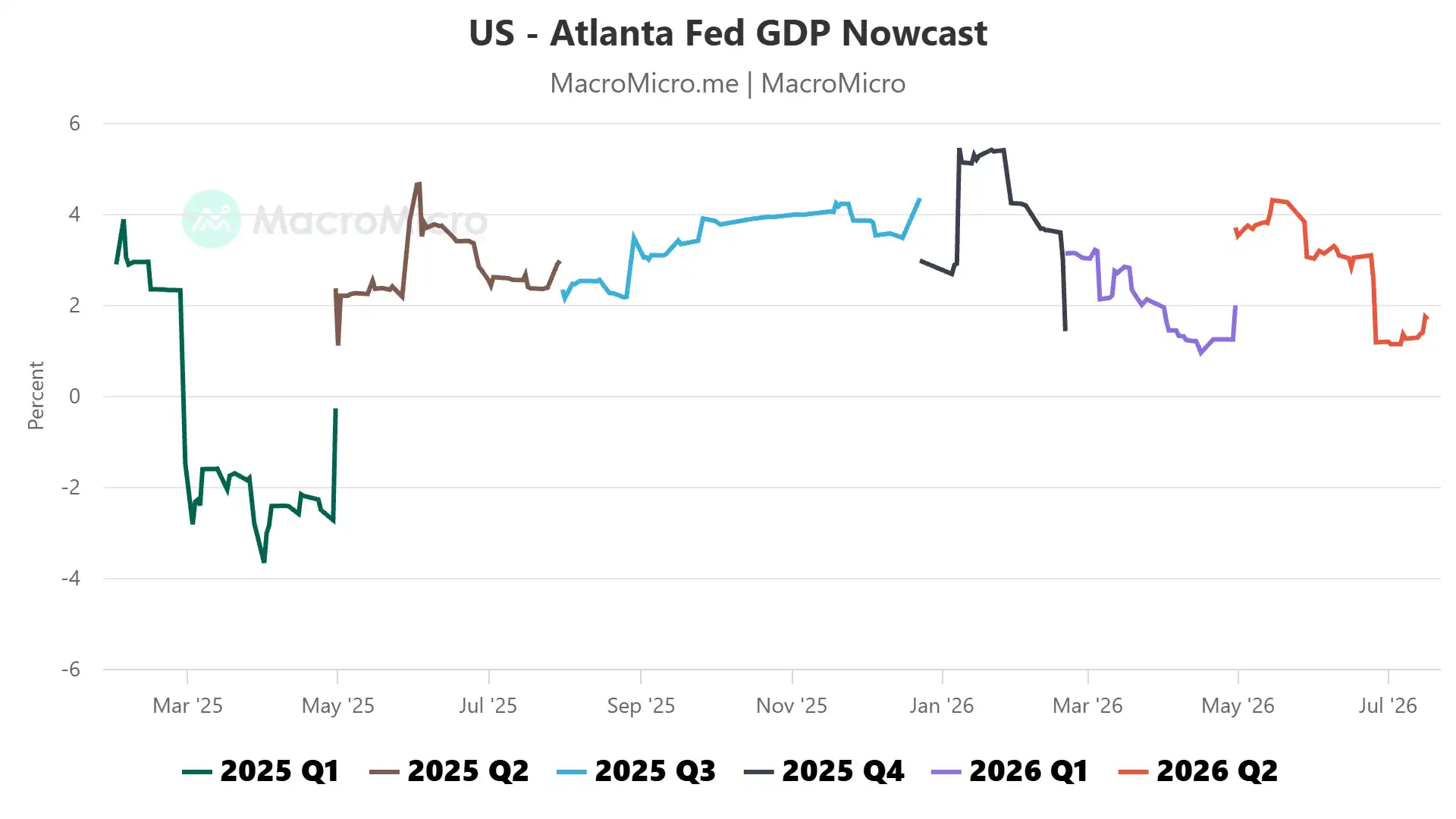
The vulnerability traces to how the US is growing. First-quarter output rose 2.1% almost entirely on the strength of the artificial intelligence (AI) investment boom, with the consumer contributing next to nothing by comparison. The last two times household spending was this feeble, in the first quarters of 2022 and 2025, gross domestic product (GDP) shrank outright, hinting that the AI build-out is the only reason growth is positive at all. That leaves the economy leaning on a small engine of demand while the largest one – the consumer – idles.
This makes for a vicious cycle. Growth powered by a narrow slice of the economy demands that sector grow at neck-snapping speed, fueling a churn that generates inflation, squeezing consumers further. Households are five times larger than investment as a share of GDP, so even modest retrenchment can swamp the boom and drag growth into reverse.
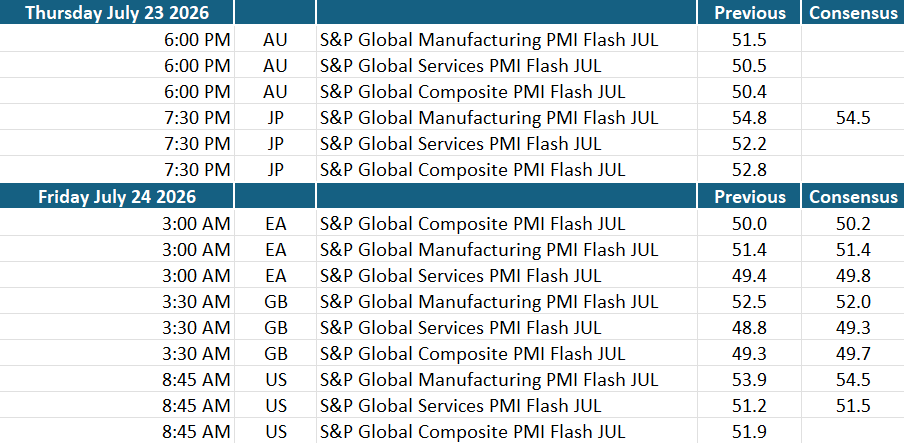
Friday’s surveys are the real test
That makes July’s S&P Global purchasing managers index (PMI) surveys – a timely proxy for global growth trends – the week’s marquee event risk. The contrast to watch is instructive. The US is still expanding, its factories humming and its service sector holding up. The Eurozone has stalled: manufacturing is growing, but its far larger service sector is in contraction mode, dragging the whole economy to a standstill. That is precisely the template the US risks following if its own consumer-driven services begin to buckle.
None of this resolves in a single quiet session, and the markets are not turning all at once. Still, the split is telling: gold and bonds are leaning one way, stocks and oil another, and the quiet refusal of inflation expectations to follow crude higher suggests something new is coming together.
The story that has driven markets all year appears to be shifting from war to the health of the global economy. Crude oil may keep swinging on the next headline out of the Persian Gulf, yet those swings may soon count for little. If the US consumer buckles and brings the economy to its knees, a painful reckoning for the stock market seems inescapable.
Ilya Spivak, tastylive Head of Global Macro, has over 15 years of experience in trading strategy. He specializes in identifying thematic moves in currencies, commodities, interest rates and equities. He hosts Macro Money and co-hosts Overtime, Monday-Thursday. @Ilyaspivak
For live daily programming, market news and commentary, visit tastylive.com or @tastyliveshow on YouTube
Trade with a better broker, open a tastytrade account today. tastylive, Inc. and tastytrade, Inc. are separate but affiliated companies.
Options involve risk and are not suitable for all investors. Please read Characteristics and Risks of Standardized Options before deciding to invest in options.
tastylive content is created, produced, and provided solely by tastylive, Inc. (“tastylive”) and is for informational and educational purposes only. It is not, nor is it intended to be, trading or investment advice or a recommendation that any security, futures contract, digital asset, other product, transaction, or investment strategy is suitable for any person. Trading securities, futures products, and digital assets involve risk and may result in a loss greater than the original amount invested. tastylive, through its content, financial programming or otherwise, does not provide investment or financial advice or make investment recommendations. Investment information provided may not be appropriate for all investors and is provided without respect to individual investor financial sophistication, financial situation, investing time horizon or risk tolerance. tastylive is not in the business of transacting securities trades, nor does it direct client commodity accounts or give commodity trading advice tailored to any particular client’s situation or investment objectives. Supporting documentation for any claims (including claims made on behalf of options programs), comparisons, statistics, or other technical data, if applicable, will be supplied upon request. tastylive is not a licensed financial adviser, registered investment adviser, or a registered broker-dealer. Options, futures, and futures options are not suitable for all investors. Prior to trading securities, options, futures, or futures options, please read the applicable risk disclosures, including, but not limited to, the Characteristics and Risks of Standardized Options Disclosure and the Futures and Exchange-Traded Options Risk Disclosure found on tastytrade.com/disclosures.
tastytrade, Inc. ("tastytrade”) is a registered broker-dealer and member of FINRA, NFA, and SIPC. tastytrade was previously known as tastyworks, Inc. (“tastyworks”). tastytrade offers self-directed brokerage accounts to its customers. tastytrade does not give financial or trading advice, nor does it make investment recommendations. You alone are responsible for making your investment and trading decisions and for evaluating the merits and risks associated with the use of tastytrade’s systems, services or products. tastytrade is a wholly-owned subsidiary of tastylive, Inc.
tastytrade has entered into a Marketing Agreement with tastylive (“Marketing Agent”) whereby tastytrade pays compensation to Marketing Agent to recommend tastytrade’s brokerage services. The existence of this Marketing Agreement should not be deemed as an endorsement or recommendation of Marketing Agent by tastytrade. tastytrade and Marketing Agent are separate entities with their own products and services. tastylive is the parent company of tastytrade.
tastyfx, LLC (“tastyfx”) is a Commodity Futures Trading Commission (“CFTC”) registered Retail Foreign Exchange Dealer (RFED) and Introducing Broker (IB) and Forex Dealer Member (FDM) of the National Futures Association (“NFA”) (NFA ID 0509630). Leveraged trading in foreign currency or off-exchange products on margin carries significant risk and may not be suitable for all investors. We advise you to carefully consider whether trading is appropriate for you based on your personal circumstances as you may lose more than you invest.
tastycrypto is provided solely by tasty Software Solutions, LLC. tasty Software Solutions, LLC is a separate but affiliate company of tastylive, Inc. Neither tastylive nor any of its affiliates are responsible for the products or services provided by tasty Software Solutions, LLC. Cryptocurrency trading is not suitable for all investors due to the number of risks involved. The value of any cryptocurrency, including digital assets pegged to fiat currency, commodities, or any other asset, may go to zero.
© copyright 2013 - 2026 tastylive, Inc. All Rights Reserved. Applicable portions of the Terms of Use on tastylive.com apply. Reproduction, adaptation, distribution, public display, exhibition for profit, or storage in any electronic storage media in whole or in part is prohibited under penalty of law, provided that you may download tastylive’s podcasts as necessary to view for personal use. tastylive was previously known as tastytrade, Inc. tastylive is a trademark/servicemark owned by tastylive, Inc.
Your privacy choices